

TL;DR
- For regulated New Jersey and New York businesses, choose MDR when you need 24/7 human-led detection and response to meet compliance and reduce time-to-contain.
- EDR is right when you have skilled internal security staff and need deep endpoint telemetry and control.
- Use the decision matrix below to map budget, staffing, and compliance needs to EDR, MDR, XDR, or traditional AV.
- Validate vendor claims with a short pilot, SLA review, and measurable metrics (MTTR, detection rate, containment time).

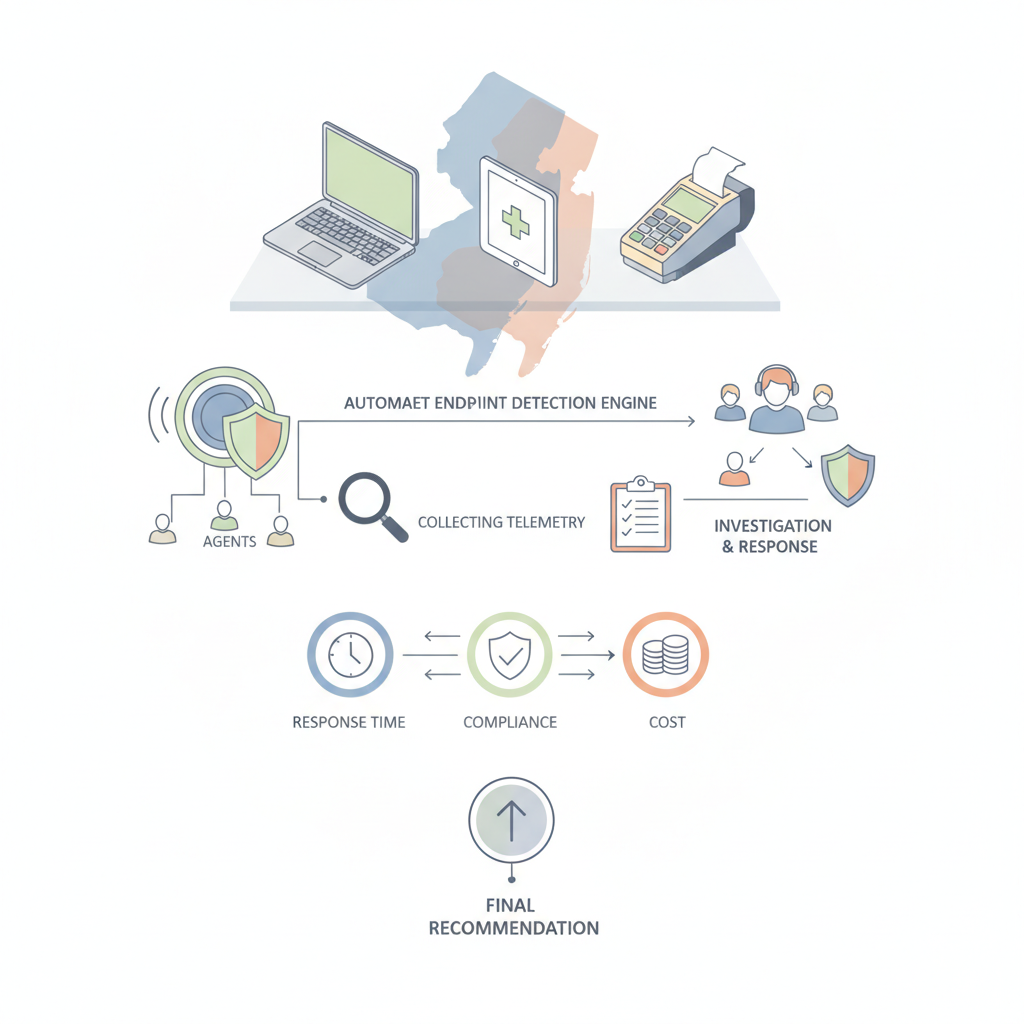
Introduction — scope, audience, and why this decision matters for regulated NJ & NY businesses
This guide explains mdr vs edr for nj businesses with practical, region-focused advice for website owners, marketers, and developers who run regulated operations in NJ and NY. You’ll find concise definitions, a decision summary, and action steps you can use when reviewing vendors or drafting security requirements. The primary goal: map capability to need so you buy the right protection for endpoints that store or access regulated data (HIPAA, financial records subject to NYDFS, or SOX-related systems).
EDR definition: Endpoint detection and response (EDR) collects endpoint telemetry, detects suspicious activity, and provides tools for investigation and containment.
MDR definition: Managed detection and response (MDR) combines EDR technology with a managed service: analysts, 24/7 monitoring, threat hunting, and guided incident response. For more on this, see Edr vs mdr vs xdr vs traditional.
Quotable decision summary: For regulated New Jersey and New York businesses, choose MDR when you need 24/7 human-led detection and response to meet compliance and reduce time-to-contain.
Quick decision matrix — when to choose EDR, MDR, XDR, or traditional AV (at-a-glance)
This two-line decision matrix helps you pick fast. Use it in procurement briefs and requirement docs.
EDR: choose when you have an in-house SOC, need endpoint control and forensic telemetry. (Pros: depth; Cons: staffing)MDR: choose when you need continuous monitoring, human threat hunting, and help meeting HIPAA/NYDFS expectations. (Pros: faster time-to-contain; Cons: recurring cost)Below is a compact HTML decision table you can copy into a RFP or security requirements doc.
| Option | Best for | Key trade-offs |
|---|---|---|
| Traditional AV | Minimal budgets, low-risk environments | Low detection, no telemetry |
| EDR | Teams with security engineers and SIEM | Powerful telemetry, requires staff & tuning |
| MDR | Regulated SMBs in NJ/NY needing 24/7 coverage | Managed service cost, but lower time-to-contain |
| XDR | Enterprises needing cross-layer correlation | Complex integration, higher cost |
Choose the service that closes your staffing gap: technology alone does not reduce time-to-contain.
What is EDR? core capabilities and typical use cases
EDR focuses on endpoints: desktops, laptops, and servers. It streams process, file, network, and behavior telemetry to allow detection, investigation, and containment. Typical capabilities include live response, process tree analysis, file reputation, and rollback on ransomware in some products. For teams in NJ or New York with a SIEM and security engineers, EDR provides the raw materials for fast investigations.
Typical use cases: a finance firm's security engineer uses EDR telemetry to pivot from a suspicious process to affected machines and contain a compromise; a developer investigates a compromised build server. In an edr vs mdr differences context, EDR gives the toolset and data — not the people to watch it 24/7.
Quotable: "EDR supplies telemetry and controls; it doesn't replace a staffed security operations process."
What is MDR? how it augments EDR with managed services
MDR packages EDR technology with people and process. A managed provider ingests telemetry, runs detections, performs human-led threat hunting, and offers playbooks for containment. For regulated organizations in NJ and NY, MDR often speeds compliance evidence collection and shortens forensic timelines. MDR also bridges the gap for teams that lack a full SOC or need after-hours coverage.
24/7 monitoring and human-led threat hunting
MDR teams provide continuous monitoring and scheduled threat hunts that look for stealthy adversary behavior beyond what automated rules catch. In practice, this means alerts are triaged by analysts and escalated with contextual notes, not left as high-volume noisy events. For managed detection and response nj customers, a key deliverable is a prioritized incident report with actionable containment steps and forensic artifacts suitable for HIPAA or NYDFS evidence needs.
Incident containment and response services
MDR includes direct containment actions (isolate endpoint, block process) either performed by the vendor with authorization or by your staff following vendor guidance. That hand-off is the real difference between EDR and MDR: EDR provides the switch, MDR flips it for you. When considering an mssp mdr edr comparison, confirm whether the vendor executes containment or only issues recommendations — this affects time-to-contain and compliance reporting.
Managed detection is effective only when containment authority and communication channels are pre-approved.
Comparing MDR and EDR across key criteria (detection, response time, staffing, cost)
Compare these criteria directly when preparing procurement documentation. Detection capability is often similar because MDR uses EDR sensors, but response time and staffing differ sharply. Typical rule-of-thumb comparisons for RFPs:
- Detection: EDR and MDR rely on the same sensors; MDR adds analyst validation.
- Response time: MDR tends to reduce time-to-contain since analysts act 24/7; EDR depends on your on-call rota.
- Staffing: EDR requires internal SOC engineers; MDR offloads that labor to the vendor.
- Cost: EDR is license + internal labor; MDR is predictable subscription including labor.
Concrete procurement artifact: require vendors to provide average detection-to-notification and example incident timelines from the past 12 months (redacted). For an mssp mdr edr comparison include these metrics in the RFP scoring matrix.
Compliance and regulatory mapping — HIPAA, NYDFS, SOX considerations for endpoints
Regulators expect demonstrable controls. For HIPAA, MDR for hipaa compliance ensures you have logged evidence, timely detection, and a containment trail. NYDFS 500 requires written policies and timely incident reporting; a managed detection and response nj provider can help meet continuous monitoring expectations described in the NYDFS 23 NYCRR 500 guidance. NIST SP 800-61 provides incident response workflows that MDR vendors should follow and document (see NIST SP 800-61 Rev. 3).
Actionable step: add a compliance clause to your contract requiring evidence packages that contain timeline, packet captures (where available), and analyst notes for any incident impacting regulated data.
Practical scenarios & decision trees for regulated SMBs in NJ & NY (finance, healthcare, legal)
Scenario: a 40-person New Jersey medical billing firm holds PHI and uses cloud EHR integrations. They lack a SOC and need documented incident response. Recommendation: choose MDR for HIPAA compliance support and nightly hunts. Scenario: a 75-person NY accounting firm has a senior security engineer and a SIEM — EDR with co-management and runbooks may suffice.
Decision rule example: if you cannot staff a 24/7 escalation rota and you handle regulated data, default to MDR. If you have internal SOC expertise and want tight control over telemetry, choose EDR and add a co-managed arrangement.
Cost, ROI and procurement considerations (licensing, SOC ops, co-managed models)
Licensing for EDR is usually per endpoint plus SIEM ingestion; MDR bundles licensing and analyst time. When calculating ROI, include avoided incident costs: containment labor, downtime, and regulatory fines. Procurement should evaluate co-managed models if you want to keep control but lack 24/7 coverage. Require vendors to provide sample billing examples and a clear list of included activities (hunting, containment, forensic export).
Concrete checklist: request a line-itemed quote with (1) sensor license cost per endpoint, (2) monthly SOC hours included, (3) escalation/remediation fees, (4) SLA for notification and containment actions.
Integration & operational checklist — SIEM, backups, backups/DR alignment
Integrations matter. Ensure EDR/MDR integrates with your SIEM, ticketing, and backup/DR processes. For example, confirmations of endpoint isolation should trigger ticket creation and snapshotting of affected systems. Align your backups with incident response: immutable backups and tested restore procedures are essential to recover from ransomware.
| Operational item | Minimum requirement |
|---|---|
| SIEM integration | EDR logs to SIEM in near real-time |
| Backup alignment | Backups isolated and tested quarterly |
| Runbooks | Playbooks for containment and legal hold |
| Change control | Approved escalation paths for vendor containment |
Recommended next steps & how to validate vendor claims (pilot, metrics to track)
Run a 30–60 day pilot with safety-scoped endpoints. Track these metrics: mean time to detect (MTTD), mean time to contain (MTTC), false positive rate, and number of hunts performed. Ask vendors for redacted incident reports and reference customers in NJ or New York with similar compliance needs. When evaluating an MSSP or MDR provider in a mssp mdr edr comparison, insist on a written SLA that specifies notification windows and containment authority.
For actionable procurement, compare shortlisted vendors using a scoring matrix that weights response time and compliance deliverables highest.
To learn about managed IT and cybersecurity offerings locally, review our services and consider a demo at our services demo page.
Appendix — vendor questions, SLA items, and a short glossary
Vendor questions (copy into RFP): Provide sample detection-to-notification timelines, describe containment authority, list included SOC hours, detail evidence package contents, and confirm SIEM/backup integrations.
SLA items to include: notification SLA (hours), containment SLA (hours or actions), forensic deliverables, and escalation contacts. Glossary: EDR, MDR, SOC, SIEM, MTTR, MTTD, MTTC. For more on this, see Contact us.
FAQ
When to choose MDR vs EDR for regulated NJ & NY businesses: A practical decision guide? Choose MDR when you need continuous monitoring, human-led threat hunting, and a vendor-assisted containment path to satisfy HIPAA or NYDFS evidence and reporting requirements; choose EDR when you have in-house SOC staff, SIEM capability, and prefer direct control of endpoint telemetry and response.