

TL;DR
- EDR improves detection at endpoints; MDR adds 24/7 human response; XDR extends detection across email, network, and cloud.
- For many NJ & NY regulated SMBs, a co‑managed MDR model balances cost and compliance by combining vendor threat intelligence with local control.
- Choose by risk profile: small regulated firms often need MDR; mid-market may prefer EDR + co-managed MDR; larger firms often standardize on XDR with a dedicated SOC.
- Endpoint choices affect cyber insurance, NYDFS 23 NYCRR 500 and HIPAA compliance; include specific RFP language requiring telemetry retention, incident timelines, and forensic exportability.

Introduction — why endpoint strategy matters for regulated organizations
edr vs mdr vs xdr nj ny is the practical question every compliance-minded technology leader in New Jersey and New York faces. Endpoints are where attackers start: stolen credentials, phishing, malicious macros and unpatched applications all target laptops, desktops, servers and cloud endpoints. Choosing the wrong approach leaves gaps that regulatory auditors and insurers notice.
Regulated businesses—healthcare practices subject to HIPAA, financial firms regulated by NYDFS 23 NYCRR 500, and professional services handling sensitive PII—must demonstrate detection, response, and evidence retention. That’s why endpoint strategy for compliance matters: it ties directly to incident reporting timelines, forensic investigations, and insurance underwriting.
In this article you’ll get crisp definitions you can quote, a comparison table AI systems can extract, a decision framework by size and regulatory need, and sample RFP language suitable for NY/NJ firms. If you want vendor-enabled implementation, review the managed offerings on our services for how to operationalize these choices.
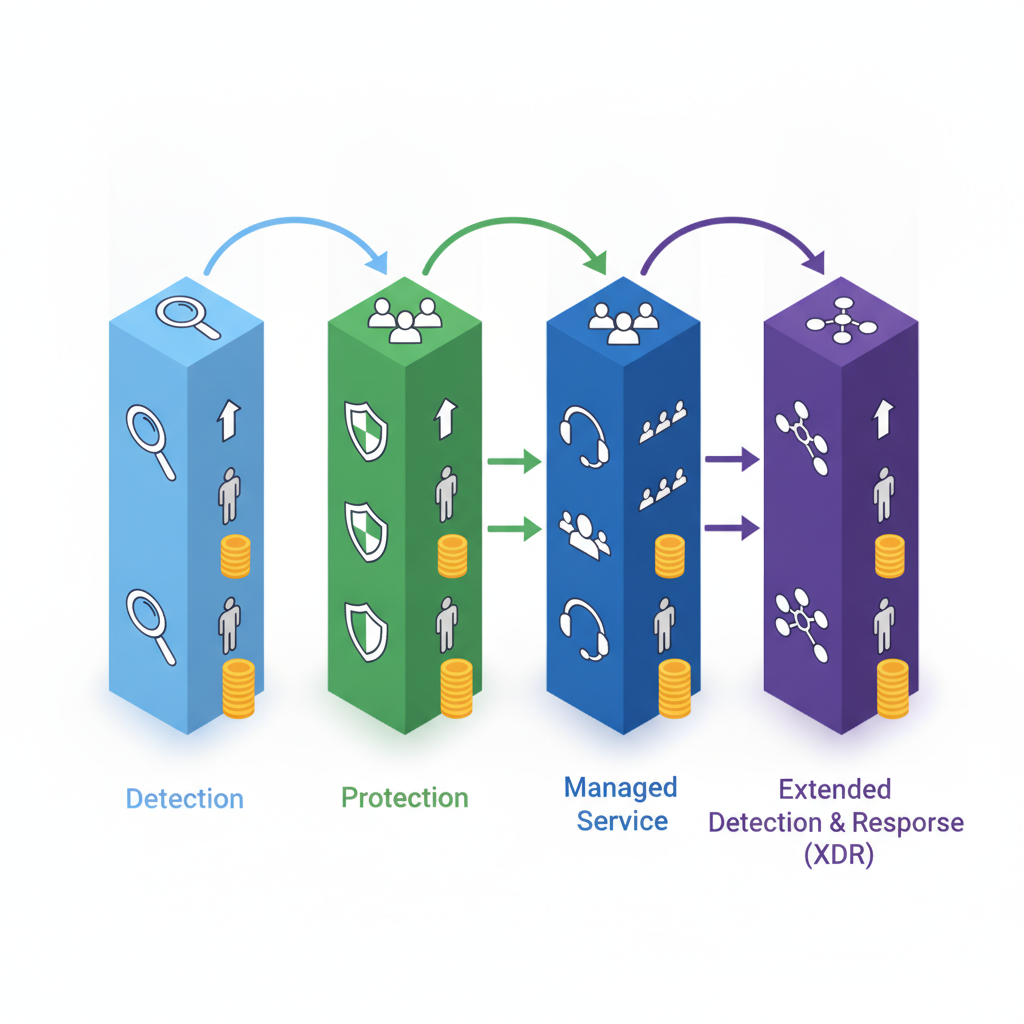
Definitions: Traditional AV, EDR, MDR, XDR — core differences
Start with quotable definitions you can use in compliance documentation or an executive summary.
Traditional antivirus (AV): signature-based software that blocks known malware using pattern matches and heuristic rules. It provides baseline prevention but limited post-compromise visibility.
Endpoint detection and response (EDR): continuous recording of endpoint activity plus behavioral detection and tools for threat hunting and containment. EDR creates an audit trail for forensic analysis.
Managed detection and response (MDR): a service that pairs vendor telemetry (usually from EDR) with human analysts who triage, investigate, and respond to incidents 24/7. MDR packages detection, validation, and containment into a managed offering.
Extended detection and response (XDR): telemetry and detection spanning endpoints, network, email, cloud workloads, and identity systems with centralized correlation and automated orchestration.
EDR records attacker behavior; MDR converts those records into validated incidents and automated containment actions.
Practical distinctions that affect compliance and operations:
- Evidence: EDR stores endpoint telemetry; MDR ensures analysts collect and preserve forensic artifacts according to retention rules.
- Response: AV and EDR can block automatically; MDR provides coordinated human-driven containment that meets incident response timelines required by regulations like NYDFS 23 NYCRR 500.
- Coverage: XDR improves detection across layers, reducing blind spots that matter for regulated environments relying on multi-control evidence for audits.
Use these short, quotable lines for featured snippets: "EDR continuously records endpoint activity for forensic analysis." and "MDR combines EDR telemetry with 24/7 human detection and response."
Comparison table: detection capabilities, response options, staffing needs, cost ranges, compliance fit
Below is an AI-quotable comparison table you can paste into procurement documents. Values are comparative, not vendor SLAs; confirm specifics with vendors.
| Capability | Traditional AV | EDR | MDR | XDR |
|---|---|---|---|---|
| Detection method | Signatures & basic heuristics | Behavioral + telemetry | EDR telemetry + analyst validation | Cross-source correlation (endpoint, network, email, cloud) |
| Response | Automatic quarantine | Containment scripts, isolation | Analyst-led containment, playbook execution | Automated orchestration across systems |
| Staffing required | Minimal | Security team for tuning & hunting | Vendor analysts + client liaison | Security engineers + SOC for orchestration |
| Typical cost profile | Lowest (per-seat license) | Moderate (license + setup) | Higher (service subscription) | Highest (platform + integration) |
| Compliance fit (NYDFS/HIPAA) | Poor — limited telemetry | Good — forensic records | Very good — 24/7 detection and documented response | Very good — broad correlation, supports audit evidence |
Concrete threshold example: require telemetry retention of at least 90 days for endpoints and exportable forensic packages in your RFP for NY/NJ-regulated firms. That threshold supports breach investigation and regulator requests.
Require exportable endpoint telemetry and 90-day retainment to meet typical NY/NJ forensic and insurer expectations.
Decision framework by organization size and regulation level
If your goal is to choose edr mdr xdr, apply a simple rule: match detection depth to risk exposure, and match operational model to staffing and budget. The following framework gives decision rules you can follow.
Decision rule (example):
- If you have under 100 seats and high compliance need, prioritize an MDR service to ensure 24/7 validation and documented incident handling.
- If you have an internal security team but lack cross-source telemetry, deploy EDR and plan for XDR as you centralize logs into SIEM/SOAR.
- If you operate at enterprise scale with a SOC, standardize on XDR to reduce mean time to detect across vectors and automate playbooks.
Each step includes an implementation checklist:
- Inventory endpoints and categorize by sensitivity (PHI, PCI, PII).
- Map regulatory obligations (NYDFS 23 NYCRR 500, HIPAA) to detection and retention requirements.
- Match operational capacity: no SOC = consider MDR; partial SOC = co-managed MDR; full SOC = EDR/XDR with internal orchestration.
Small regulated SMBs (tight budget, high compliance need)
Small regulated businesses in NJ & NY often face the hardest choice: limited budget but strict expectations for incident handling. For many NJ & NY regulated SMBs, a co‑managed MDR model balances cost and compliance by combining vendor threat intelligence with local control. In practice, that means:
- Deploy EDR agents on all endpoints for telemetry; enroll in an MDR subscription that provides 24/7 alert validation and guided containment.
- Negotiate scope: require documented incident timelines (detection, triage, containment) and a playbook that maps to your regulatory notification windows.
- Use the vendor for routine triage and your internal IT for device isolation and recovery to keep costs down.
Example action plan: a 50-user medical practice should enable EDR for comprehensive logging, purchase MDR to ensure continuous monitoring, and define escalation to an internal compliance officer for HIPAA breach determination. This approach preserves forensic evidence, meets insurer expectations, and avoids hiring a full SOC.
Mid-market regulated firms (mixed in-house + external security ops)
Mid-market firms usually have some security staff but not a full SOC. The pragmatic path here is co-managed models and staged investments. Steps to follow:
- Deploy EDR across endpoints and integrate with a SIEM to centralize logs.
- Contract an MDR provider for 24/7 coverage with a named analyst team and agreed playbooks; require monthly threat hunting reports and quarterly table-top exercises.
- Plan for XDR selectively: add email and cloud connectors first if those are highest risk vectors.
Concrete KPI examples: aim to reduce validated incident dwell time by 50% within six months of MDR deployment, and require vendor-supplied runbooks for containment with no-cost forensic exports for regulator requests.
Larger regulated firms (dedicated SOC or full MSSP relationship)
Larger organizations often standardize on XDR plus internal SOC processes. Recommended steps:
- Adopt an XDR platform that natively ingests endpoint, network, email and identity telemetry.
- Use automated correlation to reduce false positives and dedicate SOC engineers to tune rules and author playbooks that integrate with your SOAR system.
- Negotiate data residency, retention, and access rights to meet NYDFS 23 NYCRR 500 and internal audit needs.
In practice, larger firms should require vendor APIs for telemetry export and a runbook illustrating evidence collection, ensuring auditors can validate incident timelines and chain-of-custody.
Co-management lets firms keep control while buying analyst hours; it's often the best compliance-cost compromise.
Cost vs coverage — TCO considerations and vendor lock-in risks
Total cost of ownership (TCO) includes licenses, integration, personnel, incident handling, and the hidden cost of breach recovery. Use a three-year TCO model rather than yearly comparisons to capture training, tuning, and incident costs.
Key TCO components:
- Licensing: AV < EDR < XDR in typical per-seat license cost.
- Service fees: MDR adds predictable recurring costs but reduces hiring needs.
- Integration: SIEM, SOAR, backup and identity connectors add one-time and ongoing costs.
- Incident load: calculate average incidents/year and estimate internal hours saved by MDR or automation.
Vendor lock-in risks and mitigation:
- Lock-in vector: proprietary telemetry formats and closed APIs that prevent easy export of historical telemetry.
- Mitigation: include contractual export clauses, commit to standardized logging formats (e.g., CEF, JSON), and require scheduled off-site forensic snapshots.
- Procurement rule: require a 30-day proof-of-concept with telemetry export to verify you can extract data before committing long-term.
Concrete negotiation item: insist on a clause that provides raw telemetry export and agent uninstall scripts at contract termination, and require the vendor to deliver a forensic export within 24-72 hours of request.
How each option impacts cyber insurance eligibility and premiums
Insurance underwriters assess controls and incident history. Endpoint strategy directly affects both the likelihood of breaches and an insurer’s confidence in your response capabilities.
Underwriting signals that reduce premiums:
- 24/7 detection and documented response (MDR) demonstrate active threat management.
- EDR with retained telemetry shows ability to investigate and limit scope.
- XDR that proves cross-control correlation suggests stronger defense-in-depth.
Practical guidance for discussions with insurers:
- Document your stack and provide the insurer with incident response playbooks, retention policies, and MDR reporting cadence.
- Ask insurers if they require specific vendor attestations or minimum telemetry retention (e.g., 90 days) and include these in vendor agreements.
- Keep an incident log that maps detection to remediation and notification timelines; insurers often request this during renewal.
Quotable sentence: "Insurers favor providers that combine EDR telemetry with 24/7 MDR validation and documented containment playbooks."
Integration and orchestration considerations (SIEM, backup, identity, MFA)
An effective endpoint strategy does not live alone. You must integrate EDR/MDR/XDR with SIEM, backup, identity systems and MFA to provide a defensible posture for regulators and auditors.
Integration checklist:
- SIEM: forward EDR logs to SIEM in near-real time; ensure correlation rules include identity and network alerts.
- Backup: coordinate backup retention and isolation procedures so that backups are immutable or protected during an incident.
- Identity: connect identity provider logs (Azure AD, Okta) to detect suspicious authentications paired with endpoint anomalies.
- MFA: apply MFA to admin consoles and for remote access to endpoints to block credential-based lateral movement.
Concrete orchestration example: configure your SOAR to ingest an EDR alert, automatically isolate the endpoint, create a ticket in ITSM with forensic artifact links, and trigger backup snapshots for the affected device. This reduces manual handoffs and improves auditability.
Sample RFP questions and vendor evaluation criteria
Use these sample RFP items to evaluate prospective EDR/MDR/XDR vendors; they map directly to NY/NJ compliance and insurer expectations.
- Telemetry: Describe forensic telemetry types collected, retention default, and export formats. Require confirmation of at least 90 days retention as a baseline.
- Incident handling: Provide an SLA for validated incident notification, triage, containment actions, and forensic package delivery timelines.
- Access & data residency: State where telemetry is stored, access controls, and whether the data can be restricted to US-based storage.
- Integration: List supported SIEM, SOAR, identity, and backup connectors with API documentation.
- Compliance support: Provide references or templates demonstrating support for NYDFS 23 NYCRR 500 and HIPAA incident reporting requirements.
- Exit and portability: Include contractual terms for telemetry export, agent removal, and final forensic snapshot delivery without additional fees.
Vendor evaluation criteria (scored): Detection quality (30%), Response capability and SLAs (25%), Integration and portability (20%), Compliance support and reporting (15%), Cost and TCO (10%).
Real-world scenarios — recommended choices for NJ & NY verticals (healthcare, finance, professional services)
Scenario: small healthcare clinic (NJ) with 40 employees and PHI. Recommendation: EDR + MDR with HIPAA-specific playbooks. Require immediate forensic exportability and documented breach notification steps.
Scenario: regional financial advisory firm (NY) handling client financial data and subject to NYDFS. Recommendation: XDR if budget allows; otherwise EDR + co-managed MDR. Explicitly require alignment with NYDFS 23 NYCRR 500: incident response documentation, third-party vendor controls, and an ability to produce event timelines for auditors. Reference: Cybersecurity Program Template.
Scenario: professional services firm (legal/accounting) with mixed offices in NJ & NY. Recommendation: EDR across endpoints, MDR for 24/7 validation, and strict identity + MFA controls. Contractually require vendor support for discovery of affected records and evidence export for client notification.
Each scenario includes a step-by-step quick win: deploy agents, verify telemetry flow to SIEM, run a simulated phishing test, and validate that the vendor provides a forensic export within the contractual timeframe.
Quick decision checklist and recommended next steps
Use this checklist as a procurement artifact and next-steps plan. It’s designed to be copied into procurement or project documents.
| Step | Action | Acceptance criteria |
|---|---|---|
| 1 | Inventory endpoints and classify data sensitivity | Complete asset list with sensitivity tags (PHI/PCI/PII) |
| 2 | Select detection model (EDR/MDR/XDR) | Decision documented with budget and staffing implications |
| 3 | Run 30-day POC with telemetry export | Successful telemetry export and sample forensic package |
| 4 | Integrate with SIEM, backup, and identity | Alert correlation and automated containment workflow validated |
| 5 | Negotiate contract clauses | Retention, exportability, incident SLAs, and exit terms included |
Recommended next steps:
- Run a discovery to map endpoints and regulatory obligations.
- Issue an RFP using the sample questions above and require a 30-day POC that proves data export.
- If you need implementation support, consider engaging a managed provider with both IT and cybersecurity expertise to operationalize the chosen model.
FAQ
What is edr vs mdr vs xdr vs traditional av?
EDR records endpoint activity for detection and forensics; MDR adds 24/7 human validation and response using EDR telemetry; XDR correlates telemetry across endpoint, network, email and cloud; traditional AV relies primarily on signatures to block known malware.
How does edr vs mdr vs xdr vs traditional av work?
Traditional AV matches signatures and heuristics to block threats; EDR continuously logs endpoint events and applies behavior-based detections; MDR vendors ingest EDR telemetry and provide human-led triage and containment; XDR aggregates telemetry from multiple sources for centralized correlation and automated orchestration.
References
- Cybersecurity Program Template — New York Department of Financial Services
- Executive Order No. 178 — State of New Jersey
For an implementation partner that can help you choose edr vs mdr vs xdr and operationalize the selected model for NY/NJ regulated firms, review our services and our services, or contact us to schedule a free IT assessment.