

TL;DR
- For regulated NJ & NY organizations, EDR plus proactive threat hunting is a high-impact control for reducing dwell time and meeting incident detection requirements under NYDFS and HIPAA.
- Endpoint detection and response (EDR) provides endpoint-level telemetry, containment, and remediation—more than traditional antivirus.
- Co-managed or MSSP-led deployment models are common for SMBs; evaluate mssp edr services and co-managed options against specific nydfs edr requirements.
- Measure success with MTTD, MTTR, dwell time, and containment rate; use a vendor checklist and integration playbooks that include backup and identity controls.
- Eighty Seven Solutions offers Services and demo options to assess and deploy enterprise-grade EDR and threat hunting for regulated NJ & NY companies.

Introduction — Why EDR and threat hunting matter for regulated NJ & NY businesses
EDR and threat hunting for regulated businesses reduce the window attackers have inside corporate networks. For organizations subject to NYDFS 23 NYCRR 500 and HIPAA, endpoint detection and response and proactive threat hunting are not optional extras; they map directly to incident detection, response, and logging controls required by regulators. If your firm stores personal data, health records, or financial information, an unmanaged endpoint fleet is the single largest risk vector for a reportable breach.
Start with one clear fact: endpoints are the most common initial access vector in modern intrusions. In practice, that means you need telemetry at the endpoint, the ability to contain compromised devices, and human-led threat hunting to find the subtle traces automated alerts miss.
This guide explains what EDR does, how it differs from traditional antivirus, what threat hunting adds, and the specific steps regulated businesses in New Jersey and New York should take. You’ll find concrete vendor selection checklists, playbooks for ransomware and credential theft, and integration artifacts you can copy into procurement documents. Throughout, I reference how Eighty Seven Solutions’ Services and demo engagements help with assessment and deployment for regulated SMBs.
When NOT to deploy EDR and threat hunting
- You operate a strictly offline environment with no external connectivity; EDR benefits are limited in air-gapped systems.
- You cannot afford endpoint telemetry storage and network bandwidth—EDR needs baseline telemetry to work effectively.
- Your organization has no staff or vendor relationship to act on alerts; deploying EDR without response capabilities creates alert fatigue and false assurance.
EDR is telemetry, containment, and remediation at the endpoint; without human-led hunting, sophisticated intrusions often remain undetected.
What is EDR? Core functions and how it differs from traditional antivirus
Endpoint detection and response (EDR) is a class of endpoint security technology that collects rich telemetry, runs behavioral detection analytics, and provides containment and remediation actions on endpoints. Unlike traditional signature-based antivirus, EDR records process trees, network connections, file system activities, and other contextual data that let analysts reconstruct an attack timeline.
Concrete example: a traditional antivirus product blocks known malware hashes at execution time. EDR, by contrast, logs the spawned child processes, the parent executable, command-line arguments, and network callbacks. With that data you can detect living-off-the-land techniques (LOLBINs), suspicious PowerShell usage, or credential dumping attempts that carry no known signature. That detail is exactly what threat hunters use to find stealthy intrusions.
EDR typically provides three core functional areas: telemetry collection, automated detection (rules & ML), and response controls (isolate device, kill process, rollback). The rollback capability matters for regulated businesses because it shortens recovery time without rebuilding devices—however, rollback must be paired with verified backups.
Quotable: "Endpoint detection and response is endpoint-level telemetry, detection, containment, and remediation collected for forensic reconstruction and rapid containment."
Actionable takeaway: when evaluating endpoint security nj or endpoint security ny options, insist on examples of forensic capture (remote process memory capture, full disk snapshots) and on documented rollback tests. Eighty Seven Solutions’ Services include an assessment that tests these capabilities against sample incidents during a demo engagement.
Detection, response, telemetry, and remediation explained
Telemetry is the raw material EDR uses: process start/stop events, module loads, registry changes, file writes, command-line arguments, network connections, and device identifiers. When you design logging retention, decide how long to keep P95 telemetry and how to archive it for investigations; a typical retention for active investigation is 30–90 days, with long-term storage for critical incidents.
Detection methods split into signatures, heuristics, and analytics (both rules and machine learning). For regulated businesses, prioritize deterministic detection rules you can audit and document for compliance. Example rule: flag process creation where a signed Office binary spawns cmd.exe with an encoded PowerShell string longer than 200 characters.
Response capabilities are the actions you can take from a console: isolate the endpoint from the network, kill processes, quarantine files, or block execution. Remediation includes automated rollback (reverse changes), staged rebuilds, and cleanups. A concrete decision rule for containment: if a device exhibits confirmed credential dumping plus lateral authentication attempts, isolate the device and initiate the incident playbook immediately.
Actionable takeaway: confirm EDR vendors provide API-based response controls, documented rollback tests, and the ability to export full forensic artifacts for regulatory reporting. Ensure your chosen deployment (co-managed or MSSP-led) can perform these actions under your acceptable use policy. For more on this, see Deploy edr hybrid co-managed nj ny.
Keep endpoint telemetry for investigation at least 30 days active; archive critical incident artifacts for one year for regulated reporting.
What is threat hunting? Proactive detection vs automated alerts
Threat hunting is a human-driven process that searches for malicious activity that automated systems miss. Automated alerts are necessary but not sufficient: they catch known patterns and high-fidelity detections but miss low-and-slow intrusions and unique attacker tradecraft. Threat hunters use hypotheses, threat intelligence, and telemetry to find anomalies and validate whether they represent adversary activity.
Example workflow: a hunter suspects credential theft after a spike in authentication failures from geographically improbable locations. The hunter queries EDR telemetry for sequences of process creations, PowerShell invocations, and suspicious web requests, then maps results to MITRE ATT&CK techniques to build an incident timeline. If confirmed, the hunter triggers containment, escalates to incident response, and documents artifacts for compliance reporting.
For SMBs, threat hunting is often delivered as part of mssp edr services or in a co-managed model where the vendor runs regular hunts and the internal IT team focuses on remediation. Threat hunting cadence matters: monthly hunts might find persistent footholds, while quarterly hunts miss shorter dwell attacks. Choose a cadence based on your risk profile and compliance requirements. For more on this, see Our pricing.
Quotable: "Proactive hunting finds the intruder before they trigger automated alarms or exfiltrate data."
Actionable takeaway: integrate threat hunting outputs into your SIEM and incident playbooks. For small teams, prioritize hunts for credential theft, persistence, and data staging—these three areas commonly signal imminent exfiltration or ransomware deployment.
Threat hunting converts telemetry into actionable findings; hunts should be hypothesis-driven and mapped to MITRE ATT&CK for repeatable results.
Regulatory context — NYDFS 23 NYCRR 500, HIPAA, and NJ-specific considerations
Regulated businesses in New York and New Jersey must translate technical controls into evidence auditors accept. NYDFS 23 NYCRR 500 requires covered entities to maintain a cybersecurity program designed to protect information systems and regularly monitor, detect, and respond to unauthorized access. EDR and threat hunting map directly to several NYDFS controls: continuous monitoring, incident response, and audit logging.
HIPAA requires covered entities and business associates to implement technical safeguards for protecting electronic protected health information (ePHI). Endpoint detection and response contributes to these safeguards by providing detection and logging of suspicious endpoint behavior, supporting breach identification and notification obligations. For HIPAA, ensure that the EDR vendor supports role-based access controls, audit trails, and secure handling of ePHI when EDR exports artifacts.
New Jersey does not have a direct NYDFS equivalent, but state-level breach notification laws and sector-specific regulations (e.g., financial services and healthcare) impose similar operational expectations. Practical steps for NJ & NY regulated SMBs include documenting the EDR selection against specific regulatory requirements, retaining forensic artifacts for the period regulators require, and maintaining an incident response program that references EDR and hunting outputs.
Concrete mapping: build a short compliance matrix that lists the regulation (NYDFS, HIPAA), the control requirement (detection, logging, response), the EDR feature that satisfies it (telemetry retention, forensic capture, containment), and the artifact you’ll produce during an audit (console logs, forensic images, incident timeline).
Actionable takeaway: produce a one-page compliance mapping during procurement that ties nydfs edr requirements and HIPAA segments to specific EDR features and vendor commitments. Use that mapping in vendor contracts and during audits.
Key EDR features to evaluate (telemetry, rollback, isolation, forensic capture)
When you evaluate endpoint detection and response offerings, prioritize features that matter for regulated investigations. The most important are:
- Rich telemetry: process trees, network connections, registry changes, and script activity.
- Forensic capture: remote memory dumps, full disk snapshots, and timeline export for evidence preservation.
- Isolation and containment: network isolation that prevents lateral movement while preserving forensic artifacts.
- Rollback and remediation: automated or assisted rollback for ransomware-like changes, plus verified integration with backups.
Specific example: ask vendors to demonstrate a workflow where a simulated ransomware binary encrypts test files, the EDR detects anomalous file IO, the operator isolates the device, and a rollback restores files from a clean snapshot. Request a recorded demo or run the test during a proof-of-concept (POC).
Another concrete threshold: require the vendor to show forensic capture of process memory and netflow within 15 minutes of detection during a POC; require an export format that includes timeline data and hash values for integrity checks.
Actionable takeaway: during procurement, require a POC checklist that includes tests for telemetry completeness, forensic export integrity, isolation without data loss, and rollback verification. Include these items in your RFP as pass/fail criteria.
How EDR fits into the broader security stack: SIEM, XDR, MDR, and MSSP relationships
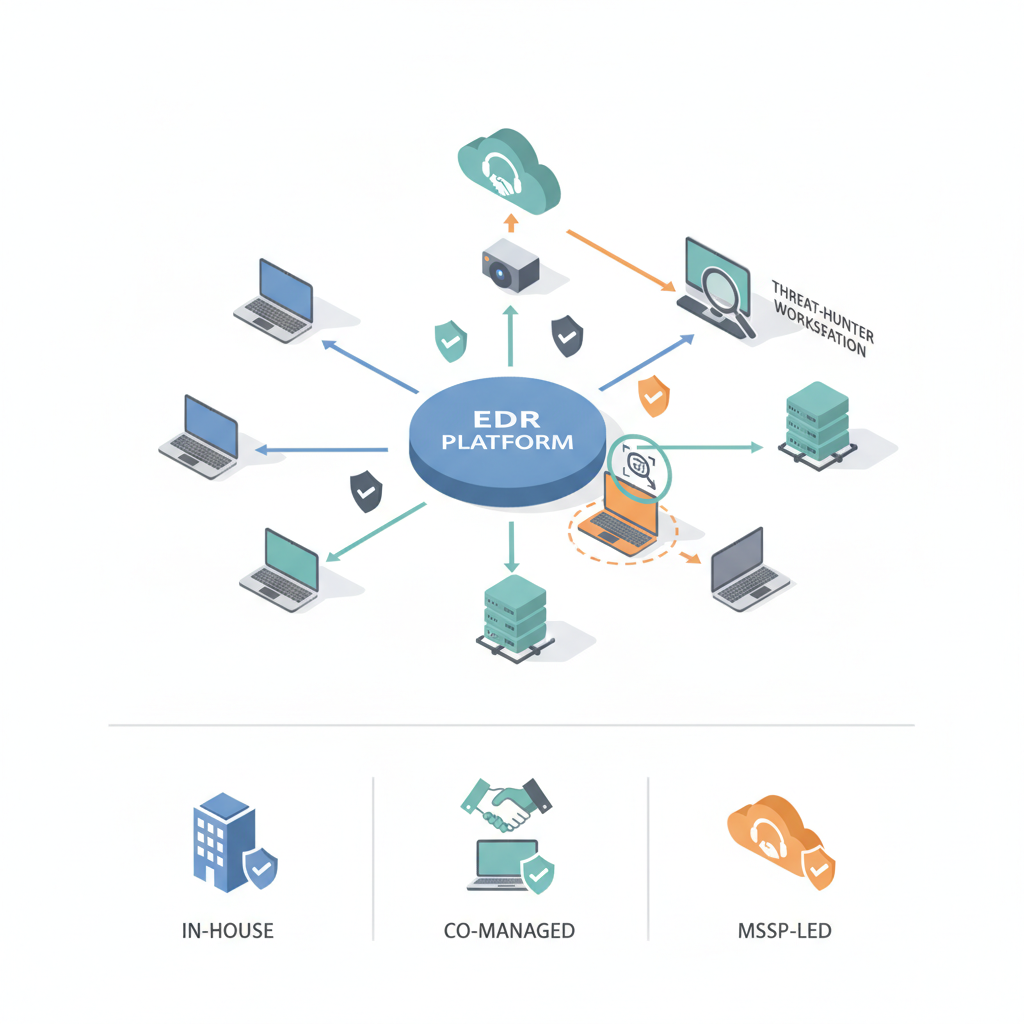
EDR is one component of the detection and response stack. It supplies endpoint telemetry to SIEM/XDR platforms and feeds alerts into Managed Detection and Response (MDR) or MSSP workflows. The practical relationships are:
- EDR → SIEM: EDR provides high-fidelity endpoint logs to a SIEM for correlation across network and cloud logs.
- EDR → XDR: XDR aggregates telemetry across endpoints, email, cloud workloads, and network devices for broader detection use cases.
- MSSP / MDR: these services operate and monitor EDR and SIEM on your behalf, offering 24/7 coverage and hunting expertise.
Example architecture for a regulated SMB: EDR agents on endpoints forward telemetry to a vendor-managed EDR console; selected alerts and aggregated logs forward to a SIEM you own or to a co-managed SIEM; the MSSP provides 24/7 monitoring and threat hunting. This co-managed approach satisfies many nydfs edr requirements because it produces continuous monitoring and an auditable incident timeline.
Actionable takeaway: design your stack with clear data flows and ownership: who stores long-term logs, who runs hunts, and who is responsible for containment actions. Put these responsibilities in your incident response plan and vendor contracts.
Deployment models for regulated businesses: in-house, co‑managed, MSSP-led
There are three common deployment models for EDR and threat hunting:
- In-house: your team manages the EDR console, writes rules, and runs hunts. This suits organizations with senior security staff and mature SOC processes.
- Co-managed: the vendor and your team share responsibilities. The vendor handles onboarding, maintenance, and routine hunts; your team handles escalations and remediation.
- MSSP-led: the vendor runs EDR, hunting, and response with SLAs for notification and action. This is typical for SMBs that lack full-time security engineers.
Concrete example: an NJ healthcare provider with a small IT team often selects co-managed EDR to retain control of remediation while outsourcing 24/7 hunt coverage. By contrast, a small law firm may pick MSSP-led services to avoid hiring dedicated analysts.
For regulated entities, co-managed setups offer a middle ground: you keep ownership of incident response policies and compliance artifacts, while the MSSP provides operational telemetry analysis and hunting. Practical rule: choose co-managed if you have at least one senior IT security engineer who can act as the escalation contact; choose MSSP-led if you do not.
Actionable takeaway: during procurement, require a clear responsibilities matrix (RACI) that specifies who performs onboarding, who runs hunts, who isolates endpoints, and who completes forensic exports for audits.
Pros/cons and SLA expectations for each model
In-house pros: full control, easier evidence custody, lower per-device cost at scale. Cons: high staffing requirements and retention risk. SLA expectation: internal teams should set measurable MTTD and MTTR targets and staff accordingly.
Co-managed pros: shared workload, knowledge transfer, and retention of control. Cons: possible handoff delays and coordination overhead. SLA expectation: vendor should commit to hunt cadence, triage SLAs (e.g., confirm critical alert within agreed window), and escalation paths.
MSSP-led pros: immediate 24/7 coverage, lower staffing burden. Cons: potential loss of day-to-day control and the need to trust vendor practices for handling ePHI and regulated data. SLA expectation: require documented incident notification windows, forensic artifact access rights, and contractual commitments for nydfs edr requirements where applicable.
Actionable takeaway: include SLA verification steps in your POC—test notification and containment procedures with a simulated incident and require written confirmation of forensic exports and chain-of-custody procedures.
Building a threat hunting program — team, tools, and playbooks
Constructing a hunting program requires three building blocks: people, tooling, and repeatable playbooks. For SMBs, the typical team includes a lead hunter (senior analyst), a responder (IT or incident responder), and a liaison to legal/compliance. Tools include EDR for telemetry, a SIEM for correlation, and threat intelligence feeds.
Start with a simple cadence: weekly triage of high-fidelity detections, monthly hypothesis-driven hunts, and quarterly red-team-style tabletop exercises. Use hunt templates mapped to MITRE ATT&CK techniques—example hunts: credential harvesting, persistence via scheduled tasks, and suspicious data staging on file shares.
Practical playbook step-by-step (credential theft):
- Trigger: repeated failed authentications followed by successful authentication from unexpected host.
- Hunt: query EDR for lsass dumps, suspicious PowerShell commands, and abnormal process tokens in last 48 hours.
- Contain: isolate affected endpoints, reset implicated credentials, and force re-authentication across sessions.
- Remediate: perform forensic capture, apply rollback if applicable, and restore from verified backups where necessary.
- Document: produce an incident timeline and compliance artifacts for reporting.
Actionable takeaway: codify hunts into playbooks and store them in a searchable runbook. If you work with an MSSP, require that their hunts produce the same artifacts and timeline format you keep for compliance.
Detection & response playbooks for common threats (ransomware, credential theft, lateral movement)
Playbooks translate detection into repeatable steps. Below are condensed playbooks you can implement immediately. Each playbook includes detection indicators, immediate containment, forensic capture steps, and remediation/restore rules.
Ransomware playbook (summary): detect anomalous mass file encryption or rename activity; immediately isolate the endpoint; take a forensic snapshot and memory image; preserve backups and verify integrity; begin staged restores from immutable backups once the environment is clean. Concrete rule: if more than 100 files are modified in the same directory within 5 minutes and unsupported processes are responsible, trigger full incident response.
Credential theft playbook (summary): detect LSASS dumps, suspicious use of mimikatz-like commands, or remote command execution; isolate affected hosts and revoke compromised credentials; enforce password resets and MFA re-enrollment; hunt for lateral movement from the compromised accounts.
Lateral movement playbook (summary): watch for abnormal RDP/SMB connections, new admin account creations, and scheduled task additions; correlate EDR process telemetry with SIEM network logs to map movement; block compromised accounts and isolate endpoints.
Actionable takeaway: encode these playbooks into a runbook and test them annually via tabletop and technical exercises. Ensure documentation includes the chain-of-custody steps regulators expect.
Measuring success: key metrics (dwell time, MTTD, MTTR, containment rate) and ROI
Measuring your program is essential for both operational improvement and compliance reporting. Key metrics include:
- Dwell time: time from initial compromise to detection.
- MTTD (Mean time to detect): average time from compromise to detection across incidents.
- MTTR (Mean time to respond/repair): average time from detection to containment and recovery.
- Containment rate: percentage of incidents contained without data exfiltration or escalation.
Concrete KPI examples: aim to reduce dwell time steadily—if typical dwell time in your sector is measured in weeks, target reducing it to days through combined EDR and hunting. Use a decision rule: if a vendor cannot provide baseline MTTD metrics from customers or POC data, treat that as a procurement risk.
ROI calculation: quantify avoided incidents (estimated breach cost by industry), time saved by faster recovery (reduced MTTR), and productivity gains from fewer outages. While you should not invent specific dollar values without internal data, producing a conservative avoidance estimate helps justify investment to leadership.
Actionable takeaway: implement dashboards tracking the four key metrics and publish them monthly to leadership. Use these figures in quarterly vendor reviews and to adjust hunt cadence and staffing.
Vendor selection checklist and RFP template highlights
A focused vendor checklist reduces procurement time and clarifies compliance needs. Use this checklist as a minimum set of requirements in your RFP:
- Telemetry scope: list exact events collected and retention periods.
- Forensic exports: ability to export memory, disk snapshots, and timeline data in portable formats.
- Containment controls: network isolation, process kill, and quarantine APIs.
- Rollback capability: documented restoration workflow and test results.
- Compliance support: mapped controls for NYDFS and HIPAA and evidence packaging.
- Service model: in-house, co-managed, or MSSP-led options and RACI matrix.
- Data handling: privacy, ePHI handling, and role-based access controls.
Include this RFP template highlight in procurement: require a 30-day POC with scripted tests for detection, containment, rollback, and forensic export. Ask for documentation that demonstrates nydfs edr requirements compliance and provide the compliance mapping matrix you created earlier.
| Requirement | Vendor response needed | Pass/fail |
|---|---|---|
| Telemetry completeness | List events and retention policy | Pass if events include process, file, network |
| Forensic export | Provide sample memory and timeline export | Pass if export includes hashes and timestamps |
| Containment controls | Demonstrate isolation and API | Pass if isolation preserves artifacts |
Actionable takeaway: add the checklist and table to your RFP and score vendors objectively during POC testing.
Integration checklist — EDR with backup, identity, MFA, conditional access, and SIEM
EDR doesn’t operate in isolation. A secure deployment integrates with backups, identity providers, MFA, conditional access, and SIEM. Use this checklist when validating integrations:
- Backup integration: verify backups are immutable and that EDR rollback works with backup snapshots.
- Identity and MFA: ensure EDR alerts can trigger forced re-authentication and MFA reset workflows.
- Conditional access: map containment to conditional access policies to block compromised accounts from cloud resources.
- SIEM integration: confirm EDR event schemas map to SIEM fields and support correlation rules.
Integration decision matrix (example): if your identity provider supports risk-based conditional access, configure a rule that increases session risk and blocks access when EDR detects confirmed credential theft. This reduces time-to-block beyond endpoint isolation.
| Integration | Concrete test | Success criteria |
|---|---|---|
| Backup | Simulate file encryption and run rollback | Files restored and backup integrity verified |
| Identity/MFA | Detect credential compromise and force MFA reset | Account re-authentication required for all sessions |
| SIEM | Forward EDR alerts and run correlation rule | SIEM shows correlated incident with timeline |
Actionable takeaway: require integration tests during POC and document responsibilities—who runs the rollback, who enacts conditional access, and who validates backups.
Case studies / hypothetical scenarios for NJ & NY regulated SMBs
Below are hypothetical, realistic scenarios that show how EDR and hunting combine to stop incidents in regulated environments. These are illustrative examples, not client stories.
Scenario 1 — medical billing firm (NY): an employee opens a phishing attachment that launches a living-off-the-land PowerShell downloader. Automated antivirus misses the evasive script, but EDR telemetry shows PowerShell invoked with base64 arguments and an unexpected parent process. A monthly hunt identifies lateral authentication attempts and LSASS access. The firm isolates affected endpoints, rotates service credentials, and recovers encrypted files from immutable backups. The incident timeline collected through EDR meets HIPAA breach reporting requirements.
Scenario 2 — regional lender (NJ): suspicious SMB file shares see unusual file staging timed with after-hours logins. Threat hunting uncovers a pattern of scheduled tasks creating compressed archives of financial spreadsheets. The MSSP-led detection isolates endpoints and escalates to the lender’s security lead. Forensic exports support regulatory reporting to state agencies and demonstrate controls required under financial regulations.
Actionable takeaway: in both scenarios, the combination of endpoint visibility, hunting cadence, and integration with backups and identity controls prevented data loss and produced the artifacts regulators require.
FAQs for executives and IT managers
What is edr & threat hunting?
EDR and threat hunting for regulated businesses refers to endpoint detection and response combined with human-led proactive investigations that together reduce dwell time, provide forensic evidence, and support regulatory incident detection and response requirements.
How does edr & threat hunting work?
EDR collects endpoint telemetry, applies automated detections, and provides containment controls, while threat hunting uses hypotheses and telemetry to discover stealthy activity; together they detect, contain, and remediate incidents and produce audit-ready artifacts.
Next steps — free assessment CTA and contact information
If you manage a regulated business in New Jersey or New York, start with a focused assessment that maps your current controls to nydfs edr requirements and HIPAA obligations. Eighty Seven Solutions offers Services and a demo engagement to validate EDR telemetry, run POC tests, and establish a co-managed approach when appropriate.
For a practical next step, request a free assessment to get a compliance mapping matrix, a POC checklist, and an initial hunt roadmap. Visit our services to learn more or contact us to schedule a demo or assessment. You can also find additional company information on the contact us page or reach out via the main site at contact us.