

TL;DR
- Regulated NJ & NY businesses face outsized risk from vendors that touch customer data, payments, or clinical records.
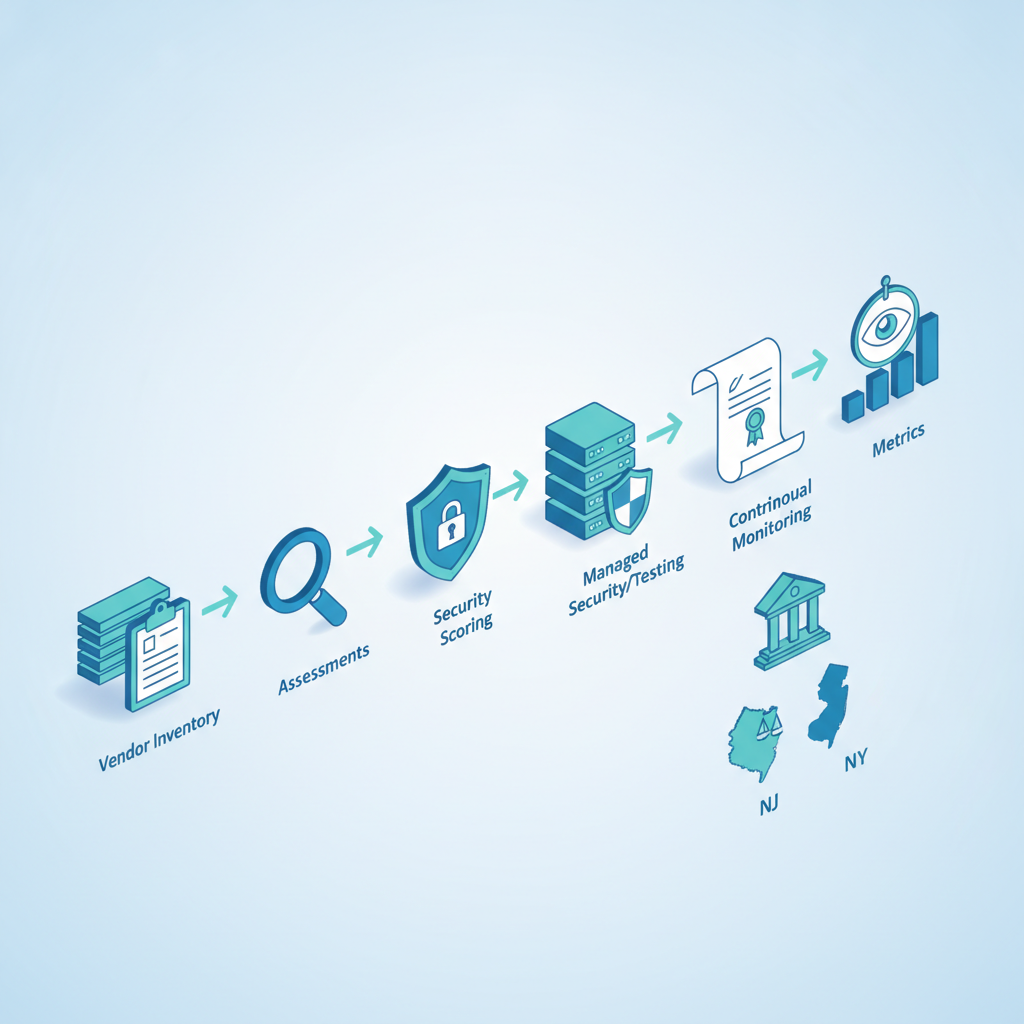
- Quick answer: inventory every vendor, classify by risk, assess with tailored questionnaires and tests, bake controls into contracts, and run continuous monitoring.
- Shareable 5-point checklist: inventory, classify, assess, contract, monitor.

Introduction — why vendor risk matters for regulated NJ & NY businesses
A payment processor update goes wrong and suddenly your site can't process credit cards for four hours. A cloud backup vendor misconfigures access, and protected health information is exposed. These are not hypothetical failures — they are the kind of vendor incidents that force regulated organizations in New Jersey and New York to respond under strict rules. For clarity: "regulated NJ & NY businesses" in this guide means organizations subject to state and federal rules such as NYDFS 23 NYCRR 500 for financial services, HIPAA for healthcare providers and payors, and PCI rules for entities that accept payments.
Vendor & third-party risk can be silent and cascading: a breach at a small subcontractor becomes a board-level crisis for the primary firm. The concrete harm is operational downtime, regulatory fines, damaged reputation, and expensive remediation. NYDFS 23 NYCRR 500 requires covered entities to assess and manage third-party provider risk, and both New York and New Jersey maintain vendor guidance and questionnaires for high-risk suppliers. If you have questions about managing these risks, feel free to contact us for assistance.
Quick answer: implement a repeatable vendor risk program that starts with a complete inventory, applies a risk-based classification, uses questionnaires plus technical tests for high-risk vendors, enforces contract clauses and insurance, and then monitors continuously. This guide walks you through that program step by step with examples relevant to finance, healthcare, and professional services in NJ & NY. For more on this, see In-house vs mssp vendor risk management guide.
When NOT to use this guide
This guide is not for hobby sites or sole proprietors without regulated data obligations. Do not treat these controls as exhaustive for global multinational compliance programs — consult counsel for cross-border transfer rules. If your vendor exposure is only to basic utilities (local janitorial services with no data access), a lightweight checklist may suffice rather than a full enterprise program.
Key regulations & standards that affect vendor risk (NYDFS 23 NYCRR 500, HIPAA, PCI, state guidance)
If you operate in New York's financial sector, NYDFS 23 NYCRR 500 is central: it requires covered entities to assess and manage third‑party provider risk and maintain written policies for cybersecurity. For healthcare organizations, HIPAA mandates safeguards for protected health information where vendors with access are business associates subject to written agreements and security controls. For merchants and any site that accepts card payments, PCI Data Security Standard (PCI DSS) requires vendors handling cardholder data to meet technical and contractual controls.
State-level guidance matters, too. New Jersey publishes a Third Party Information Security Questionnaire used across public-sector procurements; New York's Department of Financial Services issues guidance and industry letters to regulated entities about vendor controls. These resources form the minimum expectations and often include practical assessment items you'll be asked to demonstrate in an audit, which is why understanding how to build a vendor security assessment program is crucial for compliance.
Practical example: a mid-sized New York lending firm must document vendor due diligence under NYDFS 23 NYCRR 500 and maintain evidence that its cloud document vendor enforces encryption-at-rest, multi-factor authentication for admin accounts, and incident notification within a contractually defined window. A New Jersey clinic must verify business associate agreements and run penetration tests on any vendor-hosted patient portal that stores PHI.
Actionable takeaway: map each vendor to the regulation(s) that apply, and keep a one-page compliance summary per vendor that lists the specific clauses you must prove in an audit (e.g., encryption, logging, incident notification timeframes).
Third‑party risk is a business risk: if a vendor outage stops revenue collection, it's a compliance incident and a revenue problem.
Defining third‑party risk and common attack surfaces
Third‑party risk is the exposure your organization accepts when you rely on external vendors for services that touch data, identity, infrastructure, or operations. Risks fall into categories: confidentiality (data leakage), integrity (unauthorized changes), availability (downtime), and compliance (failure to meet regulatory obligations). Understanding common attack surfaces helps you prioritize.
Common attack surfaces include: vendor access to production systems (SSH, VPN, cloud console), vendor software components (third-party libraries, SaaS integrations), data transfers (APIs, SFTP), and physical or managed services (on-site contractors, managed print services). For example, a marketing platform with API access to user records presents a different risk than a local HVAC vendor that has no data access.
Real-world scenario: an MSSP vendor assessments failure—where the managed security provider's monitoring credentials were reused—led to an attacker pivoting from the MSSP into multiple client environments. That failure illustrates why "mssp vendor assessments" should include credential hygiene and separate, auditable logging per client.
Actionable takeaway: create a short template that lists the attack surface items to check for each vendor: admin access methods, credentials and secret storage, software dependencies, data classification, and expected notification SLA for incidents.
Building a vendor inventory and classification approach
You can't manage what you don't inventory. Start by collecting baseline metadata for every vendor: legal entity name, service description, data types accessed (PII, PHI, payment data), technical access (network/VPN/API), subcontractors, contract dates, and the person owning the relationship internally. Use a spreadsheet or a lightweight vendor management tool if you have many suppliers.
Classification is risk-based. A practical three-tier approach works well: low (no sensitive data, no admin access), medium (some sensitive data, API access, limited admin access), high (PHI or cardholder data, production admin access, critical business operations). For each tier, define required controls and assessment depth. Example thresholds: any vendor with access to PHI or cardholder data is automatically high-risk; any vendor with write access to production systems is high-risk.
Example workflow for classification: the marketing vendor’s entry shows API access to customer email addresses and campaign analytics — classify as medium. The cloud-hosted EHR vendor storing PHI and providing admin access is high. Flag both for appropriate assessments and contract clauses. For MSSP vendor assessments, treat the MSSP as high risk if it has privileged monitoring access.
Actionable artifacts: maintain a vendor inventory CSV with the following fields: vendor_id, legal_name, service, internal_owner, data_types, access_level (None/Read/Write/Admin), subcontractors, contract_start, contract_end, risk_tier. Export this monthly and present a vendor risk heatmap to executives each quarter.
Risk assessment frameworks & scoring models
A consistent scoring model converts qualitative judgments into repeatable outcomes. Pick one framework and stick with it. Use a scoring range (for example, 0–100) and map numeric ranges to the low/medium/high tiers you created during classification. A scoring framework forces the team to quantify impact and likelihood rather than relying on intuition.
Start by scoring along core dimensions: data sensitivity, access level, vendor controls maturity, business impact, and threat exposure. Weight these dimensions to reflect your priorities — if regulatory compliance is the top risk, give data sensitivity and regulatory exposure heavier weights.
Qualitative vs quantitative scoring
Qualitative scoring uses categories like "low/medium/high" and is fast for smaller teams. Quantitative scoring assigns numbers to criteria and yields more granular prioritization. In practice, many teams use a hybrid: qualitative labels for communication and a numeric score for internal prioritization. For example, score data sensitivity 0–30, access level 0–25, controls maturity 0–25, business impact 0–20; add for a total of 100. Then map 0–40 = low, 41–70 = medium, 71–100 = high.
Worked example: a payment gateway integration stores card tokens (data sensitivity = 25/30), has API write access (access level = 20/25), controls maturity is moderate (15/25), business impact is high (20/20) => total 80 => high risk. That numeric output directly drives assessment depth and remediation timelines.
Sample scoring matrix
Below is a simple decision table you can copy. Use it to generate numeric scores and then sort vendors by score to prioritize assessments.
| Criteria | Score range | Example |
|---|---|---|
| Data sensitivity | 0–30 | 30 if PHI/cardholder data, 10 if public |
| Access level | 0–25 | 25 for Admin, 10 for API read |
| Controls maturity | 0–25 | 25 for SOC2/ISO27001, 10 for none |
| Business impact | 0–20 | 20 if service outage stops revenue |
Actionable takeaway: implement the numeric matrix in a spreadsheet and set a quarterly review cadence to re-score vendors that change access or scope.
A numeric vendor score focuses remediation: fix the top-10 highest-scoring vendors first, not every vendor equally.
Vendor security assessment methods (questionnaires, attestations, technical testing, audits)
Assessment depth should match risk. For low-risk vendors, use a short questionnaire confirming basics: encryption in transit, MFA for admin, and breach notification. For medium-risk vendors, require an updated SSAE/SOC2 or ISO attestation and a more detailed questionnaire. For high-risk vendors, demand a combination of documentary evidence, technical testing, and on-site or remote audits.
Questionnaires: craft vendor questionnaires that go beyond checkbox answers. Include conditional follow-ups (if vendor stores PHI, list encryption algorithm and key management specifics). Share a timeline: vendors must return questionnaires within 10 business days for medium/high risk.
Attestations and reports: accept SOC2 Type II reports or ISO 27001 certificates but validate scope. A SOC2 covering payroll systems does not prove security of a hosted application you use. Always request the letter of attestation and the full report where possible and review the exceptions.
Technical testing: for vendors hosting customer-facing apps, require third-party penetration testing with a summary of findings and remediation evidence. For SaaS integrations, require configuration checks such as least-privilege API keys, IP allow lists, and event logging forwarded to your SIEM. For managed vendors like MSSPs, request evidence of per-client logging segregation and signed cryptographic artifacts proving unique credentials (when practical).
Audits: include right-to-audit clauses in contracts. If a vendor refuses a relevant audit, escalate classification and consider finding alternate providers. For critical services, schedule annual remote assessments and every-two-year on-site reviews where contractually allowed.
Actionable checklist: for each vendor assessment produce: completed questionnaire, attestation or SOC/ISO report, penetration test summary (if required), remediation plan with deadlines, and a final acceptance sign-off by the vendor owner.
Contractual controls, SLAs and insurance requirements
Contracts are where policy becomes enforceable. Typical vendor contract controls include data processing addenda (DPAs) for data protection, clear incident notification timelines, mandatory security controls, and insurance clauses. For regulated entities under NYDFS 23 NYCRR 500 or HIPAA, include specific obligations such as required encryption, audit rights, and breach notification within 72 hours (or the timeframe your regulator expects).
Examples of effective contract language: require multi-factor authentication for any admin accounts, mandate retention of logs for at least 12 months, and require that the vendor maintain cyber liability insurance with a minimum limit appropriate to your exposure. Do not accept vendor boilerplate that eliminates consequential damages without negotiation when the vendor processes regulated data.
SLA specifics: define availability metrics and remedies. For example, for a payment gateway, require 99.9% uptime over a 30-day window and a credit-based remedy for violations. For incident response, define notification SLAs like "vendor must notify within 24 hours of detection and provide a full incident report within 14 days." When precise metrics are unknown, require a timeframe tied to impact tiers (e.g., immediate for PII exfiltration, 72 hours for non-sensitive incidents).
Insurance: require cyber insurance with coverage for notification costs, forensic investigations, and third-party liabilities. Ask for proof of insurance and track renewal dates in your inventory. If a vendor cannot provide coverage, escalate to legal and consider risk acceptance documentation from senior leadership.
Actionable takeaway: standardize contract addenda with legal and procurement so every vendor contract includes your minimum security clauses, a breach notification SLA, audit rights, and insurance requirements. Keep a contract summary attached to each vendor record.
Continuous monitoring & metrics
Assessment and contracting are necessary but insufficient without ongoing monitoring. Continuous monitoring detects changes in vendor posture, new vulnerabilities, or incidents that affect your risk profile. Design key metrics and an alerting strategy to provide timely signals to owners and security teams.
Alerting, evidence collection for cyber insurance
Define alerts for high-risk conditions: credential exposure in public breach feeds, anomalous vendor account access (logins from unexpected geographies), or service degradations exceeding SLA. Configure your SIEM or monitoring platform to ingest vendor-supplied logs where possible and create dashboards for vendor-related alerts. For cyber insurance, collect preserved evidence: logs showing access at the time of incident, chain-of-custody for forensic artifacts, and copies of vendor incident notifications. These records simplify claims and demonstrate due care.
Practical metric examples: track mean time to detect (MTTD) vendor-origin issues, mean time to remediate (MTTR) vendor findings, and the percentage of high-risk vendors with up-to-date attestations. Typical target ranges: aim for MTTD under 24 hours for vendor-origin incidents in critical services; for noncritical, aim under 72 hours — adjust to your environment.
Cadence and automation
Cadence matters. Run automated vulnerability scans monthly for vendor-facing assets, refresh questionnaires annually for medium risk, and require high-risk vendors to submit attestations every 6–12 months. Use an automated workflow to triage questionnaire responses: auto-escalate any answer that indicates missing MFA, lack of encryption, or missing logging.
Automation examples: integrate breach-detection feeds into your inventory so vendors with exposed credentials are flagged automatically, and use scheduled reminders to vendors and internal owners for expiring certificates or expiring attestations. For MSSP vendor assessments, use automation to check that monitoring accounts remain active and that log ingestion pipelines stay healthy.
Actionable takeaway: adopt a monthly monitoring dashboard and automate the low-effort checks (certificate expirations, domain changes, public breaches) so human attention focuses on high-value review and remediation.
Incident coordination with vendors — playbook and evidence checklist
When a vendor incident occurs, coordinated response wins time and reduces harm. Your incident playbook should include vendor-specific steps, assigned owners, communication templates, and evidence collection checklists. Define escalation paths both internally and with the vendor, and rehearse vendor incident scenarios regularly.
Playbook steps: detect and triage, notify vendor owner and legal, request vendor containment actions, collect logs and evidence, run forensic analysis, determine regulatory notification obligations, and execute customer communication if required. Include timeline expectations: for example, request an initial vendor situational report within 24 hours and a full root cause and remediation plan within 14 days.
Evidence checklist: preserved access logs, system snapshots, copies of vendor notifications, scope of affected data, timestamped communication records, signed statements of remedial actions, and retained forensic images. If insurance claims are likely, maintain chain-of-custody and avoid modifying affected systems until a forensic image is taken.
Example scenario: a cloud backup vendor reports unauthorized access. Your playbook requires immediate suspension of vendor access to backups containing regulated data, forensic imaging of affected systems, and simultaneous notification to regulators within the timeline required by the applicable regulation (e.g., HIPAA breach notification rules).
Actionable takeaway: keep a vendor incident runbook attached to each high-risk vendor record, and run at least one table-top exercise per year involving the vendor owner, security, legal, and communications teams.
Governance: roles, escalation & board reporting
Vendor risk must have a home in governance. Assign clear roles: vendor owner (business stakeholder), security reviewer (technical lead), procurement (contract owner), and legal (contract and regulatory obligations). Define escalation triggers — for example, an unresolved high-risk vendor finding after 30 days escalates to the CISO, and after 60 days to the CEO and board.
Reporting to leadership should be concise and risk-focused. Provide a rolling list of top 10 vendor risks, remediation progress, any regulatory exposures, and a metric dashboard with vendor-scoring trends. For the board, summarize only what matters: high-risk vendors, incidents affecting regulated data in the last quarter, and any contractual or insurance shortfalls requiring executive decisions.
Practical governance rhythm: monthly operational reviews for remediation teams, quarterly risk reviews with executives, and an annual board update that demonstrates the program maturity, results of high-risk audits, and the vendor inventory status. Document risk acceptance decisions — if leadership accepts a vendor risk, capture the rationale and duration in writing.
Actionable takeaway: designate a vendor risk coordinator who runs the operational cadence and produces the quarterly board-friendly vendor risk summary.
Implementation roadmap & prioritized milestones for 30/60/90 days
Roll out vendor risk management in prioritized phases so you deliver quick wins while building a repeatable program. Below is a practical 30/60/90 roadmap tailored for regulated NJ & NY businesses.
- Days 0–30: build the inventory; record all vendors, owners, data types, and contracts. Classify vendors into low/medium/high. Send an initial short questionnaire to all medium/high vendors requesting basic security controls and attestation timelines.
- Days 31–60: score vendors using a sample scoring matrix, prioritize the top 20 high-risk vendors, and schedule deep assessments (SOC2 review, penetration testing, or technical reviews). Begin contract review for high-risk vendors to add missing clauses and insurance requirements.
- Days 61–90: complete first round of deep assessments, finalize remediation plans for high-risk vendors, and implement automated monitoring for certificate expirations, public breach feeds, and vendor domain changes. Present a quarter-one vendor risk dashboard to executives.
Example priority: if a vendor processing payments is high risk and does not provide a SOC2 report, schedule a penetration test and negotiate temporary mitigations (tokenization, reduced scope) while pursuing contractual remediation.
Actionable takeaway: aim to reduce the number of unmanaged high-risk vendors by 30–50% within the first 90 days by reclassifying, remediating, or replacing vendors based on assessment results.
Case studies / examples for NJ & NY regulated sectors (finance, healthcare, professional services)
Finance (NY): a regional lender in New York must align vendor controls with NYDFS 23 NYCRR 500. Practical steps include evaluating cloud-hosted loan origination systems for encryption, access logging, and incident notification; demanding SOC2 Type II reports scoped to the service; and retaining audit rights. For that lender, vendor security assessment ny should prioritize payment gateways and data aggregation providers that access customer financial information.
Healthcare (NJ): a New Jersey clinic that integrates a patient portal must treat the portal vendor as a business associate under HIPAA. The clinic requires a signed business associate agreement, proof of encryption, and documented controls around PHI export. The New Jersey Third Party Information Security Questionnaire can serve as a baseline for assessments of vendors supplying software or managed services.
Professional services: a law firm in NY relying on a document management SaaS must ensure the vendor separates client data, supports role-based access, and provides audit logs. For firms handling sensitive client data, the vendor’s SOC2 report and a contractual right to request on-site audits are non-negotiable.
Actionable takeaway: map common vendor archetypes in your industry to the controls you must demand. Use industry-specific checklists (finance: transaction integrity and encryption; healthcare: BAA and PHI access controls) to speed assessments.
Tools, templates & downloadable checklists (vendor questionnaire template, scoring sheet)
Below are two artifacts you can copy immediately. Paste the questionnaire items into a form and import the scoring sheet into a spreadsheet.
Shareable 5‑point checklist (copyable):
- Inventory: record vendor, owner, and data types accessed.
- Classify: assign low/medium/high based on data sensitivity and access.
- Assess: send questionnaires, request SOC2/SOC3/ISO, and run technical tests for high risk.
- Contract: add DPAs, incident notification SLAs, audit rights, and insurance requirements.
- Monitor: automate certificate, domain, and breach-feed checks and review top vendors monthly.
Vendor questionnaire (core items) — paste into your vendor form:
- Describe the data types you will access and where they are stored.
- Do you encrypt data at rest and in transit? Specify algorithms and key management.
- Do you use MFA for administrative access?
- Do you subcontract any services? If so, list subcontractors and their controls.
- Provide most recent SOC2/ISO27001/penetration test dates and executive summaries.
- What is your incident notification timeline by severity?
Copyable scoring sheet: use the sample scoring matrix earlier in this guide and implement as columns in a spreadsheet for automated ranking.
Conclusion & recommended next steps (CTA: free IT/vendor risk assessment)
Vendor risk is manageable if you act methodically: inventory, classify, assess, contract, and monitor. For regulated NJ & NY businesses, tie each vendor to your regulatory obligations (NYDFS 23 NYCRR 500, HIPAA, PCI) and document evidence for audits. Quotable fact: "NYDFS 23 NYCRR 500 requires covered entities to assess and manage third‑party provider risk."
Next steps you can take today: run a one-week inventory sprint, score the top 30 vendors, and send the core questionnaire to your medium/high vendors. If you want support, Eighty Seven Solutions helps organizations secure and manage IT and cybersecurity: our services include 24/7 monitoring, senior-engineer-led support, enterprise-grade backup and disaster recovery, and cybersecurity controls such as endpoint detection and response and SIEM that integrate with vendor monitoring. Explore our services or schedule a demonstration at our services. For direct outreach, contact us or visit contact us for a free IT/vendor risk assessment.
FAQ
What is vendor & third-party risk management? Vendor & third-party risk management is the process of identifying, assessing, controlling, and monitoring risks introduced by external suppliers that access systems or data the organization relies on, including regulatory and operational exposures in NJ and NY.
How does vendor & third-party risk management work? It works as a program: create an inventory, classify vendors by risk, run assessments proportional to risk, include enforceable contract controls, and maintain continuous monitoring and governance to detect changes and respond to incidents.
References
- SP 800-161 Rev. 1, Cybersecurity Supply Chain Risk Management Practices for Systems and Organizations
- Industry Letter, May 21, 2026: Measures Regulated Entities Should Consider in a Heightened Cybersecurity Threat Environment (New York Department of Financial Services)
- New Jersey Third Party Information Security Questionnaire
- Securing the Software Supply Chain — CISA recommended practices
- Third-Party Risk Management - A Guide for Community Banks (FDIC)