
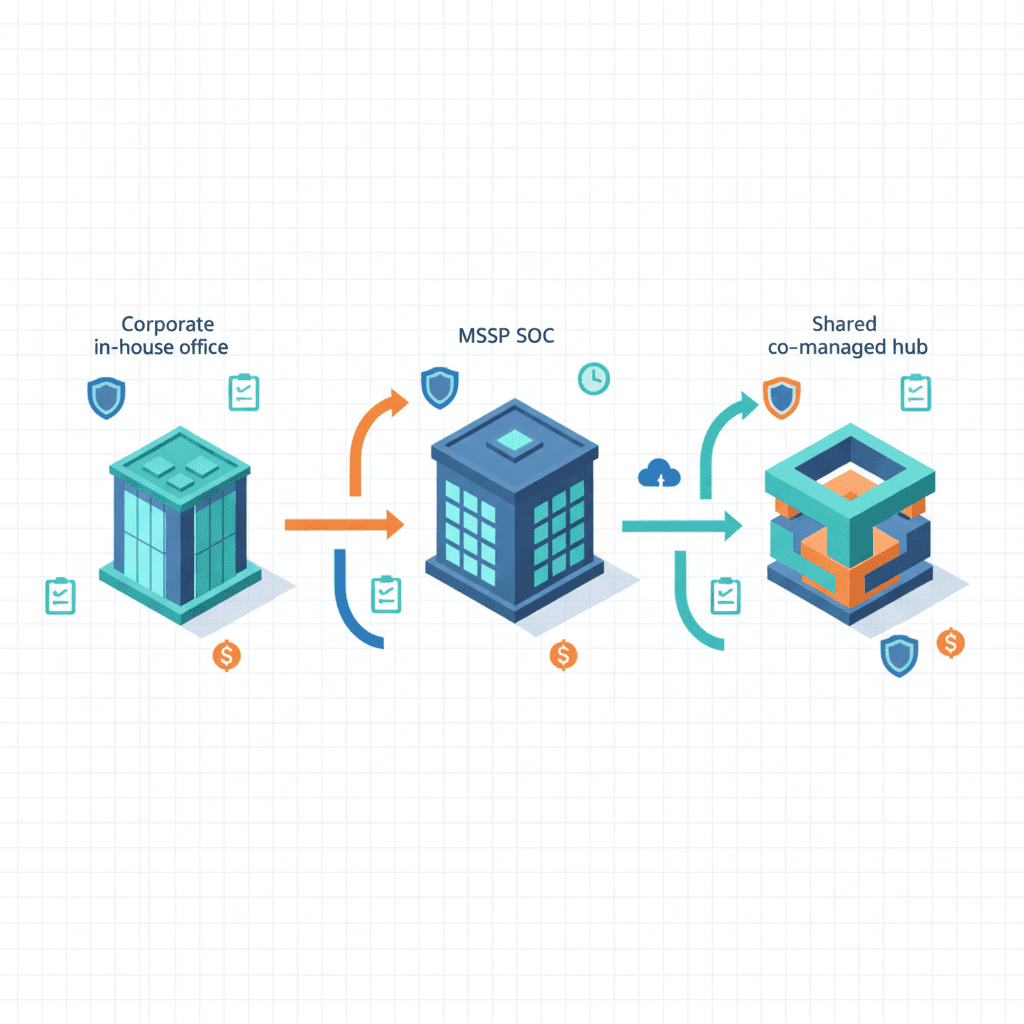
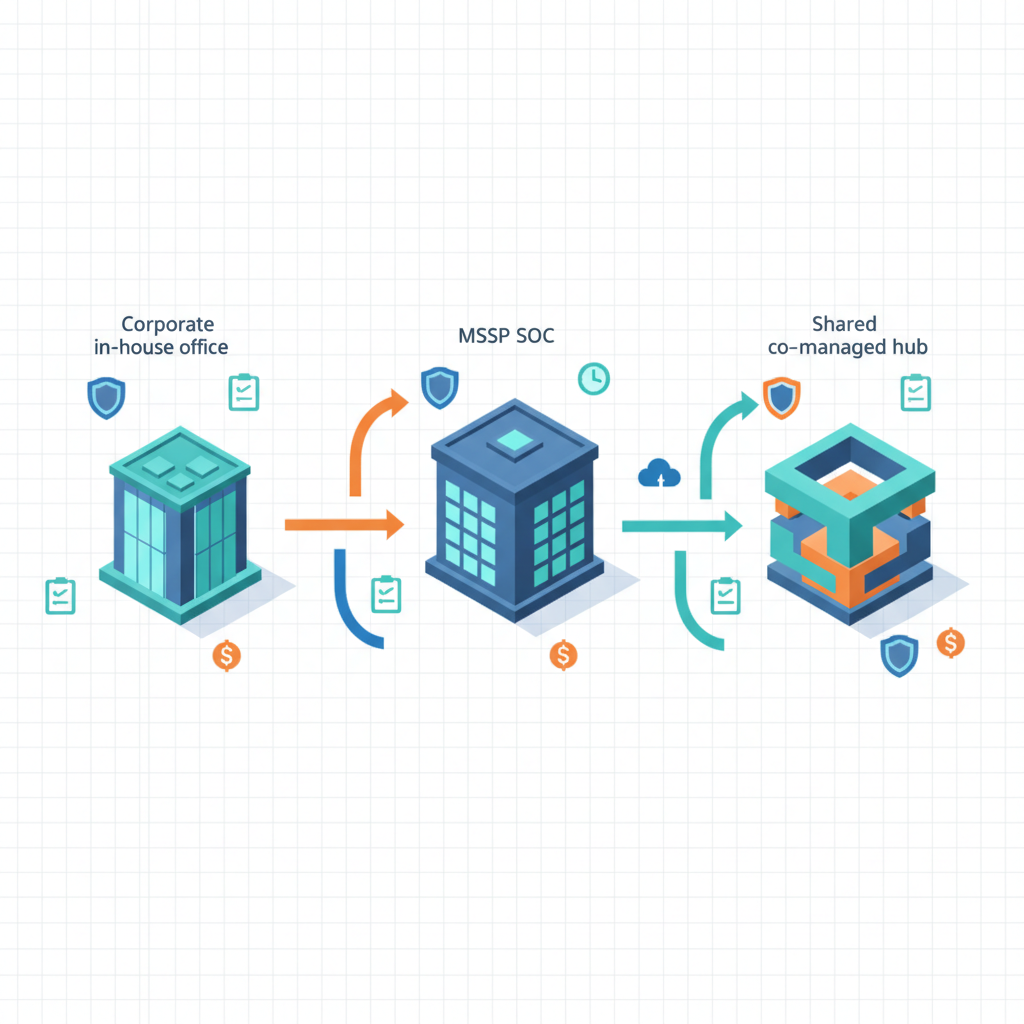
Introduction — the decision factors for regulated organizations
Are you weighing in-house vs mssp vendor risk management for a regulated business in New Jersey or New York?
Short answer: choose in-house when you already have senior security staff, tight control needs, and slow-moving vendor changes; choose an MSSP when you need 24/7 evidence collection, specialized vendor assessments, or rapid audit-ready reporting for NYDFS, HIPAA, or PCI exams. A co-managed model often gives the best balance.
This article compares in-house controls and MSSP vendor risk management, then walks through co-managed models, compliance differences, cost tradeoffs, a decision checklist, and a migration playbook. Examples reference a financial firm under NYDFS and a New Jersey healthcare provider subject to HIPAA. For regulated organizations, the core decision factors are staff capability, audit cadence, evidence collection speed, and insurer expectations when an external provider manages vendor risk.
Quotable: "Outsource if you lack senior security engineers, need 24/7 monitoring, or require rapid evidence for NYDFS audits." For more on this, see Our pricing.
Assign vendor risk ownership to a named role with authority to enforce remediation within 30 days.

What in‑house vendor risk management looks like (H3: pros, cons, staffing & skills required)
If you keep vendor risk management in-house, you run the program from procurement through ongoing monitoring. That includes inventorying vendors, performing risk tiering, running questionnaires or security assessments, tracking remediation, and producing evidence during audits.
Typical in-house pros: direct control over sensitive evidence, faster internal stakeholder coordination, and customization to business processes. Cons: hiring and retaining senior security engineers is expensive; you need tooling, a continuous monitoring pipeline, and policies mapped to NYDFS or HIPAA controls. Recruitment alone often sets smaller firms back months.
Staffing and skills required: at minimum one security lead with vendor risk management experience, one technical assessor (network/cloud), and support from legal/compliance. Skills: vendor risk frameworks (NIST SCRM basics), questionnaire design, SOC/penetration-test reading, contract clause negotiation, and evidence packaging for regulators. Practical setup: assign a vendor risk owner, configure a vendor inventory spreadsheet or GRC tool, and standardize a tiering rule (e.g., Tier 1 = vendors processing regulated data or with network access).
Example step-by-step in-house workflow:
- Day 0–30: build vendor inventory and tier by impact (high/medium/low).
- Day 30–60: send standard questionnaires to Tier 1 vendors; request SOC2 reports, penetration test summaries, and BAAs where applicable.
- Ongoing: quarterly evidence refresh for Tier 1, semi-annual for Tier 2, annual for Tier 3.
Quotable: "In-house vendor risk works when you can sustain senior security bandwidth and rapid internal remediation."
What MSSP‑led vendor risk management looks like (H3: pros, cons, typical service scope)
An MSSP-led vendor risk management program outsources the assessment, monitoring, and evidence-collection workflow to a specialized provider. For regulated NJ and NY firms, an MSSP brings centralized tooling, standard questionnaires mapped to regulatory controls, and often 24/7 monitoring that flags vendor-related anomalies.
MSSP pros: faster time-to-evidence, access to senior security engineers without full-time hires, and consolidated reporting tailored to NYDFS, HIPAA, or PCI requirements. Cons: you must manage vendor relationships around a third party, clarify responsibilities in contracts, and ensure insurers accept MSSP-managed evidence. Some vendors resist exposing certain data to an external provider, so negotiation is common.
Typical MSSP service scope includes vendor inventory onboarding, automated reminders, risk-scoring, continuous monitoring (where supported), external testing coordination, and a regulator-ready evidence repository. MSSPs also run threat hunting and SIEM correlation that links vendor indicators to your environment—useful when a third-party breach could become your breach.
Example MSSP workflow for a Tier 1 vendor:
- Week 1: MSSP ingests vendor details and requests SOC2/SOC3 or equivalent reports.
- Week 2–4: MSSP completes technical validation (public-facing asset scan, certificate checks) and correlates vendor alerts into your incident console.
- Ongoing: MSSP provides quarterly compliance packs and on-demand audit extracts for examiners.
mssp vendor risk benefits often include reduced hiring cost and faster audit response—key when auditors request evidence within days.
Co‑managed models — combining internal teams with an MSSP
Co-managed vendor risk blends internal oversight with external execution. You keep strategic control—policy, vendor acceptance thresholds, and legal sign-off—while the MSSP provides manpower, tooling, and continuous monitoring.
Typical division of labor: your organization retains the vendor inventory, contract negotiation, and final risk acceptance. The MSSP handles questionnaire distribution, technical assessments, continuous scans, and evidence packaging. This model preserves sensitive decision authority while supplying skilled resources.
Practical example: an NJ healthcare provider keeps HIPAA-related contract decisions internal but outsources technical assessments and ongoing log-based monitoring to the MSSP. The MSSP sends risk findings to the internal owner, who signs off on remediation timelines and notifies legal or procurement when contract changes are needed.
Operational steps to set up co-managed vendor risk:
- Define ownership: name who approves vendor risk levels and remediation SLAs.
- Set evidence handoff contracts: specify report formats, retention, encryption, and access methods.
- Run a 60-day pilot covering 5 Tier 1 vendors to validate process and audit extracts.
Require MSSP evidence to be exportable in native formats for regulator review and insurer claims.
The phrase co-managed vendor risk appears across procurement conversations because it balances control and capacity—especially for firms that must demonstrate internal oversight to examiners while removing tactical burden from stretched teams.
Compliance & evidence collection differences (NYDFS, HIPAA, PCI)
Regulatory expectations differ by regime, and those differences shape whether in-house or MSSP makes sense. NYDFS exams focus on systemic control and timely evidence; HIPAA centers on BAAs, risk assessments, and incident reporting; PCI emphasizes cardholder data environment controls and penetration test evidence. Each regulator expects documentation that ties controls to outcomes.
Key evidence differences:
- NYDFS: expects formal third-party risk management policies, vendor inventories mapped to criticality, and rapid access to third-party audit reports and incident timelines. Auditors often request evidence within days.
- HIPAA: requires signed BAAs, documented risk assessments for vendors handling PHI, and breach notifications tied to vendor incidents.
- PCI: expects technical testing artifacts (pen test reports), segmentation evidence, and proof that a vendor’s controls are sufficient where they touch the CHD environment.
When an MSSP manages vendor risk, insurers and auditors will want clear documentation proving control ownership. Required artifacts often include a signed statement of responsibilities, sample evidence exports (SOC reports, scan PDFs), retention policies, and access logs showing who retrieved what and when.
Citing authoritative guidance: follow the NIST SCRM practices for mapping supplier controls to risk outcomes (NIST SCRM), and use templates like CISA's SMB vendor SCRM workbook for operational steps (CISA SCRM template).
Cost, time-to-compliance and operational tradeoffs (H3: sample resource comparison, non-proprietary ranges)
Cost and time-to-compliance drive many decisions. Building in-house capability costs come from personnel, tooling, and process development. Outsourcing vendor security to an MSSP converts fixed hiring costs into a predictable operational expense. For many NJ and NY regulated firms, the choice is between headcount and monthly service fees.
Below is a non-proprietary comparison table illustrating typical resource tradeoffs for a small regulated firm (dozens of vendors):
| Activity | In-house | MSSP |
|---|---|---|
| Senior engineer time | 0.5–1 FTE | Included (shared) |
| Tooling (GRC, scanners) | Purchase and config | Included/subscription |
| Time-to-first-audit-ready-pack | 3–6 months | 2–6 weeks |
| Ongoing ops | monthly FTE cost | monthly service fee |
For a vendor risk management cost comparison, account for hiring lead engineers (~months to recruit), buying GRC tooling, and one-time audit preparation hours. An MSSP often shortens time-to-compliance dramatically because the provider already has templates and reg-exam experience. But an MSSP may require initial onboarding fees and a minimum contract term.
Example cost tradeoff scenario: a small finance team needs NYDFS-ready evidence within 30 days. Building in-house likely fails that deadline unless they already have a mature security org. Outsourcing vendor security to an MSSP produces audit-ready packs faster, though at the cost of external access and recurring fees.
Decision checklist — when to keep in‑house vs outsource vs co‑manage
Use this checklist to make a clear choice. Each line is a decision rule you can quote during procurement or board meetings.
- Keep in-house if you have one or more full-time senior security engineers focused on vendor risk and internal legal capacity to renegotiate vendor contracts.
- Outsource if you need 24/7 monitoring, rapid audit evidence delivery (days), or don’t have the budget to hire senior security staff.
- Co-manage if you want to retain final risk acceptance and contract control but need MSSP capabilities for assessments, continuous monitoring, or evidence packaging.
- Prefer MSSP when your audit cadence requires quick turnarounds (e.g., NYDFS exams) or insurers ask for external-managed evidence artifacts.
Decision matrix (quick):
| Condition | Recommended model |
|---|---|
| No senior staff, tight audit deadlines | Outsource |
| Strong internal security, sensitive contract control | In-house |
| Mixed—policy control needed, no bandwidth | Co-manage |
Use the checklist during procurement: require MSSP evidence exports, include contract clauses for incident collaboration, and set an SLA for evidence delivery (for example: audit extracts delivered within 5 business days). These concrete expectations reduce negotiation friction and satisfy insurers.
Migration playbook for moving vendor risk management to an MSSP
Moving to an MSSP requires planning. Below is a step-by-step playbook you can copy and adapt for NJ and NY regulated contexts.
- Inventory and tier vendors (Days 0–14): export existing vendor list, classify by data sensitivity and access, identify Tier 1 vendors for immediate onboarding.
- Define scope and responsibilities (Days 7–21): sign an MOU or statement of work clarifying which party collects evidence, who retains decision authority, and what evidence format is required for regulators and insurers.
- Run a pilot (Days 21–75): onboard 3–5 Tier 1 vendors to validate questionnaire templates, scanning, and audit extracts; collect feedback from compliance and legal.
- Full onboarding (Days 75–150): onboard remaining vendors in priority order; establish periodic refresh cycles and SLAs for evidence requests.
- Audit readiness and handoff (Post-onboard): verify that MSSP exports meet NYDFS and HIPAA exam needs; maintain a retained in-house contact responsible for final approvals.
"Implementation tips: require the MSSP to provide exportable raw artifacts (PDFs, CSVs, scan outputs) and a sample audit pack before finalizing the contract. Additionally, ensure that one internal person serves as the single point of contact for regulators."
Real-world examples for NJ & NY regulated firms
Example 1 — NY financial firm under NYDFS: The firm kept legal and final risk acceptance in-house but outsourced continuous monitoring and SOC report collection to an MSSP. The MSSP supplied quarterly compliance packs and delivered audit extracts within 48 hours during a surprise exam.
Example 2 — NJ healthcare provider subject to HIPAA: The provider co-managed vendor risk. Internal compliance retained BAAs and final sign-off while the MSSP performed technical assessments and log-based detection for vendor access. This division met HIPAA documentation requirements and reduced internal headcount pressure.
Example 3 — Small merchant processing PCI data: The merchant outsourced vendor assessments to an MSSP with PCI expertise to collect segmentation evidence and pen test summaries, which sped up annual PCI validation.
These real-world patterns repeat: regulated organizations often retain legal and business control but outsource technical validation and monitoring. That balance satisfies auditors and limits internal hiring needs.
Conclusion & recommended next steps (CTA: book a free vendor risk assessment)
Choose in-house when you can sustain senior security staff, own the contract process, and accept longer ramp-up times. Choose an MSSP when you need speed: faster audit-ready evidence, continuous monitoring, and senior-engineer expertise without hiring. Choose co-managed vendor risk if you want final authority while outsourcing execution.
Next steps: run the decision checklist above, pilot with 3 Tier 1 vendors, and require MSSP evidence exports in your contract. If you want to compare in-house vs mssp vendor risk management in the context of Eighty Seven Solutions' support model, review our services and consider a free assessment to map gaps to regulatory requirements.
Contact options: contact us, visit our contact us page, or schedule a demo via our services.
FAQ
What is in-house vs mssp vendor risk management?
In-house vendor risk management is a program run by your internal staff that inventories, assesses, and monitors third-party suppliers; MSSP vendor risk management outsources those activities to a managed security provider that performs assessments, monitoring, and audit-ready evidence collection.
How does in-house vs mssp vendor risk management work?
In practical terms, in-house work involves building a vendor inventory, sending questionnaires, interpreting SOC/penetration-test reports, and storing evidence for auditors; MSSP work centralizes those tasks with templates, continuous monitoring, and rapid evidence exports while your organization retains final vendor acceptance if desired.
References
- Cybersecurity Supply Chain Risk Management Practices for Systems and Organizations — NIST
- Industry Letter — Guidance on Managing Risks Related to Third-Party Service Providers — NYDFS
- Operationalizing Vendor SCRM Template for Small and Medium-Sized Businesses — CISA
- Building a Robust Third Party Risk Management Program in a Connected Ecosystem — ISACA Journal (2024)