

TL;DR
- Build a vendor security assessment program to reduce third-party risk, meet NYDFS/HIPAA expectations, and speed audits.
- Inventory vendors, tier by data access, use a standard third party security questionnaire, and require evidence (SOC, pentest reports).
- Score vendors, apply contractual controls and insurance requirements, and run continuous vendor monitoring nj ny using automated feeds and attestations.
- Reassess high-risk vendors semi‑annually, others annually; map tiers to NYDFS and HIPAA controls for regulator-ready evidence.

Introduction — goals of a vendor security assessment program
A vendor security assessment program defines how your organization evaluates, accepts, and monitors third-party risk. For regulated businesses in New Jersey and New York, a vendor security assessment program is both practical risk management and compliance evidence—useful during NYDFS examinations, HIPAA audits, and insurer reviews. This article walks you through a repeatable, seven-step process to build one, with concrete artifacts you can copy: a vendor assessment template, a third party security questionnaire sample, and a vendor onboarding checklist.
Quotable definition: "A vendor security assessment program is the repeatable process that converts vendor controls into evidentiary artifacts for auditors and insurers."
Why this matters to you: without a program, critical vendors remain blind spots. With one, you reduce breach surface, shorten audit timelines, and prove to insurers that controls exist. Use this 7‑step vendor assessment program to quickly evidence control for insurers and auditors in NJ & NY.
Step 1 — scope and vendor inventory (H3: identifying critical vendors by data access and regulatory impact)
Identifying critical vendors by data access and regulatory impact
Start by building a single, authoritative vendor inventory. Don’t create a dozen spreadsheets; consolidate. Each vendor record should include: vendor name, service description, contract start/end, data types accessed (PHI, PII, financial), technical integration points (API, SFTP, VPN), and primary contact. Add columns for regulatory impact: NYDFS relevance, HIPAA Business Associate status, and any other sector rules you follow.
Practical example: For a payroll vendor that stores employee SSNs and transmits files via SFTP, tag as HIPAA (if handling health benefits), high data sensitivity, and high regulatory impact. That single tag drives the next steps: questionnaires, scoring thresholds, and monitoring cadence.
How to prioritize during inventory: rank by two dimensions—data access and operational criticality. Use a 1–5 scale for each and multiply to get a prioritization score. Example decision rule: anything scoring 12+ (e.g., data access 4 × criticality 3) becomes a high-risk vendor requiring SOC 2 or equivalent, annual penetration tests, and quarterly attestations.
Implementation note: most teams find vendors missed from procurement-driven lists; ask finance, HR, and engineering for their top 20 suppliers and reconcile against accounts payable. The usual trap is missing shadow IT SaaS subscriptions that store PII. Fix this by running expense and single-sign-on reports.
Inventory every vendor by data type and integration point; unknown integrations are the most common breach vector.
Step 2 — building standardized questionnaires and evidence requests (H3: sample Q&A and required artifacts)
Sample Q&A and required artifacts
Standardization reduces review time and forces vendors to submit consistent artifacts. Build a base third party security questionnaire that all vendors complete, then append a short module for high-risk vendors. Keep the core to 20–30 questions and collect artifacts for each affirmative control claim.
Sample third party security questionnaire snippet for NJ/NY regulated needs (quotable):
1. Do you encrypt data at rest and in transit? (Yes/No) — Provide encryption standard and certificate.2. Do you maintain a current SOC 2 Type II or equivalent? (Yes/No) — Attach report and cover letter.3. Are you subject to NYDFS or HIPAA? (Yes/No) — Provide attestation and controls mapping.Required artifacts list (give each vendor a checklist): SOC 1/2/3 reports, penetration test report (last 12 months), vulnerability scan summary, encryption proof (KMS logs, certificate), incident response plan, cyber insurance declaration page, and subcontractor list. For smaller vendors without SOC reports, accept compensating controls plus a short penetration test and continuous vendor monitoring feeds.
Vendor assessment template tip: include explicit deadlines—e.g., provide SOC report within 10 business days of questionnaire completion. Provide a sample evidence table: column one control claim, column two artifact name, column three date, column four reviewer notes. This keeps reviewers from chasing attachments.
Ask for artifacts, not promises: every control line must map to verifiable evidence.
Step 3 — risk scoring and tiering vendors (H3: sample scoring thresholds for regulated sectors)
Sample scoring thresholds for regulated sectors
Turn the inventory and questionnaire responses into a numeric risk score. Use four categories: data sensitivity (1–5), access scope (1–5), business criticality (1–5), and control maturity (1–5, inverted). Sum or weight them to produce a composite score between 4 and 20. Decision rule example: 16–20 = Tier 1 (high), 11–15 = Tier 2 (medium), 4–10 = Tier 3 (low).
Concrete thresholds for regulated sectors (example mapping): map Tier 1 to NYDFS/HIPAA expectations — require SOC 2 Type II, cyber insurance with minimum limits, and semi‑annual attestations. Map Tier 2 to annual SOC or self-attestation plus annual penetration test. Tier 3 gets a basic vendor assessment template and an annual review.
Worked example: a hosted EMR connector that processes PHI would score data sensitivity 5, access scope 4, business criticality 5, and control maturity 3 (because the vendor only submits a self-attestation). That totals 17 → Tier 1. The program then triggers contractual controls, evidence collection, and continuous monitoring.
Scoring governance: establish a small vendor risk committee (security lead, legal, procurement, and a business owner). The committee reviews borderline scores and exceptions. Record rationale in the vendor record to avoid rework during audits.
Step 4 — technical assessments and validation (H3: penetration testing, SOC reports, attestations)
Penetration testing, SOC reports, attestations
Validation converts questionnaire answers into confidence. For Tier 1 vendors require independent validation: recent penetration test (with remediation evidence), SOC 2 Type II or equivalent, and on-premises security architecture diagrams where applicable. For cloud/SaaS vendors, request shared-responsibility matrices and evidence of secure deployment practices.
How to handle gaps: assign remediation tickets with clear timelines—e.g., critical vulnerabilities fixed within 30 days, high within 60. Include an acceptance rule: if remediation is incomplete after the window, restrict the vendor's access or require a compensating monitoring control (e.g., additional logging or isolation).
Concrete artifact examples: accept a redacted penetration test report and a remediation attestation signed by vendor CISO; accept a SOC report with controls relevant to data encryption, access controls, and incident management. For vendors who cannot provide SOC reports, require a focused penetration test and quarterly attestations for 12 months.
Validation workflow: security requests artifact → technical team reviews for 5–10 controls → score is updated → if score falls below acceptable threshold the vendor is escalated to the vendor risk committee. This workflow is the backbone of audit evidence: it demonstrates repeatable decisions and remediation timelines.
Step 5 — contractual controls, insurance & remediation timelines
Contracts convert assessment outcomes into enforceable obligations. Standardize contract language that aligns with your risk tiers: data processing addenda, minimum encryption standards, breach notification timelines (e.g., notify within 72 hours), and forensic cooperation clauses. For Tier 1 vendors require cyber insurance with a minimum limit and named additional insured status when possible.
Contract examples to include in templates: SLA for incident notification, right to audit clause (quarterly or annual), subprocessor disclosure, and data return/deletion obligations on termination. If a vendor refuses standard language, escalate and document the risk acceptance with business justification and compensating controls.
Remediation timelines must be explicit. Use a color-coded rule table: critical = 30 days, high = 60 days, medium = 90 days, low = 180 days. Tie remediation to contract: failure to remediate critical issues within the timeframe may trigger penalties or access restrictions. Keep remediation evidence in the vendor record for audits and insurers.
Negotiation tip: legal teams often stall over indemnity and liability caps. For regulated NJ & NY businesses, explain regulator expectations (NYDFS guidance) to vendors; that often opens concessions on notification and cooperation clauses without rewriting liability positions.
Step 6 — continuous monitoring & periodic reassessment (H3: automated feeds, SIG, attestations)
Automated feeds, SIG, attestations
Continuous monitoring turns point-in-time assessments into ongoing assurance. Use automated feeds—security platform integrations that check for newly disclosed CVEs, domain changes, certificate expirations, or leaked credentials. For regulated environments, set up alerts for material changes like changes to the vendor’s SOC status or a new breach disclosure.
Practical sources for automation: vulnerability scan integrations, domain monitoring, and SIG or Shared Assessments feeds. Require vendors to provide periodic attestations: Tier 1 vendors attest quarterly; Tier 2 annually. Typical reassessment cadences are annually, or semi‑annually for high‑risk vendors.
Concrete checklist for continuous monitoring nj ny: 1) Enable automated certificate and DNS monitoring; 2) Subscribe to vendor breach feeds; 3) Ingest vendor SOC/attestation updates; 4) Run annual penetration tests for Tier 1; 5) Renew cyber insurance proof annually. This creates a defensible trail for regulators and insurers.
Quotable fact: "Reassess high-risk vendors semi‑annually and all others at least annually to keep evidence current for audits."
Continuous vendor monitoring nj ny reduces silent drift—controls degrade silently; automation catches changes fast.
Step 7 — reporting, escalation and board-ready dashboards
Reporting translates assessment activity into risk decisions. Build dashboards that show vendor counts by tier, overdue remediations, open exceptions, and recent incidents. Create a succinct board slide: number of Tier 1 vendors, percentage with current SOC reports, percentage overdue on remediation, and top three risk trends.
Escalation paths must be clear: operational issues escalate to the business owner and vendor manager; unresolved critical risks escalate to the vendor risk committee and then to the CISO. If business-critical services remain non-compliant, report to the executive risk committee for acceptance or termination decisions.
Board-ready dashboards should favor counts and trend lines over granular logs. Example KPIs: percent of vendors with current attestations (target 95%), median remediation time (target <60 days for high), and number of vendors with active critical vulnerabilities. These KPIs give boards a clear snapshot and support insurer conversations.
Implementation timeline and responsibilities (30/60/90 day plan)
A practical 30/60/90 plan speeds rollout. Day 0–30: build inventory, identify Tier 1 vendors, and deploy the base third party security questionnaire. Responsibilities: security leads inventory, procurement compiles contracts, business owners validate data access.
Day 31–60: send questionnaires to Tier 1 and Tier 2 vendors; collect artifacts; run initial technical validations for Tier 1 (basic pentest or SOC checks). Responsibility: vendor risk team reviews responses and flags gaps. Decision rule: vendors with missing critical artifacts move into remediation tracking.
Day 61–90: put contractual language into negotiation for Tier 1 vendors, define remediation timelines, and enable continuous monitoring feeds for top vendors. Responsibility: legal completes addenda, procurement signs off on insurance, and security configures automated alerts. After 90 days you should have an operational program with at least Tier 1 vendors assessed and monitoring active.
Example assignments: security handles technical validation and monitors alerts, procurement owns contract updates, and the business owner approves risk acceptance with written justification. Keep a RACI (Responsible/Accountable/Consulted/Informed) table for clarity.
Templates & downloads (vendor questionnaire, scoring sheet, evidence checklist)
Provide reusable artifacts to speed reviews. Below are two copyable artifacts: a vendor onboarding checklist and a scoring table. Use them as a baseline and adapt to your regulatory needs.
Vendor onboarding checklist:
- Complete vendor intake form (service, contacts, contract dates).
- Classify data types and integration points.
- Send third party security questionnaire and set 10 business day deadline for artifacts.
- Collect SOC/pen test/insurance; validate artifacts.
- Score vendor and assign tier; notify business owner.
- Execute contract addendum with required clauses.
- Enable monitoring feeds and schedule reassessment.
Scoring sheet (HTML table):
| Factor | Scale | Example |
|---|---|---|
| Data sensitivity | 1–5 | PHI = 5, Non-sensitive = 1 |
| Access scope | 1–5 | API with write access = 5 |
| Business criticality | 1–5 | Payroll = 5 |
| Control maturity (inverse) | 1–5 | No SOC = 5 (higher risk) |
| Composite score | 4–20 | 16+ = Tier 1 |
Vendor assessment template note: include a short mapping column that maps vendor controls to NYDFS and HIPAA controls. That mapping is quick evidence for regulators and insurers.
When not to use this vendor security assessment program
This seven-step program is designed for regulated and medium-to-large organizations that must produce audit-ready evidence. Do not adopt it if any of the following apply:
- Your organization has fewer than five vendors and no regulated data—simple manual checks may suffice.
- You lack any legal or procurement function to enforce contractual changes—without enforceability the program stalls.
- You need immediate vendor termination decisions rather than measured remediation—this program focuses on assessment and remediation, not rapid shutdowns.
- Your vendor estate is entirely internal and isolated from external networks—monitoring external vendors provides little value in that case.
When the program isn’t appropriate, prefer light-weight supplier reviews and basic technical checks instead of the full seven-step approach.
Conclusion — next steps and where an MSSP can help
Start by building your inventory and sending the standardized third party security questionnaire to Tier 1 vendors. Map your tiers to NYDFS and HIPAA controls so auditors see a clear bridge from vendor evidence to regulatory requirements. Reassess high-risk vendors semi‑annually and others annually to keep evidence current. Use the vendor assessment template and vendor onboarding checklist above to accelerate implementation.
Eighty Seven Solutions offers managed IT & cybersecurity services that support many of these activities—24/7 monitoring, senior-engineer-led support, and threat detection that feed continuous vendor monitoring workflows. For help implementing monitoring and building board-ready dashboards, review our services or request a demo via our services. For procurement or program questions, contact us, visit the contact us page, or use the contact us page.
FAQ
What does it mean to build a vendor security assessment program for regulated nj & ny businesses?
Building a vendor security assessment program for regulated NJ & NY businesses means creating a documented, repeatable process for inventorying vendors, collecting evidence (SOC reports, pentests), scoring risk, enforcing contractual controls, and continuously monitoring vendors to meet NYDFS, HIPAA, and insurer expectations.
How do you build a vendor security assessment program for regulated nj & ny businesses?
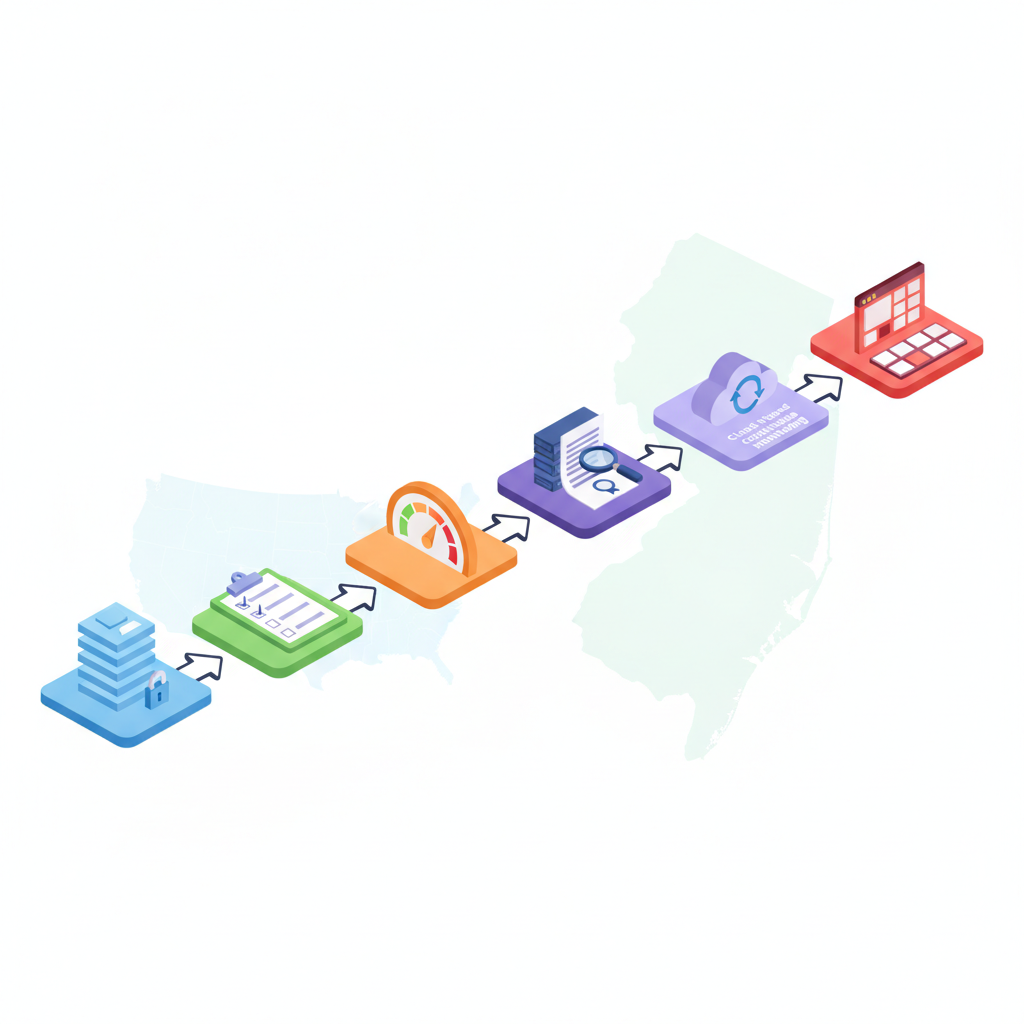
Build it by following a seven-step process: (1) inventory and classify vendors, (2) deploy a standardized third party security questionnaire and vendor assessment template, (3) score and tier vendors, (4) validate controls with technical assessments, (5) enforce contractual terms and insurance requirements, (6) enable continuous vendor monitoring nj ny and scheduled reassessments, and (7) report to leadership with escalation rules.
References
- Cybersecurity Supply Chain Risk Management Practices for Systems and Organizations (NIST)
- The NIST Cybersecurity Framework (CSF) 2.0 (NIST/CSRC)
- Industry Letter - Guidance on Managing Risks Related to Third-Party Service Providers (NYDFS)
- Which SIG Should I Use? (Shared Assessments)
- Software Acquisition Guide for Government Enterprise Consumers (CISA)