

TL;DR
- Use a weighted vendor risk score (security controls, data sensitivity, access level, business impact) to prioritize remediation and contract controls.
- 23 NYCRR 500 requires written third-party service provider security policies and risk assessments for covered entities; HIPAA imposes similar expectations for health data handling.
- Recommended auditor-friendly thresholds: >75 = low risk, 50–75 = medium, <50 = high/critical.
- Build a rubric that weights technical controls, certifications, business impact, and contractual risk; convert scores into a vendor risk matrix for triage.

If you run a regulated organization in New Jersey or New York, a repeatable vendor risk scoring template saves time and limits audit exposure. This guide explains what a vendor risk scoring template is, defines vendor and third-party for NYDFS and HIPAA contexts, and walks through a practical scoring rubric, sample vendor risk matrix, remediation prioritization, procurement integration, and implementation artifacts you can copy.
When this template is not the right fit
This scoring approach is not for one-off, low-value suppliers where the cost of assessment exceeds business value; nor for open-source dependencies without vendor support; and not for companies that lack basic asset inventory and cannot map data flows. If you don’t have an inventory of systems and data classifications, establish those first before applying a weighted vendor risk score.
Why a Vendor Risk Scoring Template Matters for Regulated NJ & NY Businesses
Vendor risk assessment scoring standardizes how you judge third parties that touch sensitive systems or data. For NJ healthcare providers bound by HIPAA and NY-headquartered financial firms subject to NYDFS rules, a consistent template proves you did the analysis, not just ad hoc judgments. A template forces you to capture: what data the vendor accesses, the vendor’s security controls, contractual protections, and the business impact if the vendor fails. For more on this, see Vendor security assessment program.
Example: a New Jersey clinic engaging a cloud backup vendor should capture whether the vendor handles ePHI, whether backups are encrypted at rest, and whether the vendor provides an SOC 2 report. You then convert those answers into numeric scores to justify monitoring frequency, contractual clauses, and remediation deadlines. That audit trail is what examiners expect during a review.
Regulatory Drivers — NYDFS, HIPAA, NIST & State-Level Expectations
Regulators define the problem. For NYDFS-covered entities, '23 NYCRR 500 requires written third-party service provider security policies and risk assessments for covered entities.' HIPAA requires covered entities and business associates to safeguard ePHI and exercise reasonable due diligence with vendors who handle that data. NIST's supply chain guidance provides practical control mappings that many firms follow when assessing vendors (see NIST guidance linked below).
Practical implication: if a vendor stores customer data for a New York financial firm, your vendor risk assessment scoring must capture contractual incident notification timelines, encryption status, and the vendor’s right to access production environments. Use the regulator language in your policy and retain artifacts (questionnaires, evidence, scoring sheets) to support compliance examinations.
Regulatory auditors expect written vendor assessments, not oral assertions or undated spreadsheets.
Core Scoring Categories (Security, Compliance, Business Impact, Access)
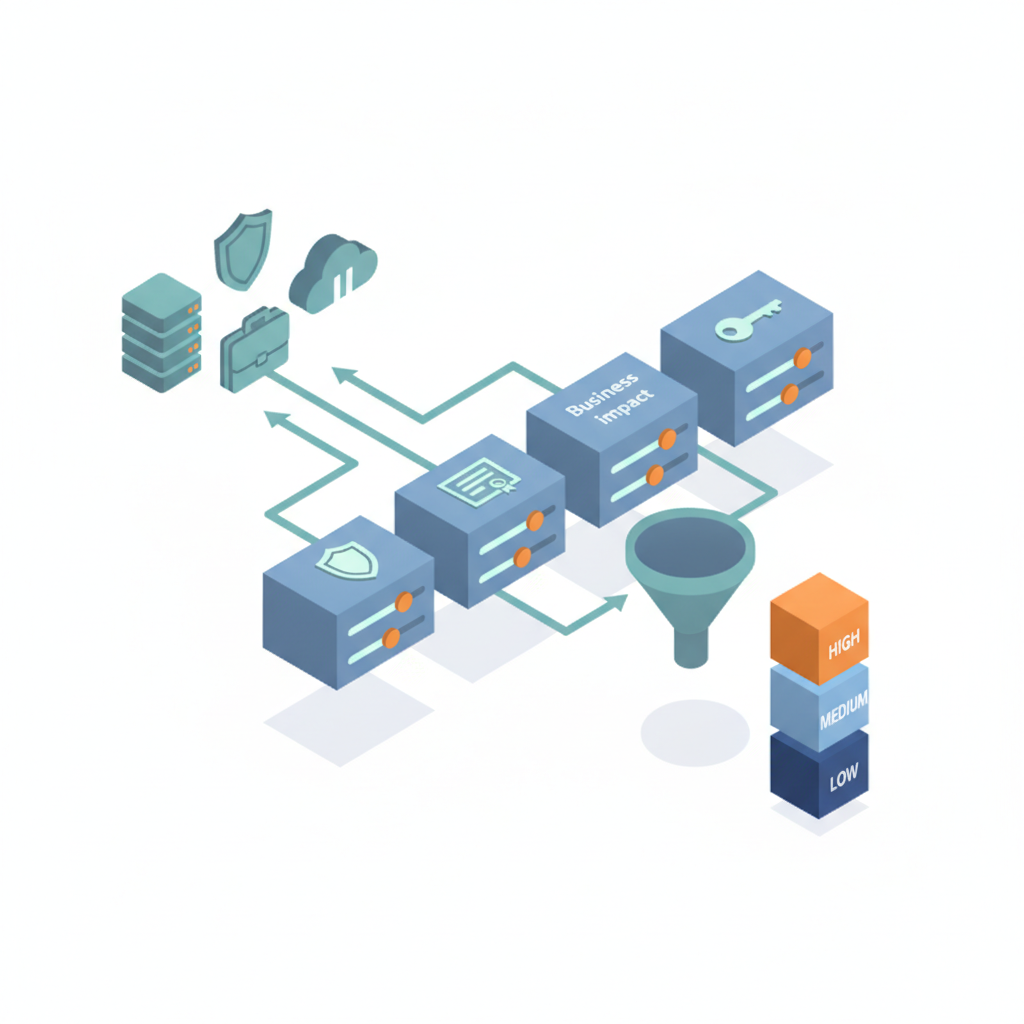
A reliable vendor risk matrix uses four core categories: security controls, compliance posture, business impact, and access level. Score each category 0–25 (total 0–100) or use weighted percentages. Security controls evaluate encryption, endpoint detection, and patching; compliance checks for SOC 2, HIPAA, or ISO attestations; business impact measures how disruptive a vendor failure is; access measures privilege level and network connectivity.
Concrete worked example: score a payroll vendor like this — security controls 18/25 (uses MFA, partial encryption), compliance 20/25 (SOC 2 Type II), business impact 22/25 (payroll outages halt operations), access 20/25 (SFTP access to HR database) => total 80/100 = low risk per recommended thresholds.
Technical Controls (EDR, encryption, MFA)
Technical controls are the first filter. Verify whether the vendor deploys endpoint detection and response (EDR) on systems that process your data, whether data is encrypted in transit and at rest, and whether administrative access enforces multi-factor authentication (MFA). For cloud vendors, confirm logging retention and access controls (least privilege).
Example checklist for technical controls (yes = full points, partial = half points):
- EDR on vendor endpoints
- Encryption at rest (AES-256 or equivalent)
- Encryption in transit (TLS 1.2+)
- MFA for admin accounts
- Centralized logging with 90-day retention
Compliance & Certifications (SOC 2, ISO, HIPAA attestations)
Certifications serve as external validation but don’t replace controls verification. A current SOC 2 Type II report covering relevant trust service criteria reduces residual risk; an ISO 27001 certificate shows an information security management system exists. For HIPAA-relevant vendors, require a Business Associate Agreement and attestation that safeguards are in place. For more on this, see Vendor risk management nj ny.
Scoring rule: grant full points for recent, in-scope attestations with evidence; half points for management assertions without audits; zero for none. Track certificate scope and effective dates in your template so you can flag expirations.
Contractual & Legal Risk
Contracts are where risk transfers and response obligations live. Score vendors for breach notification timeframes (e.g., 72 hours), insurance limits, indemnities, data residency clauses, and right-to-audit provisions. A vendor that refuses audit rights or limits notification windows increases contractual risk and should score lower even if technical controls look strong.
Example contractual decision rule: if notification <=72 hours, award points; if vendor refuses audit or restricts data return, deduct points and escalate to legal.
Contractual controls convert technical gaps into enforceable obligations when remediation isn’t immediate.
Step-by-Step: Build a Practical Scoring Rubric (with sample weights)
Follow these steps to build a rubric you can apply across vendors:
- Inventory vendors and classify the data they access (sensitivity levels: public, internal, confidential, regulated).
- Choose category weights—for regulated firms a typical split is Security 35%, Compliance 25%, Business impact 25%, Access 15%.
- Create scoring rules within each category (e.g., encryption = 10 points, MFA = 8 points).
- Normalize scores to 0–100 and apply thresholds: >75 = low risk, 50–75 = medium, <50 = high/critical.
- Document evidence expected for each score (reports, screenshots, contracts).
Worked example: vendor scores: security 70/100 weighted to 24.5, compliance 80 weighted to 20, business impact 60 weighted to 15, access 90 weighted to 13.5 => total 73 = medium risk. That numeric result triggers medium-level controls (quarterly reviews, updated SLA).
Sample Vendor Risk Matrix & Downloadable Template (with thresholds: low/medium/high/critical)
Turn scores into a matrix for triage. Below is a simple decision matrix mapping score ranges to actions.
| Score | Risk level | Required action |
|---|---|---|
| >75 | Low | Annual review |
| 50–75 | Medium | Quarterly monitoring, remediation plan |
| 25–49 | High | Immediate remediation, contract controls, elevated monitoring |
| <25 | Critical | Stop onboarding, require replacement or significant contract changes |
Downloadable template note: prepare a CSV with columns: vendor_name, data_classification, security_score, compliance_score, business_impact_score, access_score, total_score, risk_level, next_review_date. See Appendix for a sample CSV snippet.
How to Prioritize Remediation and Resource Allocation Based on Scores
Prioritize remediation by combining risk score with exploitability and exposure. High-impact vendors with remote administrative access and low controls are top priority. Use this rule: sort vendors by (100 - total_score) * business_impact to rank fixes when resources are limited.
Operational example: if a vendor scores 40 (high) and has direct access to production databases, assign a remediation owner within 7 days, require compensating controls (network segmentation, temporary restricted accounts), and set a target re-assessment date within 30 days.
Integrating Scores into Procurement, Contracting & Continuous Monitoring
Embed scoring into procurement workflows: require a baseline score before signing and include minimum controls in RFPs. For contracting, map required controls to SLA clauses and incident notification timelines. For continuous monitoring, schedule evidence refreshes—SOC reports annually, technical evidence (EDR, MFA screenshots) every 90 days for medium/high vendors.
Practical tip: incorporate the vendor risk matrix into procurement checklists so a procurement approver cannot finalize a contract without the vendor scoring and assigned remediation actions.
Example Use Case: NJ Healthcare SME & NY Financial Services Firm
Use case A — NJ healthcare SME: A small clinic engages a cloud backup vendor that stores ePHI. The team classifies data as regulated, requires a Business Associate Agreement, demands encryption at rest and SOC 2 evidence, and scores the vendor 68 => medium. Actions: require SOC 2 report, add 48-hour breach notification clause, and re-score in 60 days.
Use case B — NY financial services firm: A mid-sized New York trading firm integrates with a market data provider with direct API access. The provider lacks SOC 2 but has strong technical controls; score = 58. Actions: conduct a focused remote penetration test, require contractual right to audit, and increase monitoring frequency to monthly logs review.
Implementation Checklist & Timeline (30/60/90 day plan)
30-day plan
- Inventory all vendors and map data classifications.
- Deploy scoring rubric and score top 20% highest exposure vendors.
60-day plan
- Complete scoring for remaining vendors, escalate high/critical vendors, and issue remediation tickets.
- Embed scoring requirements into procurement templates.
90-day plan
- Validate remediation for high-risk vendors, schedule evidence refresh cycles, and present results to risk committee.
Appendix: CSV Template, Example Calculations, Glossary
Sample CSV rows (first line = header):
vendor_name,data_classification,security_score,compliance_score,business_impact_score,access_score,total_score,risk_level,next_review_date
AcmeBackup,regulated,18,20,22,20,80,Low,2026-05-01
MarketDataCo,internal,15,10,20,18,63,Medium,2026-03-15
Glossary:
- Vendor: an entity providing goods or services under contract.
- Third-party: any external party that processes, stores, or transmits your data or connects to your systems.
- Weighted vendor risk score: a numeric score combining security controls, data sensitivity, access level, and business impact.
FAQ
What is vendor risk scoring template?
A vendor risk scoring template is a structured spreadsheet or form that converts vendor answers and evidence into numeric scores to evaluate third-party risk and document remediation decisions for regulatory review.
How does vendor risk scoring template work?
The template assigns category weights (for example security, compliance, business impact, access), scores each category based on evidence, normalizes totals to 0–100, and maps totals to thresholds that trigger monitoring and contractual actions.
References
- Cybersecurity Supply Chain Risk Management Practices for Systems and Organizations (NIST)
- Industry Letter: Guidance on Managing Risks Related to Third-Party Service Providers (NYDFS, October 21, 2025)
- New Jersey Third Party Information Security Questionnaire (NJ government)
For hands-on help translating your vendor scores into controls and monitoring, review our services or our services; to discuss a specific assessment, contact us, see contact us, or contact us.