

TL;DR
- Question: What immediate steps should a regulated NJ or NY company take to preserve ransomware evidence?
- Answer: Stop further change, capture volatile data (memory, running processes), preserve logs and disk images, document chain of custody, and involve counsel or a forensic team within 24–72 hours.

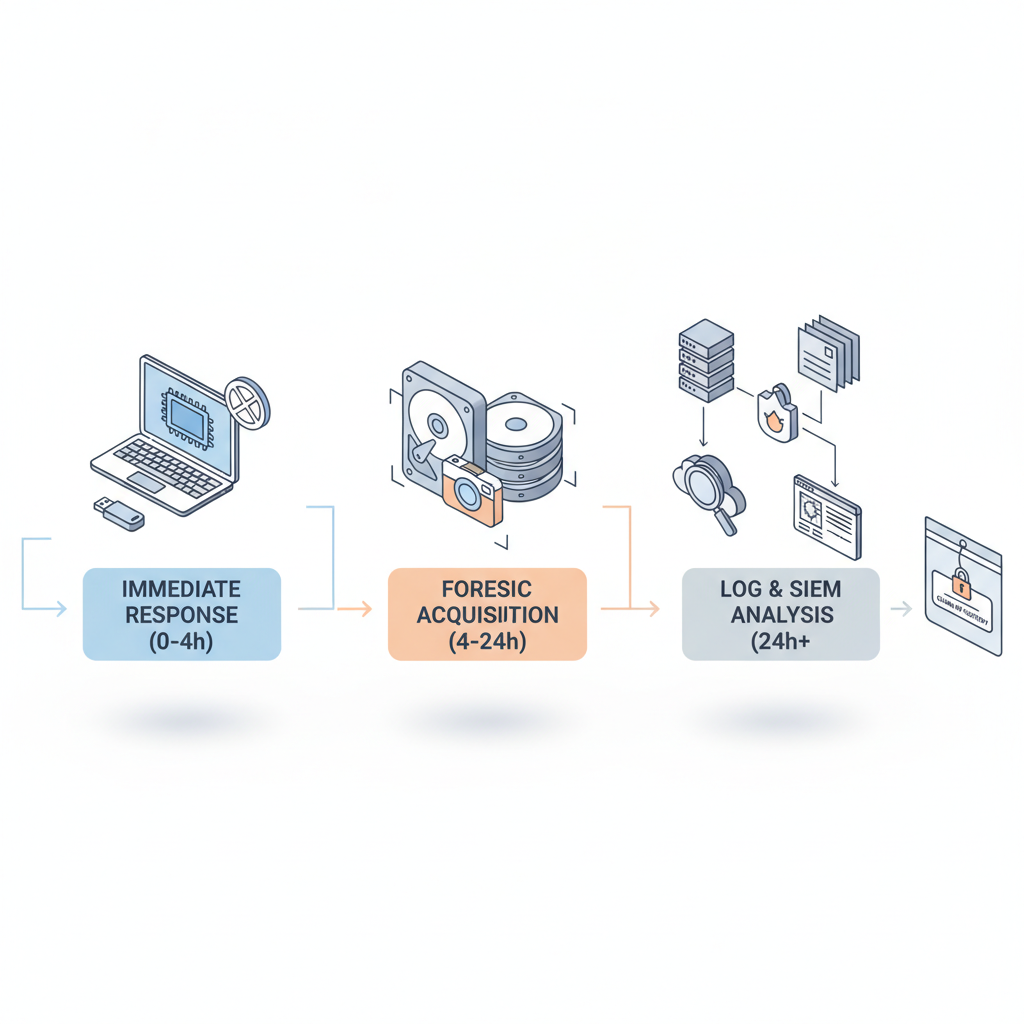
Why evidence preservation matters for regulated NJ & NY organizations
Preserving evidence after a ransomware event protects legal options, insurance claims, and regulatory compliance. For NY-regulated institutions, evidence practices should align with NYDFS expectations (23 NYCRR 500); both New Jersey and New York have breach-notification requirements that affect timing and disclosures. Preserving forensic evidence within the first 24–72 hours materially improves insurer and law enforcement outcomes.
Example: a financial firm subject to 23 NYCRR 500 that captures a memory dump and EDR telemetry within 24 hours can provide concrete timelines to the insurer, reducing disputes over whether backups or logs existed before the attack. For healthcare organizations, preserving access logs and email headers helps meet HIPAA investigation needs (see HHS guidance).
Quotable definition: "Evidence preservation is capturing system state, logs, and artifacts intact so they can support incident response, legal review, and insurance claims." For more on this, see Ransomware incident response nj ny.
Short comparison of immediate priorities for regulated sectors:
| Sector | NJ priority (first 24h) | NY priority (first 24h) |
|---|---|---|
| Financial | EDR telemetry, transaction logs, SIEM alerts | EDR telemetry, immutable backups, access logs (NYDFS focus) |
| Healthcare | PHI access logs, email headers, system images | PHI access logs, EDR, backup verification |
| Professional services | Client file integrity, VPN logs, privileged account trails | Client file integrity, SIEM, privileged session logs |
Quick-start checklist (first 0–24 hours) — what to capture immediately
Action within the first 24 hours determines what you can prove later. Use this checklist immediately and follow up with formal forensic collection.
- Disconnect affected hosts from the network but do not power them down or wipe them.
- Take photos of ransom notes, screen messages, and affected displays (include timestamps and device IDs).
- Capture volatile memory (RAM) and running process lists from infected endpoints.
- Export active network connections (netstat), open ports, and current user sessions.
- Preserve logs: forward copies of SIEM alerts, EDR detections, firewall and VPN logs, and mail headers to a secure archive.
- Record who took each action; start a single incident log that all responders append to with timestamps.
Concrete checklist (copyable): 1) Isolate device; 2) Photograph screens; 3) Dump memory; 4) Export running processes; 5) Export network state; 6) Archive logs to read-only storage; 7) Notify counsel/insurer. Use this for evidence collection after ransomware events. For more on this, see Ransomware preparedness nj ny.
Preserve volatile state first; disks can be imaged later without losing live forensic indicators.
Isolate but preserve: preserving volatile memory and system states
If attackers are still active, isolation reduces spread while preserving volatile evidence avoids destroying artifacts. Do not reboot or shut down suspected hosts: rebooting clears RAM and may alter timestamps. Capture a memory dump (WinPMEM, FTK Imager, or vendor EDR memory capture) and a live process list.
Example procedure: with an approved forensic toolkit, an engineer captures a 16GB RAM dump to an external write-blocked device, documents the host name, user session, and exact clock time, and records SHA256 hashes of captured files. That hash creates immutable evidence for later ransomware forensics nj reviews.
Network and endpoint logs to secure first
Network artifacts often contain the earliest indicators of compromise. Prioritize: EDR telemetry, SIEM correlated alerts, firewall logs, VPN login histories, DNS query logs, and proxy/web gateway logs. Copy logs to a secure, read-only repository; do not edit source logs.
Practical example: if a rogue RDP session is the likely vector, extract the VPN and RDP logs and preserve corresponding Windows Security Event logs (4624/4625). For cloud-hosted services, collect admin activity logs and API call histories. These items drive evidence collection after ransomware scenarios and support ransomware forensics nj investigations.
Detailed forensic data collection (24–72 hours)
Once you have stabilized the environment, perform in-depth collection to preserve chainable evidence. Formal forensic work usually occurs between 24 and 72 hours: disk imaging, whole-system snapshots, EDR artifact export, and coordinated log pulls from multiple sources.
Tasks during this window: create forensic disk images (see next section), collect EDR alerts with device timelines, export SIEM correlated incidents with raw event payloads, and gather cloud provider audit logs. Confirm write-blocking and hashing of every image and copy. For regulated entities, document who authorized each collection and the legal basis—this improves outcomes in ransomware incident evidence nj ny matters.
Disk images, memory dumps, and EDR artifacts
Create bit-for-bit disk images using forensic tools (e.g., FTK Imager, dd with hashing) and preserve EDR artifacts such as quarantine files, dropped payloads, registry changes, and timeline data. Always record hash values (MD5/SHA1/SHA256) and capture the imaging tool version and operator name.
Example thresholds and artifacts: image affected volumes at 'forensic read-only' mode, generate SHA256 hashes for each image, and retain EDR timelines covering at least 30 days before the incident. These artifacts are standard inputs to ransomware forensics nj teams and insurers.
Collecting logs: SIEM, firewall, VPN, email, and cloud activity
Collect the full range of logs simultaneously: SIEM raw events, firewall flow records, VPN auth logs, email gateway headers and quarantine archives, and cloud provider audit logs (IAM, S3, GCP/Azure activity). Export logs in native format with metadata preserved.
Concrete rule: when possible, export at least 30 days of pre-incident logs and keep an additional 90 days archived for regulator or insurer requests. Evidence collection after ransomware frequently depends on correlating events across these sources to build an attacker timeline.
Legal chain of custody & documentation best practices
Documenting chain of custody is non-negotiable. Each physical or logical transfer of evidence must be logged: who handled it, why, when, and how it was transferred. Use signed forms or an electronic chain-of-custody system with timestamped entries.
Sample chain of custody fields: item ID, description, source host, date/time collected, collector name and signature, storage location, hash values, and transfer records. This documentation supports insurer claims and law enforcement. For regulated NY entities, a clear chain of custody can also demonstrate compliance steps taken after detection.
Every image must include a SHA256 hash recorded at capture and re-verified after transfer.
How to timestamp, document, and transfer evidence to counsel or forensic teams
Timestamp with synchronized NTP servers and record the NTP server used. Use immutable storage (WORM or write-blocked media) for copies sent to external teams. When transferring, include a signed transfer form, list of included artifacts with hashes, and a copy of the incident log summarizing actions taken.
Practical transfer checklist: 1) verify hashes; 2) create transfer manifest; 3) sign and photograph transfer; 4) send via encrypted channel or secure courier; 5) log receipt confirmation. These steps ensure chain of custody ransomware processes remain defensible in legal and insurance reviews.
Working with law enforcement and cyber insurers — what evidence they need
Law enforcement (FBI) and insurers look for the same core items: timelines, forensic images, EDR timelines, and preserved logs proving scope and vector. Provide a clear incident timeline, copies of ransom notes, and preserved images with hashes. Insurers will also want proof of backups and restoration attempts.
When contacting authorities, provide a concise package: incident summary, evidence manifest, preserved logs, and contact details for your forensic lead. Many insurers require prompt notification and proof of forensic steps taken—documenting evidence collection after ransomware reduces claims friction.
Practical templates and downloadable checklist (for compliance and insurance)
Below are two reusable artifacts you can copy: a one-page preservation checklist and an incident evidence manifest table. Use them as a starting point for internal playbooks and to share with third-party responders.
| Preservation checklist | Done |
|---|---|
| Isolate affected hosts (network disconnect) | [] |
| Capture memory dump and running processes | [] |
| Photograph ransom notes/screens | [] |
| Export SIEM/EDR/firewall/VPN logs | [] |
| Create forensic disk images and record hashes | [] |
| Document chain of custody and transfers | [] |
Incident evidence manifest (copy into a secure doc): item ID, source, timestamp, collector, storage, SHA256, notes. For insured/regulatory claims, attach this manifest to your insurer submission.
Post-incident review: preserving lessons learned and evidence retention policies
After containment and recovery, run a post-incident review and preserve the investigation record for a defined retention period (e.g., 1–3 years depending on regulation and insurer requirements). Create remediation tasks, update playbooks, and sanitize retained forensic images when legal holds expire.
Example: after a ransomware incident, an organization updated its backup retention policy to maintain immutable backups for 90 days and extended SIEM log retention to 365 days to improve future evidence collection after ransomware incidents.
Conclusion and one-page printable preservation checklist
Preserving evidence fast and methodically protects legal, regulatory, and insurance outcomes. Remember: "Preserving forensic evidence within the first 24–72 hours materially improves insurer and law enforcement outcomes." Use the checklist above, follow chain of custody ransomware procedures, and involve qualified ransomware forensics nj professionals when needed.
For regulated NJ and NY companies that want expert help implementing these procedures or conducting a post-incident forensic review, see our services or schedule a demo at our services. For direct contact, visit contact us, contact us, or contact us.
FAQ
What is ransomware evidence preservation checklist for regulated NJ & NY companies (step-by-step)?
It is a practical sequence of actions—immediate isolation, volatile memory capture, log preservation, forensic imaging, and documented chain of custody—designed to secure evidence for legal, regulatory, and insurance review in NJ and NY.
How does ransomware evidence preservation checklist for regulated NJ & NY companies (step-by-step) work?
The checklist works by prioritizing volatile evidence first, preserving logs and images in read-only storage, recording each transfer with hashes and signatures, and delivering an evidence package to counsel, forensic teams, insurers, or law enforcement.
References
- #StopRansomware Guide (CISA)
- Ransomware guidance (FBI)
- Cybersecurity Resource Center (NYDFS)
- Ransomware and HIPAA fact sheet (HHS)