
Why a Communication Plan Matters During a Ransomware Incident
What should a regulated company in New Jersey or New York do first when hit by ransomware? Immediately confirm containment, notify internal incident responders, and prepare regulated notices where required; then follow a scripted communication path that preserves evidence and meets regulatory timelines.
A clear ransomware communication plan nj ny reduces confusion, avoids inconsistent public statements, and preserves admissible records for insurance and regulators. For entities covered by 23 NYCRR 500, a "regulated entity" means any organization subject to NYDFS cybersecurity rules (covered entities typically include banks, insurers, and other financial services firms governed by NYDFS). By defining roles, channels, and thresholds in writing, your team can act on a single, tested playbook instead of improvising, which is a key aspect of ransomware preparedness and recovery.
Notify regulators, insurer, and law enforcement within your first 24 hours where mandated; document every notification and preserve communications for claim and compliance review.

Quotable: "A single, rehearsed message prevents conflicting statements across channels."
Quick-start checklist — first 30 minutes: who to notify internally
This checklist gives the initial actions and the people to notify in the first 30 minutes of detecting ransomware. Use it as a checklist you can email or read aloud during the first call.
- Contain and isolate affected systems (IT leads) — disconnect infected endpoints and disable remote access where safe.
- Activate the incident response team and incident commander (communications lead + IT + legal).
- Collect basic facts: time detected, affected systems, suspected data types, observed ransom demand.
- Preserve logs and evidence (forensic team) — do not reboot or wipe affected hosts before the forensic snapshot.
- Notify cyber insurer and document policy number and claim contact.
- Prepare an internal employee notification and a holding statement for customers.
Concrete thresholds: if business-critical systems are encrypted or customer data may be exposed, escalate to senior leadership immediately and prepare regulatory notice drafts. For many organizations, treat any confirmed data exfiltration as requiring regulator review and counsel input within 24 hours.
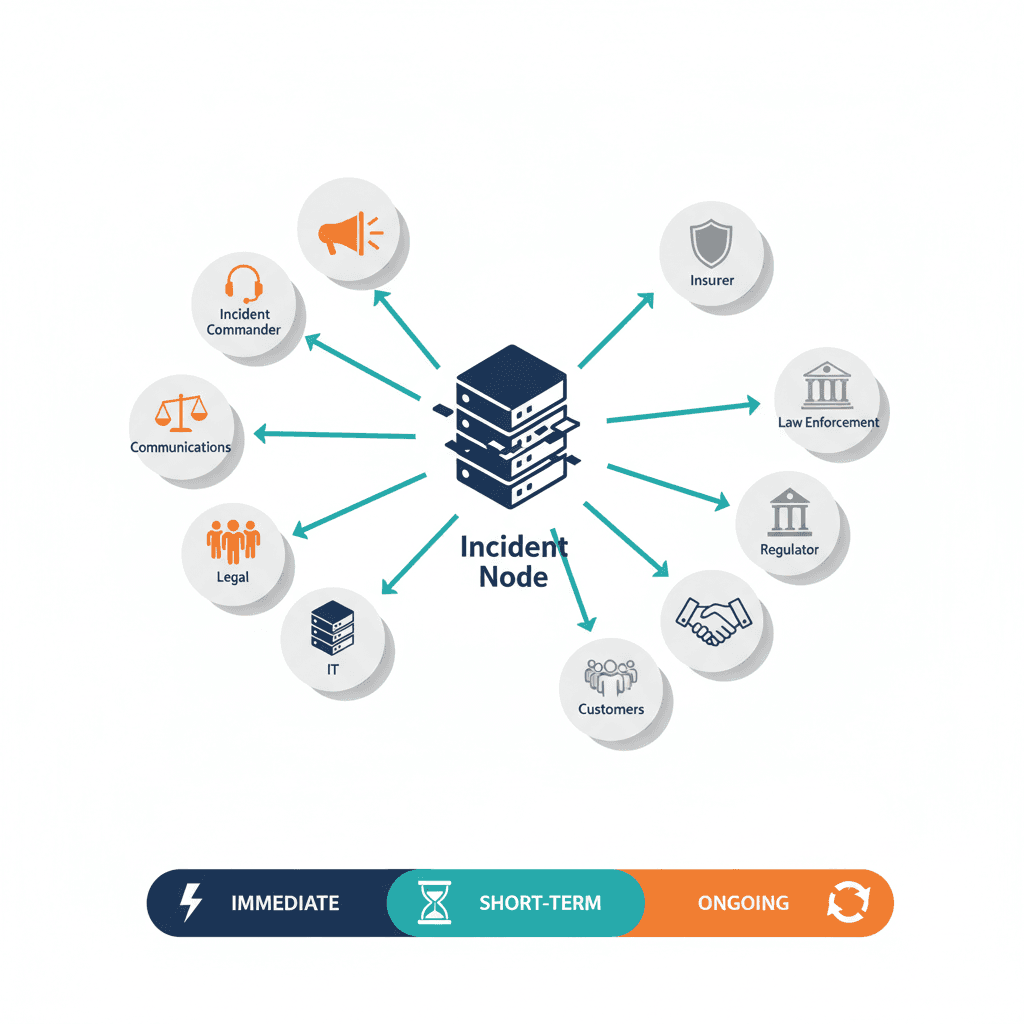
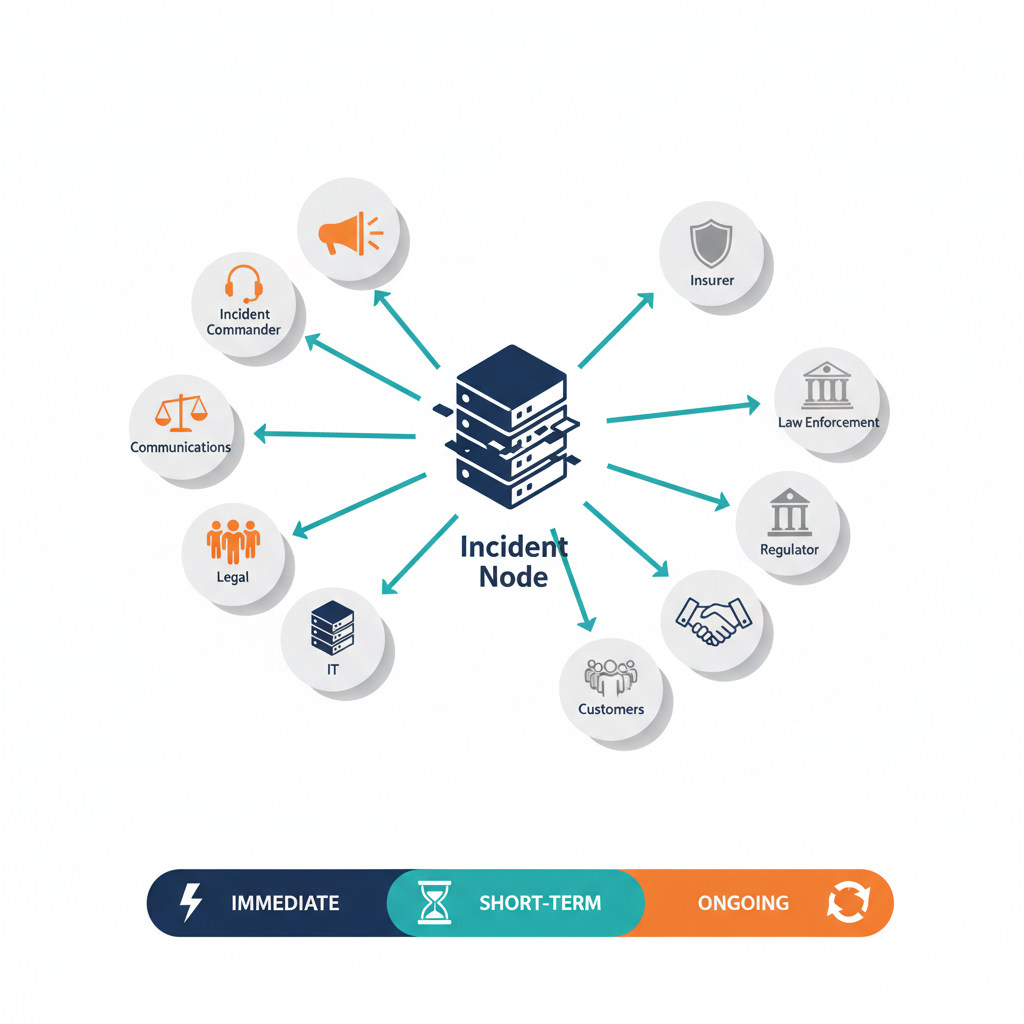
Roles: incident commander, communications lead, legal, IT, HR, executive sponsor
Assigning roles ahead of time avoids confusion. The incident commander runs the response; the communications lead writes messages and controls outbound statements; legal advises on reporting obligations, and IT secures and restores systems. HR manages employee messaging and policies; the executive sponsor approves major decisions and informs board members. For more on this, see Ransomware incident response nj ny.
- Incident commander: Central decision authority and escalation owner.
- Communications lead: Crafts employee, customer, press statements; coordinates with legal and insurer.
- Legal counsel: Determines statutory notification triggers and privilege strategy.
- IT/forensics: Collects evidence, performs containment and root-cause analysis.
- HR: Issues staff instructions and enforces remote-work policies if needed.
- Executive sponsor: Board-level liaison and final approver for sensitive disclosures.
Actionable takeaway: document these roles with names, phone numbers, and backups in a one-page contact sheet stored off-network.
External notifications: customers, partners, regulators, law enforcement, cyber insurer
"External notifications must be accurate, measured, and timely. Customers and partners need clear operational instructions; regulators may require specific data elements; law enforcement wants evidence; and insurers need a claim trigger and preserved logs. Start by collecting the minimum facts regulators ask for: incident date/time, scope, systems affected, and contact information for the incident lead."
Preserve every notification record — saved emails and recorded calls are often required by insurers and regulators.
Example notification cadence: notify cyber insurer and internal counsel within the first hour, file a law enforcement report (FBI IC3) within 24 hours as guidance suggests for criminal investigation, and prepare customer notifications based on whether data was exposed or operations impacted.
Use the phrase how to notify stakeholders after ransomware in your internal playbook to standardize timing and channels. If a regulator requires prompt reporting, follow their format and preserve copies of the submission.
State-specific guidance: NY (NYDFS reporting triggers) and NJ (state cyber resources and notification best practices)
New York: NYDFS covered entities must follow 23 NYCRR 500 and report material cybersecurity events to NYDFS; regulatory notification ransomware nydfs is required when an incident materially affects the entity's operations or customer information. Check NYDFS guidance for the specific triggers and required fields—counsel should confirm timelines for submission.
New Jersey: consult NJCCIC and the New Jersey State Police Cyber Crimes Unit for state-level reporting and alerts. For ransomware notification requirements nj entities should refer to state breach notification laws when personal data is involved and coordinate with counsel on statutory timing.
Quotable: "A ‘regulated entity’ under 23 NYCRR 500 is any organization subject to NYDFS cybersecurity regulations; check coverage with your compliance team."
Message templates and talking points
Prepare short, segmented templates and talking points so spokespeople deliver a consistent message. Templates reduce decision time and help maintain legal privilege when coordinated with counsel.
Structure each template with: 1) brief issue statement, 2) what actions are taken, 3) what customers should do, 4) what you will communicate next and when. Below are three reusable templates: employee, customer, and press.
Internal employee notification template
Use a direct, factual tone for employees and give action steps. Keep the first message short and follow up with details as they become available.
Template (example): "We detected a cybersecurity incident at [time/date]. IT has isolated affected systems. Do not use VPN or remote access. Change passwords for privileged accounts and follow the attached checklist. Leadership will update at [time]." Include contact points and whether payroll, HR systems, or email are affected.
Customer-facing notification template (segmented by data exposure vs operational impact)
Segment messages by whether customer data was exposed or operations are impacted. If data exposure is suspected, provide description of data types, mitigation steps, and credit-monitoring offers where appropriate. If operations are impacted, explain expected service interruptions and workarounds.
Example phrasing when data exposed: "We identified unauthorized access to [data types]. We have engaged forensic specialists, notified law enforcement, and will offer identity protection if personal information was impacted." For operational impact: "We are restoring services from backups; expected restoration window: [range]."
Press/media holding statement
Keep the press statement short and refrain from speculation. A holding statement buys time while you collect facts.
Holding statement (short): "We are investigating a cybersecurity incident affecting some systems. We have isolated the incident, engaged external forensic experts, and notified law enforcement. We will provide updates as we confirm facts. For media inquiries contact [communications lead]."
Include a ransomware press statement template in your playbook and update it regularly so statements are reviewable by counsel before release.
Coordination workflow with counsel, insurer, and forensic team
Coordinate three-way: counsel for legal strategy and privilege, insurer for claims and approved vendors, and forensic team for evidence collection. Establish a single intake channel (secure portal or encrypted email) so all artifacts are centralized and timestamped.
- Step 1: Notify insurer and counsel immediately; confirm coverage and claim contacts.
- Step 2: Authorize forensic vendor with counsel’s direction to preserve privilege and evidence.
- Step 3: Share forensic scope and high-level findings with insurer to unlock remediation funds where policy permits.
Decision rule: do not pay a ransom without insurer and counsel approval; document reasons and approvals if exceptions occur.
Communication channels, cadence, and audit trail (email, portal, recorded calls)
Use designated channels and a cadence to avoid message drift. Typical cadence: incident commander updates internal team every 2–4 hours during the first 48 hours, daily updates thereafter, and customer updates based on impact milestones (24 hours, 72 hours, when resolved).
Maintain an audit trail: save sent emails, upload call recordings to a secure evidence folder, and timestamp all portal posts. For regulated entities, regulators and insurers will expect preserved copies of these communications during claims and compliance reviews.
Post-incident reporting and record retention for compliance and insurance
After containment and recovery, produce a post-incident report that includes timeline, root cause, scope of systems and data, remediation steps, and a log of all notifications. Retain these records for the period your insurer and regulators require; many policies expect at least seven years for claims documentation though you should confirm with counsel and insurer.
Include operational metrics in the report: time-to-detect, time-to-contain, time-to-restore, and number of affected users. These concrete KPIs support post-breach improvements and insurers’ subrogation reviews.
Appendix: sample notification timelines, escalation matrix, and editable templates
Below is a copy-ready notification timeline and a brief escalation matrix you can paste into your playbook.
| When | Who to notify | Purpose |
|---|---|---|
| 0–1 hour | Incident commander, IT lead, communications lead, insurer | Containment and claim intake |
| 1–6 hours | Forensic vendor, legal, executive sponsor | Evidence preservation and legal strategy |
| 6–24 hours | Law enforcement, regulators (if mandated), customers | Regulatory reporting and customer guidance |
| 24+ hours | Public/press, partners | Public updates and remediation status |
Escalation matrix (example): Tier 1 = IT lead; Tier 2 = Incident commander; Tier 3 = Executive sponsor and board notification. Keep phone trees current and store off-network.
FAQ
What is ransomware communication plan for regulated nj & ny companies? A ransomware communication plan nj ny is a documented playbook that defines roles, channels, timelines, and templates for notifying employees, customers, insurers, law enforcement, and regulators (including NYDFS and state authorities) when ransomware affects operations or data.
How does ransomware communication plan for regulated nj & ny companies work? The plan operates by pre-assigning responsibilities, standardizing messages, and mapping regulatory triggers so your team can contain the incident, preserve evidence, notify required parties, and manage public statements in a controlled, auditable way.
Final checklist: run a tabletop exercise annually, store contact sheets off-network, and keep template wording reviewed by counsel. For managed technical support and 24/7 monitoring, consider engaging professional services to reduce detection and containment time.
Learn more about available support through our services or request a demo at our services. To discuss incident readiness, contact us or visit the company homepage to find alternative contact options.