
Introduction — why EDR + SIEM + threat hunting matters for regulated organizations
Question: How do you integrate EDR with SIEM in NJ to meet regulatory and operational security needs?
Answer: Integrating EDR with SIEM creates a single correlation layer that turns endpoint telemetry into actionable alerts and supports continuous threat hunting for NJ and NY regulated businesses. Proper integration improves detection speed, preserves audit trails for HIPAA and NYDFS review, and makes investigations reproducible. For more on this, see Edr vs mdr vs xdr vs traditional.
SIEM (security information and event management) centralizes logs and correlates events; telemetry is raw endpoint and network data such as process events, file hashes, and network connections; threat hunting is a proactive search for adversary activity. Quotable playbook intro: 'Step 1: Inventory endpoints; Step 2: Forward prioritized telemetry; Step 3: Tune alerts; Step 4: Run regular threat-hunting cycles.'
For NJ/NY organizations regulated by HIPAA or NYDFS, integrating EDR with SIEM is both an operational improvement and an audit control. For example, forwarding rich process trees to a SIEM enables investigators to reconstruct a breach timeline faster than relying on alerts alone. This introduction frames the practical steps below and explains why each matters to regulated teams.
When NOT to integrate EDR and SIEM: Do not prioritize full telemetry forwarding if your team cannot store or review it—over-collecting without capacity creates blind spots; do not skip endpoint inventory before deployment; and avoid one-off forwarding that lacks retention planning for audits.
Collect fewer high-value events reliably, rather than every event inconsistently.

Architecture overview — telemetry flows, log collection, and retention considerations
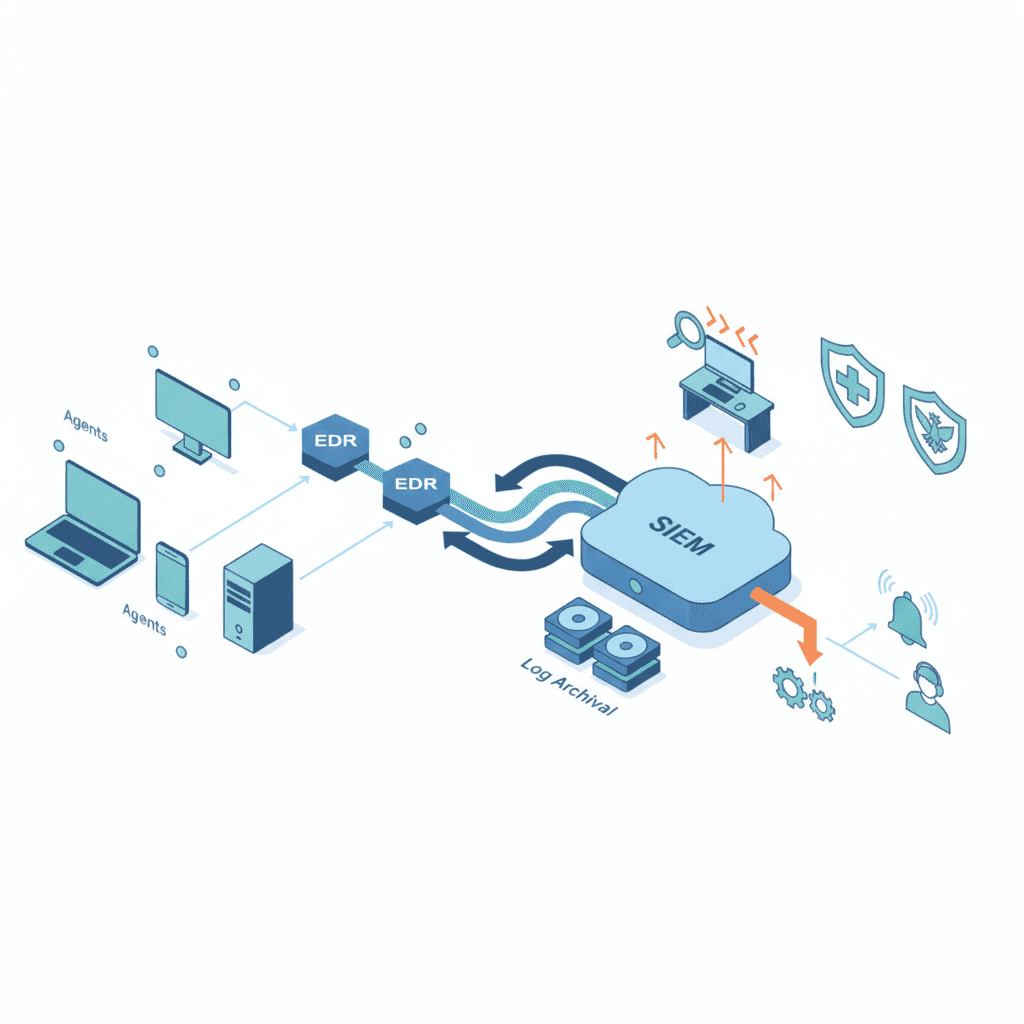
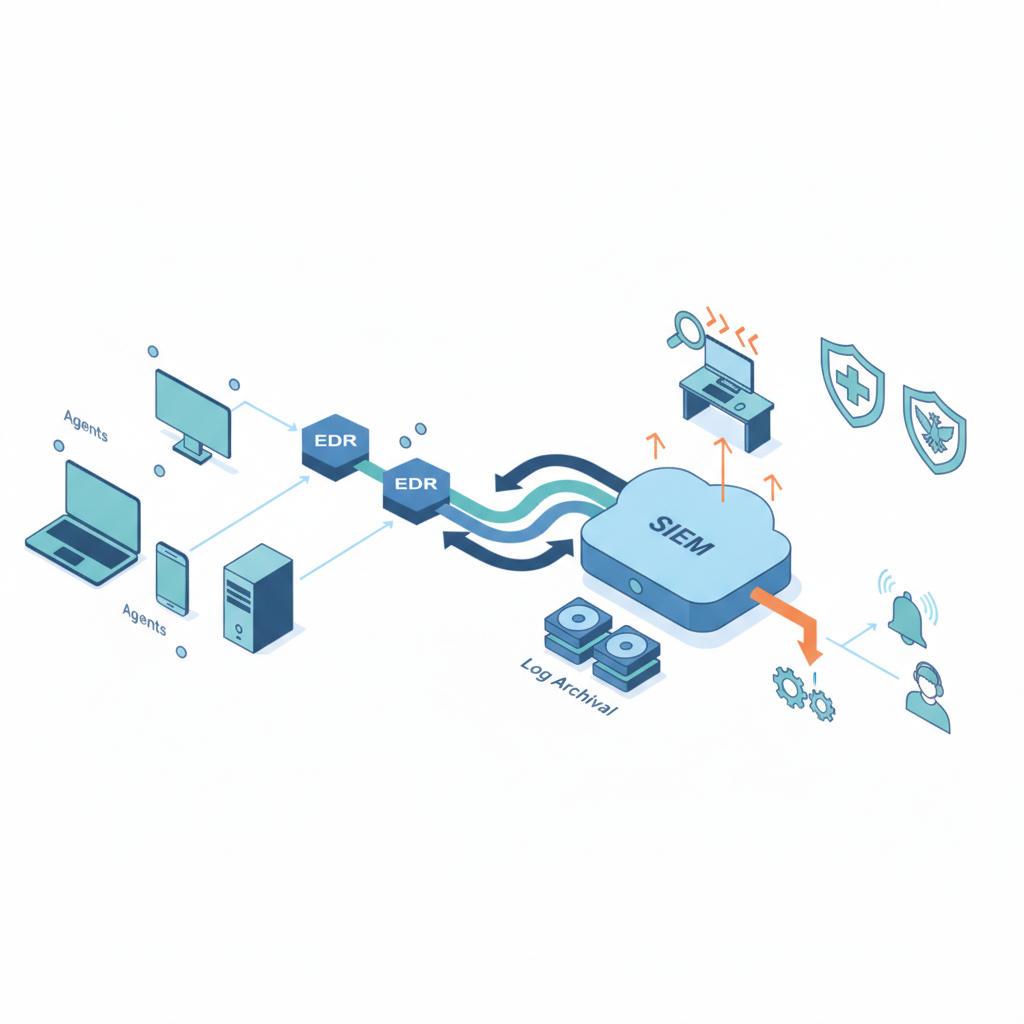
Why this matters: a clear architecture prevents data gaps during investigations and ensures you meet retention rules. Typical architecture routes EDR agents on endpoints to forward alerts and telemetry to a broker (syslog, cloud collector, or native connector), which then forwards normalized events to the SIEM cluster for correlation and long‑term storage.
Concrete flow: EDR agent → secure collector (TLS) → parsing/enrichment layer → SIEM index. Include both high-fidelity alerts and raw telemetry (sampled or prioritized) so hunters can pivot from alerts to process trees. For endpoint telemetry forwarding, prioritize events that show execution, code injection, and persistence mechanisms. Use a message queue or buffer to handle spikes; target P95 forwarding latency under typical network load for alerting (typical-case target: under 5 seconds for alert delivery when feasible).
Retention: map retention tiers to regulatory needs—hot indexes for 90 days for active investigations, archive indexes for 1–7 years depending on HIPAA/NYDFS expectations. Verify your SIEM storage and compression to budget costs. For NJ/NY regulated firms, instruct editors to cite official NYDFS and HIPAA guidance when defining legal retention windows for logs.
Types of data to forward from EDR to SIEM (alerts, telemetry, process trees)
What to send: alerts, raw and enriched telemetry, process trees, network connections, file events, and authentication events. Alerts provide triage triggers; process trees and full telemetry let hunters validate scope and root cause. For example, forward: (1) descriptor alerts (malware, execution anomalies), (2) process creation with parent/child PIDs and command-line, (3) file creation/modification with hashes, and (4) DNS and outbound connection logs.
Practical rule: always forward full alerts plus a prioritized subset of telemetry (process creation, module loads, network sockets) rather than all I/O. That keeps event volumes manageable while preserving investigative value. In practice, implement filters in the EDR connector so only events matching risk criteria or coming from critical assets are forwarded at full fidelity.
Frequency and retention sizing guidance for compliance
Plan frequency by use case: alerts and critical telemetry should be near-real-time; bulk telemetry can be batched. For alerting, aim for sub-10-second ingestion into the SIEM; for bulk telemetry, hourly or daily batches are acceptable if they don’t block investigations. Estimate sizing using endpoint count: a 500-endpoint shop forwarding prioritized telemetry will typically generate tens of GB per day; scale accordingly.
Retention sizing: map categories to retention policies—security alerts (retain 1–3 years for NYDFS evidence), authentication and access logs (retain per HIPAA guidance—confirm with official guidance), and sampled telemetry (retain 90–365 days). Example decision rule: retain alerts and authentication logs for a minimum of one year, extended to three if required by your regulator or risk profile. Always validate with legal and cite NYDFS/HIPAA guidance for final retention thresholds.
Implementation steps — inventory, deployment, onboarding, and tuning
Start by inventorying endpoints and business-critical assets—list OS, EDR agent version, and network zones. Next, pilot connector deployment on a representative set of hosts: admin workstations, domain controllers, and a sampled production server. Configure the connector to map EDR fields to SIEM schema, test TLS transport, and validate timestamps and host identifiers.
Onboarding checklist: 1) inventory and asset classification; 2) deploy collectors in pilot; 3) validate event schemas; 4) enable prioritized telemetry forwarding; 5) confirm retention and indexing policies. Tune in waves: week one for schema issues, week two for volume tuning, week three for alert mapping. A worked example: deploy to 50 endpoints in week one, monitor volume and false positives, then scale by 100 endpoints per week while maintaining retention and alert SLAs.
Tune at scale: adjust forwarding and parsing during the pilot to avoid bulk re-ingestion later.
Alert tuning and reducing false positives for busy regulated teams
Regulated teams are typically understaffed. Reduce noise by classifying alerts by business impact and verified signal strength. Implement three tiers: actionable (investigate immediately), contextual (requires enrichment before escalation), and monitoring (track trends only). Use enrichment—asset tags, owner, business criticality—to filter alerts automatically for escalation.
Practical adjustments: suppress noisy rules for specific application signatures, raise thresholds for benign but noisy telemetry, and turn on allowlists for known service accounts. Track alert-to-investigation ratio as a KPI (example target range: 1–5% of alerts become investigations for mature programs). Regularly review suppressed rules to avoid blind spots.
Threat hunting playbook — hypothesis development, queries, and escalation paths
Start every hunt with a hypothesis tied to observable telemetry. Example hypothesis: 'RDP brute force followed by an unusual PowerShell child process indicates lateral movement.' Translate hypotheses into SIEM queries that pivot from authentication logs to process trees and network connections. Keep hunts repeatable with saved queries and documented escalation paths.
Include a local playbook snippet: collect confirmed IOCs → run a cross-index search for process trees referencing those IOCs → identify host pivot points → snapshot volatile data and escalate to incident response. This threat hunting playbook NJ NY should be practiced monthly for high-risk assets and after any detection. Save playbook queries in the SIEM and document required artifacts for evidence collection.
Mapping to regulator expectations (HIPAA, NYDFS) and audit-readiness tips
Map SIEM use cases to control objectives: log collection and integrity for HIPAA, and detection/response for NYDFS. Maintain an evidence trail showing that alerts were reviewed and actions taken. Keep evidence of configuration (connector settings, retention policies) and investigator notes indexed as attachments to incidents.
Audit tips: record chain-of-custody for forensic images, timestamp synchronization across EDR and SIEM, and exportable incident reports. Reference NYDFS regulation and HIPAA guidance when defining retention and alerting SLAs and instruct compliance teams to keep copies of official guidance for audits.
Testing, tabletop exercises and measuring program maturity
Run quarterly tabletop exercises that simulate common scenarios: credential compromise, ransomware detection, and insider data exfiltration. Use these exercises to validate telemetry coverage, SIEM queries, and escalation playbooks. After each exercise, track remediation items in a runbook and measure time-to-detect and time-to-contain.
Maturity metrics: mean time to detect (MTTD), mean time to respond (MTTR), percent of alerts that lead to investigation, and playbook coverage percentage. For a starting program, measure baseline MTTD and reduce it in staged quarterly targets.
Operational handoff — co-managed responsibilities, SLAs and runbooks
Define clear boundaries: which alerts the onshore team handles, what gets escalated to senior engineers, and what Eighty Seven Solutions manages if engaged. Maintain runbooks that list SIEM queries, incident evidence artifacts, and escalation contacts. SLAs should specify response windows for high, medium, and low severity alerts; document who performs evidence preservation and who communicates with legal/compliance.
Example co-managed split: the internal IT team resolves low-priority events; the managed security team takes confirmed incidents and leads containment; a shared dashboard surfaces incidents and status. Keep runbooks versioned and accessible to auditors.
Checklist & templates (log sources, alert rules, sample SIEM queries)
Use the checklist below during onboarding and a sample comparison table to decide what to forward.
- Inventory spreadsheet: host, owner, agent version, criticality
- Connector test plan: TLS, schema mapping, timestamp accuracy
- Retention matrix: hot/archived tiers and durations
- Alert catalog: rule name, severity, owner, suppression logic
| Data type | Forward? | Notes |
|---|---|---|
| EDR alerts | Yes | Always forward for correlation |
| Process trees | Yes (prioritized) | Forward for high-value assets and alerts |
| Full file I/O | No (sample) | Forward on suspicion to avoid overload |
Sample SIEM query (pseudo): search index=edr_events where (event_type=process_create OR event_type=network_conn) | stats count by host, parent_process
How Eighty Seven Solutions supports integration and managed operations
Eighty Seven Solutions helps NJ and NY organizations design SIEM architectures, onboard EDR connectors, and run continuous threat hunting cycles as part of managed operations. Our senior-engineer-led teams assist with pilot deployments, alert tuning, and documenting runbooks to meet HIPAA and NYDFS evidence needs. For more on capabilities, see our services and request a demo via our services.
To start a compliance-ready integration or discuss co-managed SLAs, visit the website or contact us for an assessment. You can also learn about the company on the about page at contact us.
FAQ
What is integrating EDR with SIEM & threat hunting for regulated NJ & NY businesses?
Integrating EDR with SIEM and threat hunting means forwarding prioritized endpoint telemetry and alerts into a centralized SIEM for correlation, investigation, and scripted hunting cycles to meet NJ/NY regulatory and operational needs.
How does integrating EDR with SIEM & threat hunting for regulated NJ & NY businesses work?
The process works by installing EDR agents, mapping and forwarding alerts and prioritized telemetry to a SIEM connector, enriching events with asset and identity context, tuning alert rules to reduce noise, and executing scheduled threat-hunting playbooks to detect and contain adversary activity.