

TL;DR
- Engage an independent forensic firm immediately and coordinate insurer-approved scope—document cost approvals to ensure coverage.
- Define roles before evidence collection: MSP/MSSP isolates, forensic firm images, insurer approves scope, legal controls communications.
- Small forensic engagements typically start in the low five-figures; complex incidents scale much higher—seek insurer pre-approval.
- NJ and NY regulated entities face extra auditor scrutiny; consult NJCCIC and NYDFS guidance when planning post-incident compliance activities.

Ransomware response is a team sport: technical containment, forensic evidence, insurer funding, and auditor acceptance must align quickly. This guide explains how to coordinate forensics, insurers, and auditors after ransomware—what each party does, how to select a forensic vendor in the NJ/NY market, expected costs, realistic timelines, and a practical playbook you can copy into incident plans. The primary focus is to help website owners, marketers, developers, and IT leaders reduce downtime and preserve evidentiary value while meeting post-incident compliance activities.
When NOT to coordinate an extensive forensic engagement
Do not initiate a full forensic engagement when: the incident is confirmed to be a false positive with no data compromise; a single workstation displays unrelated malware with no lateral movement; the insurer explicitly declines forensic coverage for trivial incidents; or immediate life-safety systems are affected and operations must be prioritized. In those scenarios, targeted remediation led by your MSP/MSSP and documented internal incident logs may suffice. If the business is unsure, obtain a short triage from a qualified responder to avoid unnecessary expense.
Why coordinated response between forensics, insurers, and auditors is critical
Without coordination, evidence gets overwritten, insurers decline coverage, and auditors flag compliance gaps. Coordinate forensics insurers auditors ransomware to ensure forensic artifacts remain admissible, that costs are pre-approved by insurers, and that auditor-mandated remediation steps are traceable. For example, an NJ financial firm that restored systems without imaging affected endpoints lost key logs; the insurer later denied parts of the claim citing lack of forensics. Coordinated action preserves chain of custody, proves the scope of compromise to auditors, and speeds claim settlements. For more on this, see Ransomware preparedness nj ny.
Documented insurer approvals before retention of a forensic firm protect coverage and speed claims.
Quotable definition: "Coordinated post-ransomware forensic coordination is the synchronized process of preserving evidence, aligning investigation scope with insurer requirements, and producing auditor-ready reports." Use the CISA ransomware playbook for technical checklists and consult NYDFS guidance for covered entities in New York (NYDFS cybersecurity guidance).
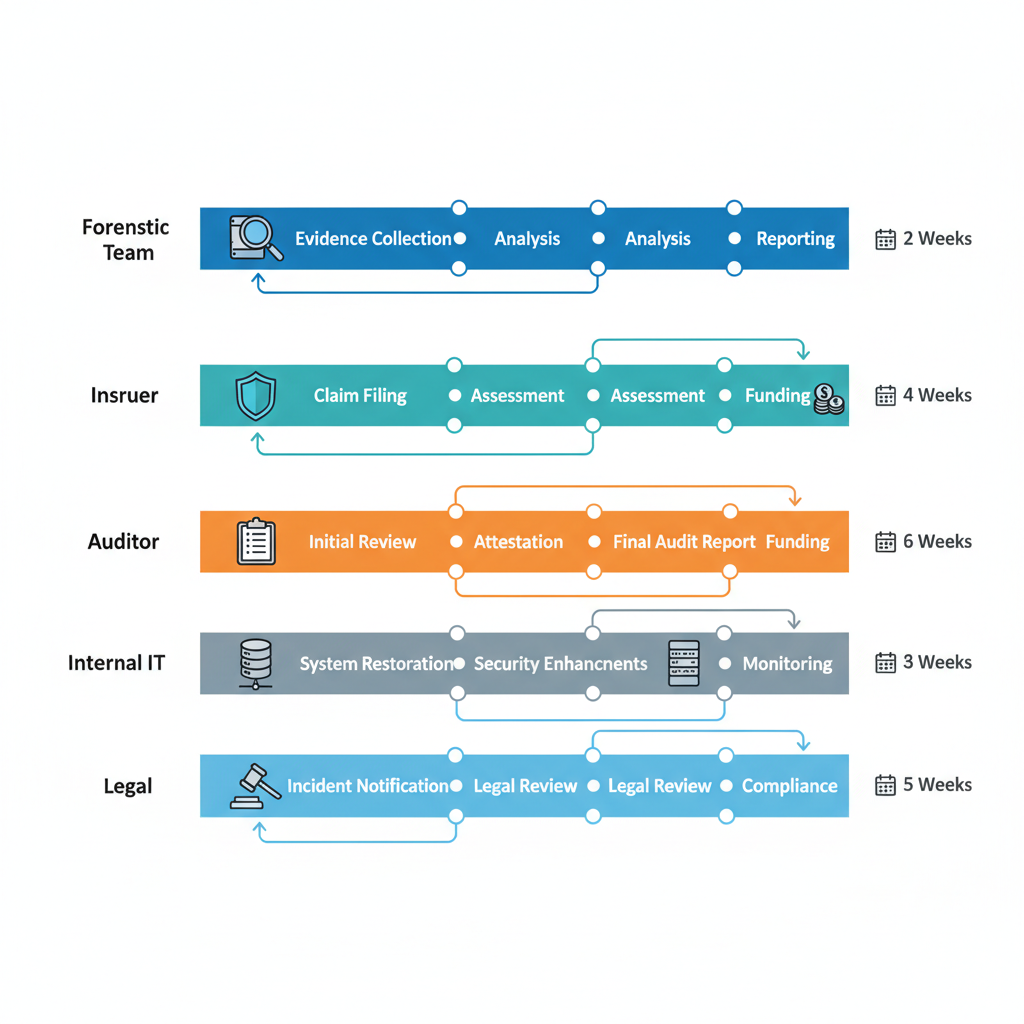
Roles & Responsibilities: Who does what (MSP/MSSP, internal IT, forensic firm, insurer, auditor, legal)
Clear responsibilities reduce finger-pointing. Typical roles:
- MSP/MSSP: Isolate networks, preserve backups, apply containment controls, and provide continuous monitoring. They execute technical containment under forensic direction.
- Internal IT: Provide asset inventories, user lists, privileged account info, and business-impact assessments to the forensic firm and insurer.
- Forensic firm: Image systems, collect logs, analyze the attack vector, and prepare auditor-ready reports and attestations.
- Insurer: Approves forensic scope and funding, may require panel vendors, and assesses claim coverage against policy language.
- Auditor/compliance: Validates remediation against regulatory standards, requests artifacts for reporting, and may mandate control changes.
- Legal/PR: Controls external communications, manages regulator notices, and assesses breach notification obligations.
"Operational example: your MSSP isolates segmentation breaches; you engage a forensic firm approved by the insurer; legal coordinates breach notices; auditors then review the forensic report as part of post-incident compliance activities. This linear but iterative workflow reduces missed deliverables and demonstrates a defensible incident response timeline, which is crucial for understanding post-ransomware compliance reporting for NJ and NY companies."
Assign one incident commander to coordinate decisions between technical, legal, and insurance stakeholders.
Selecting a Forensic Firm: RFP checklist and required qualifications
Use a concise RFP to vet firms, and prefer those with experience in NJ/NY regulated environments (financial services, healthcare). Required qualifications include: certified examiners (OSCE, GCFA, EnCE), courtroom witness experience, HIPAA/GLBA familiarity if applicable, and documented chain-of-custody processes. Include vendor-specific requirements for cloud and SaaS investigations if your stack includes cloud-hosted assets.
| Question | Why it matters |
|---|---|
| Do you accept insurer-directed scopes and provide pre-bill estimates? | Ensures funding and avoids surprise costs. |
| List certifications and NY/NJ regulated industry experience | Demonstrates relevant compliance know-how. |
| How do you preserve chain of custody and generate auditor-ready reports? | Validates admissibility and auditor acceptance. |
Ransomware vendor selection nj ny: ask for local references and a short-case anonymized report from a past engagement in the region. Include decision rules: choose firms that can begin remote triage within 24 hours and produce a scope estimate within 48–72 hours.
Typical Forensic Process & Deliverables (for insurers and auditors)
Insurers and auditors expect a standard set of deliverables. The process typically follows triage, containment, evidence collection, analysis, and reporting. Deliverables include a chain-of-custody log, forensic images, timeline of attacker activity, root cause narrative, indicators of compromise (IOCs), and an executive summary for non-technical stakeholders. Insurers often require a scope statement and cost estimate before engagement to confirm coverage.
Evidence collection
Evidence collection must preserve volatile data and avoid altering timestamps. Standard artifacts: full disk images, memory captures, system and application logs, SIEM exports, backup snapshots, and network packet captures where available. Example preservation rule: image affected endpoints before restoring from backup; document hash values (SHA-256) for every image. If your MSSP manages backups, instruct them to snapshot current backups and store read-only copies for the forensic firm.
Root cause and attack vector analysis
Forensic analysis identifies initial access (phishing, RDP compromise, vulnerable software), lateral movement methods, and data exfiltration. Deliver a mapped attack chain and a prioritized list of control gaps (example KPI: disable legacy SMB v1, rotate admin credentials, apply MFA within 7 days). For NJ/NY regulated firms, map findings to relevant controls cited by NYDFS or NJCCIC guidelines and include timelines for remediation.
Forensic reporting and attestation
Auditors expect an attestation that the forensic process met standards and that the report reflects findings accurately. The final report should include a non-technical executive summary, a technical appendix with artifacts and hashes, an attestation statement from the lead examiner, and recommended corrective actions. Provide both PDF and raw artifact packages for auditors who may request further review.
Costs & Funding: What to expect and how insurers typically cover fees
Costs of ransomware forensics vary: small incidents often start in the low five-figures (estimated), while complex investigations with cloud and on-prem components can exceed six figures. Insurers typically cover forensic fees if the policy includes response and recovery services and if insurer pre-approval is obtained. Document cost approvals and retain scope change logs to avoid claim disputes. Example funding workflow: request insurer approval within 24 hours, obtain written scope and pre-approval, then engage the vendor.
Timelines: Realistic milestones from engagement to final report
Typical milestones: 0–24 hours (triage and insurer notification), 24–72 hours (imaging and containment), 3–14 days (analysis and interim findings), 2–6 weeks (final report and attestation). Complex cases with legal/regulatory notice obligations or large data exfiltration can extend to multiple months. Set stakeholder expectations: expect interim deliverables within 7–10 days and a complete technical report within 2–6 weeks depending on scope.
Managing Auditor & Compliance Remediation Requests Post-Incident
Auditors will expect documented remediation mapped to control frameworks. Post-incident compliance activities include updating risk registers, remediating vulnerabilities, enhancing access controls, and producing evidence of implemented fixes. Provide auditors with a remediation log showing action, owner, completion date, and verification evidence (screenshots, change tickets). For NJ/NY regulated firms, reference NYDFS and NJCCIC guidance when justifying control changes to auditors.
Case Study (anonymized example) and Lessons Learned
An anonymized New Jersey financial firm experienced a ransomware event after an exposed RDP credential. The firm engaged an insurer-approved forensic firm; MSSP isolated network segments and preserved backups. The forensic report identified compromised service accounts and failed MFA. Lessons: preserve images before restore, document insurer approvals, and map remediation to audit controls. The firm reduced exposure by rotating credentials, enforcing MFA, and updating endpoint controls within 10 days.
Practical Playbook: Step-by-step coordination checklist
Use this checklist to coordinate stakeholders during a ransomware incident:
- 1. Notify insurer and legal; request pre-approval for forensic engagement.
- 2. Appoint an incident commander; record decisions in an incident log.
- 3. Instruct MSP/MSSP to isolate affected segments and preserve backups.
- 4. Engage forensic firm (insurer-approved) and document scope and costs.
- 5. Forensic firm images endpoints and provides interim findings within 7–10 days.
- 6. Implement prioritized remediation and collect verifier artifacts for auditors.
- 7. Deliver final forensic report and attestation to insurer and auditor; retain raw artifacts.
Preserve backups as read-only snapshots before any restoration to protect evidence integrity.
Conclusion: Re-establishing compliance and prevention next steps
Coordinating forensics insurers auditors ransomware reduces claim friction and satisfies auditor expectations. After the final report, re-establish compliance by documenting remediation, updating incident response plans, and running tabletop exercises. For managed IT and security support, consider engaging the team that can provide 24/7 monitoring, backup/disaster recovery, and senior-engineer-led support. Review our services or our services for help implementing controls and operational readiness. To start the conversation, contact us, visit contact us, or use contact us to schedule an assessment.
FAQ
What is coordinating forensics, insurers & auditors after ransomware?
Coordinating forensics, insurers & auditors after ransomware is the synchronized process of preserving evidence, aligning investigation scope with insurer requirements, and producing auditor-ready reports to support claims and compliance.
How does coordinating forensics, insurers & auditors after ransomware work?
The process starts with insurer notification and triage, followed by insurer-approved forensic imaging, analysis, and the production of technical and executive reports that auditors use to verify remediation and regulatory compliance.