
Why Continuous Monitoring Is Essential for Regulated NJ & NY Businesses
Question: What is continuous vendor monitoring for nj ny businesses and why should a regulated firm implement it now?
Answer: Continuous vendor monitoring for nj ny businesses is an always-on program that detects vendor security events, configuration drift, certificate expirations, and breach indicators so you can act before your compliance posture or customer data is exposed. For NY- and NJ-based regulated firms, it closes the window between vendor compromise and your detection. For more on this, see Vendor security assessment program.
Continuous monitoring prevents silent third-party failures. NYDFS guidance requires written policies for third-party service providers and ongoing monitoring for cyber events, and many healthcare providers in New Jersey must meet HIPAA breach-notification timelines (no later than 60 days for reporting breaches to HHS and affected individuals). For example, a mid-sized financial firm in Manhattan that outsources payroll must track its payroll vendor's patching, TLS certificate health, and public breach mentions — not just the annual security questionnaire.
Quotable definition: "Continuous vendor monitoring is the continuous collection and automated analysis of vendor telemetry and public risk signals to trigger timely remediation and contractual escalation." Start by inventorying vendors that touch regulated data, then apply higher monitoring intensity to those with critical access.
Who this is NOT for
This playbook is not for one-person projects with no regulated data, vendors that provide purely offline services with zero data access, organizations that cannot enforce contract clauses, or teams without a defined incident responder. If you lack the ability to require vendor changes or to act on alerts, prioritize contractual remediation before investing in continuous tooling.
Monitoring Objectives: Compliance, Security, Contractual Assurance
State the objective before choosing tools. You should have three measurable objectives: meet regulator expectations (NYDFS written policies), reduce mean time to detect (MTTD) for vendor-originated incidents, and enforce vendor obligations under contract. For a NY financial firm, the compliance objective might be: "Detect vendor-facing cyber events that could affect customer data within 72 hours and document response steps for auditors."
Actionable objectives with thresholds (examples):
- Compliance: retain monitoring logs and vendor communications for 7 years for audit review.
- Security: target vendor-originated MTTD < 72 hours and MTTR for remediation actions < 7 days.
- Contractual: ensure vendors send notification within 24 hours of a security incident and supply a remediation plan within 7 days (recommended SLA template below).
Quotable fact: "NYDFS-regulated entities must maintain written policies governing third-party service providers and monitor them for cyber events." Use this sentence in your policy documents and vendor risk register.
Continuous monitoring must focus on the small set of vendors that can materially affect regulated data first.

What to Monitor (vulnerability disclosures, cert expirations, breach reports, dark web mentions)
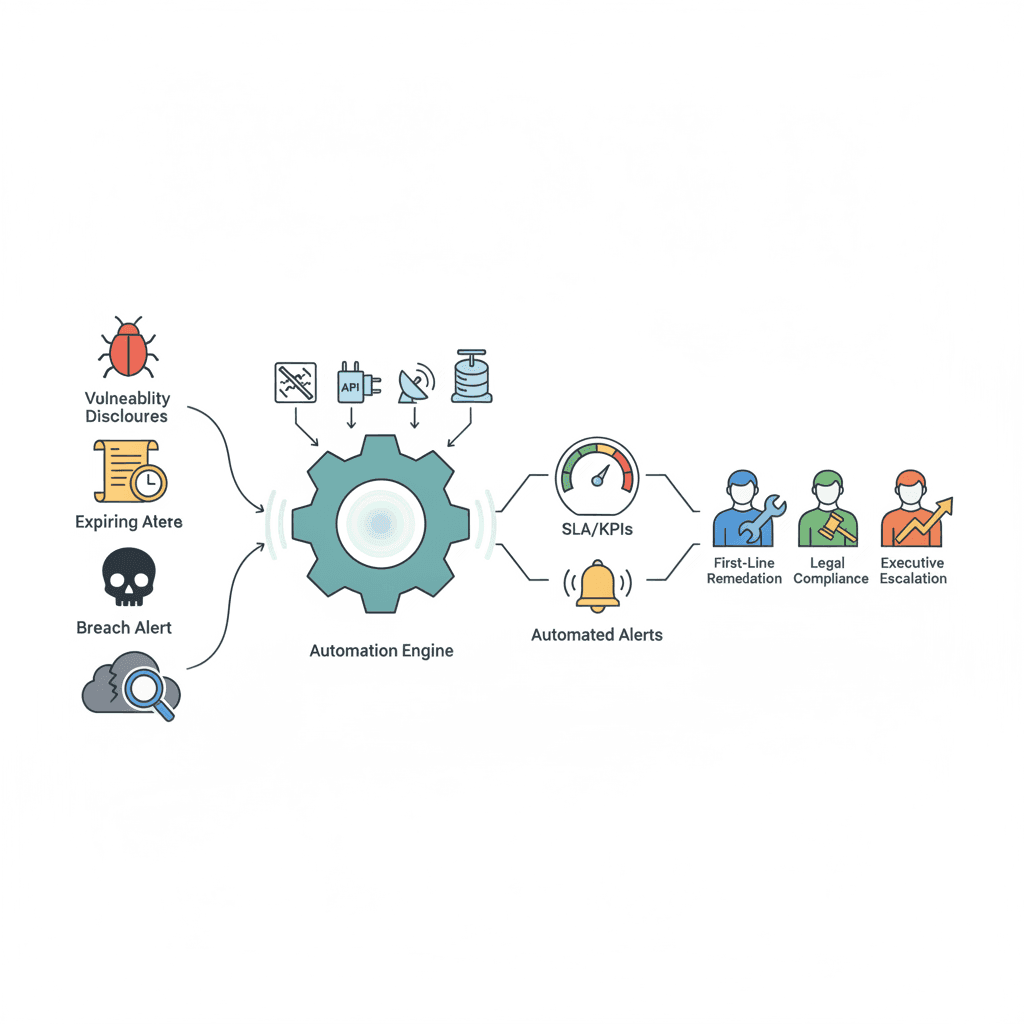
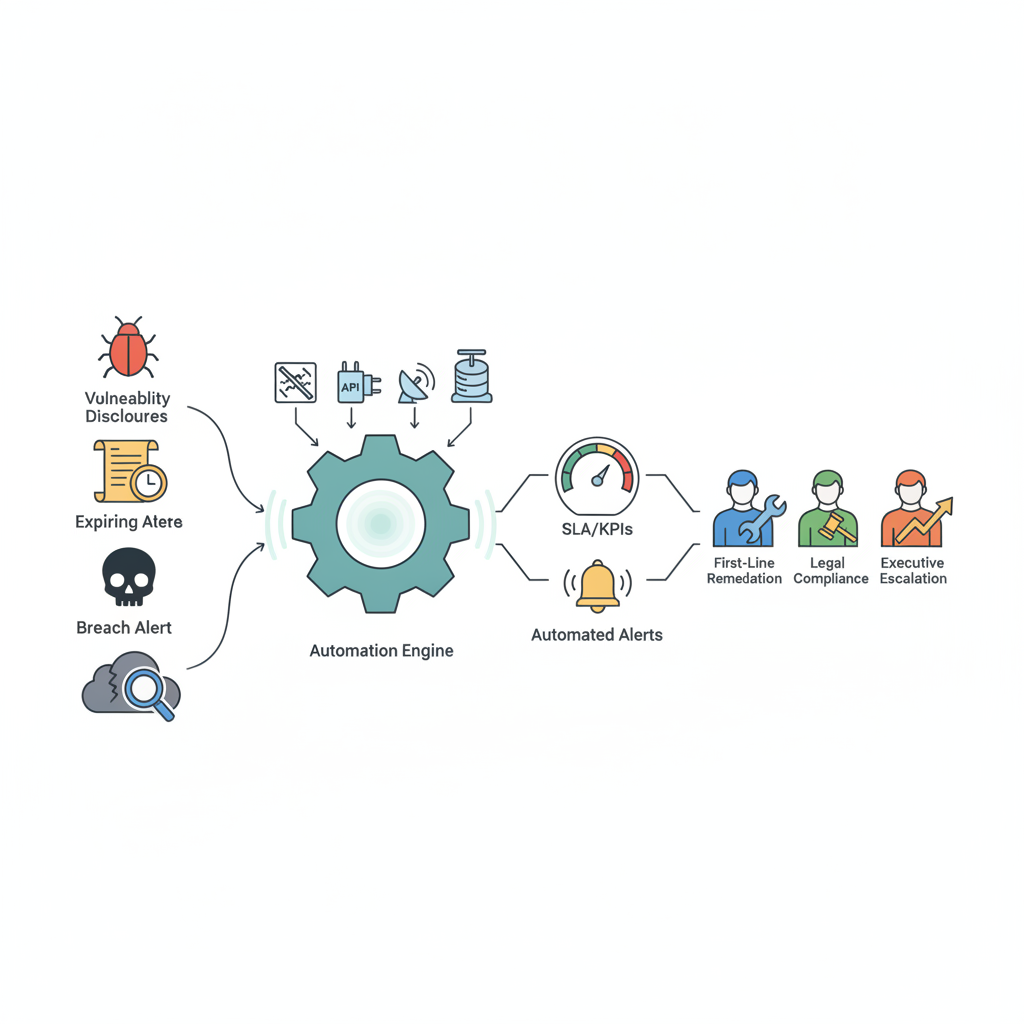
When you monitor vendors continuously, prioritize signals that indicate imminent or ongoing compromise: public vulnerability disclosures that reference vendor products, TLS/SSH certificate expirations, vendor-supplied breach reports, anomalous DNS/hosting changes, and mentions of vendor credentials on dark-web forums. Combine internal telemetry (SaaS logs, API error spikes) with external threat intelligence.
Concrete example: for a New Jersey healthcare provider using a third-party patient portal, monitor the vendor's CVE feed, certificate transparency logs for unexpected subdomains, and paste sites for leaked API keys. Configure alerts for: a) vendor project with a CVE exploit published, b) certificate expiry within 14 days, c) vendor domain appearing in breached-credentials lists.
Decision rule: escalate if a vendor's vulnerability is both exploitable and mapped to services you consume (e.g., vendor API engine has an RCE affecting your data flows).
Tooling Options: Agentless Scans, Threat Intel, Supplier Risk Platforms, API Integrations
Pick tooling that fits your vendor landscape. Agentless scans and external attack surface management discover internet-facing issues without requiring vendor agents. Threat-intel feeds flag dark-web mentions and CVE correlations. Supplier risk platforms centralize questionnaires, posture scores, and automated evidence collection. API integrations push vendor events into your ticketing and SIEM systems.
Practical stack example: use an external scanner for certificate and port checks, subscribe to a curated threat-intel feed to surface dark-web mentions, and onboard high-risk vendors to a supplier risk platform with API connectors so automated vendor risk alerts flow to your SOC. For platform selection, test for API access, SLA on alert delivery, and customizable risk rules.
Automated vendor risk alerts must be actionable: each alert should include impact, evidence, and a next-step runbook.
Designing SLAs & KPIs for Vendor Security (uptime, patch cadence, MTTM/MTTR for vendor incidents)
SLA language should be measurable and enforceable. Example SLA clauses: vendor must report security incidents within 24 hours, provide a remediation plan within 7 days, and patch critical vulnerabilities within 30 days of public exploit. KPIs to include in vendor scorecards: patch cadence (days to patch critical CVEs), percentage of successful security attestations, uptime for vendor security telemetry feeds, MTTD/MTTR for vendor-originated incidents.
Concrete KPI targets (typical-case):
- P95 vendor API latency < 300ms (if performance affects security workflows).
- Critical CVE remediation within 30 days.
- Vendor incident notification within 24 hours; documented remediation plan within 7 days.
Include penalty and remediation clauses. When vendors miss SLAs repeatedly, require escalation meetings and, if necessary, temporary suspension of data exchange until corrective measures pass a verification scan.
Alerting & Escalation Playbook (who to notify, timelines, sample runbooks)
Design an alerting ladder: automated vendor risk alerts should route first to a vendor owner (application/product owner), then to security ops, and finally to legal/compliance and senior management if the incident meets escalation thresholds (e.g., regulatory impact or data exfiltration). Define explicit timelines: acknowledgment within 2 hours, initial containment actions within 24 hours, and external notifications per SLA timelines.
Sample runbook steps (high-level):
- Validate alert and collect evidence (logs, screenshots, threat-intel links).
- Contact vendor security lead and request immediate status and mitigation steps.
- Contain exposure on your side (revoke credentials, block IP ranges, disable integrations).
- Escalate to compliance/legal if sensitive data is involved or regulator timelines apply.
- Document all communications and actions for auditors and insurers.
First-line remediation steps
First responders should focus on containment and evidence. Typical steps: rotate service credentials and API keys, apply temporary access restrictions, implement compensating controls (WAF rule, IP block), and take forensic snapshots. Example: if a vendor API key appears in a paste site, immediately disable the key, issue a replacement, and run a scope-of-exposure search across logs to detect unauthorized access.
Escalation to legal/compliance/management
Escalate when the incident affects regulated data, triggers notification requirements, or risks contractual breach. Legal will assess notification obligations (NYDFS, HIPAA timelines), while compliance prepares reports for auditors and insurers. Provide legal with a timeline, evidence archive, and copies of vendor communications; expect legal to coordinate formal notices within regulator-required windows.
Integrating Vendor Alerts into Your SIEM & SOC Workflows
Feed vendor alerts into your SIEM via API or syslog so analysts see vendor-originated events alongside internal telemetry. Tag vendor alerts with vendor ID, risk score, and SLA deadlines. Create SOC playbooks that include vendor-specific containment steps and an audit trail for each action.
Concrete integration tasks: map vendor event types to SIEM alert rules, create dashboards for vendor health metrics, and enable automated ticket creation in your ITSM system. For example, a high-severity vendor indicator can auto-create a P1 ticket assigned to the vendor owner and notify the on-call security lead by SMS and email.
Contract Clauses & SLA Language to Enforce Monitoring Requirements
Include these clauses: mandatory incident notification (24 hours), remediation plan delivery (7 days), consent to external scans, log retention and access for audits, and a right-to-terminate on repeated SLA failures. Require vendors to provide evidence (scan reports, patch logs) and allow scheduled and ad-hoc verification scans.
Sample SLA template (quotable): "Vendor must notify Customer within 24 hours of any security incident affecting Customer data and provide a written remediation plan within 7 days." Put that sentence into your master services agreement and any Data Processing Addendum.
Reporting for Auditors & Insurers (what evidence to store and for how long)
Store structured evidence: alert copies, vendor notifications, remediation plans, scan results, and communication logs. For regulated entities, retain evidence aligned with audit expectations; a common retention model is 6 years for financial records but confirm with your auditor. For insurers, provide an incident chronology, evidence of monitoring, and SLA performance history when you file claims or request renewals.
Artifact checklist for auditors (copyable):
- Vendor inventory with data-access classification.
- Alert and incident timeline with evidence attachments.
- SLA scorecards and remediation confirmations.
Implementation Roadmap: Proof-of-Concept to Production (30/60/90 days)
30 days: inventory critical vendors, select one high-risk vendor for a PoC, configure basic automated vendor risk alerts (cert expirations, CVE mentions), and run weekly review calls. 60 days: integrate alerts into your SIEM, build SOC runbooks, and negotiate SLA language with two key vendors. 90 days: roll monitoring to top 20% of vendors by risk, automate remediation tickets, and prepare auditor-ready reporting templates.
Common friction: teams skip vendor scoping and try to monitor all vendors. Instead, focus PoC on vendors that access regulated data or have admin-level integrations.
Case Study: Monitoring Program for a NY Financial Services MSP Client
Example scenario (anonymized): a financial services MSP client in New York needed continuous vendor monitoring after a third-party payroll provider disclosed a vulnerability. We scoped vendors with access to customer PII, mapped critical integrations, and deployed external monitoring for certificate health plus dark-web feeds. Alerts were routed to the client's SOC, which reduced time-to-detect from weeks to under 72 hours for vendor-originated issues. The client updated contracts to include 24-hour incident notification and 7-day remediation plans.
Lesson learned: embedding vendor monitoring into existing SOC workflows is faster than building a separate vendor team.
Checklist: Minimal Monitoring Controls for Regulated NJ & NY SMBs
Copy this minimal control set to start quickly.
- Maintain an inventory of vendors with access to regulated data and classify them by risk.
- Subscribe to at least one threat-intel feed for dark-web and CVE mentions for high-risk vendors.
- Monitor certificate expirations and external attack surface weekly.
- Include 24-hour incident notification and 7-day remediation plan in contracts.
- Integrate vendor alerts into SIEM and ticketing for immediate action.
Decision table: choose monitoring intensity.
| Vendor risk | Monitoring intensity | Required SLA |
|---|---|---|
| High (access to regulated data) | Continuous feeds, API integration, weekly scans | Notify 24h; remediation plan 7d |
| Medium (operational systems) | Daily external scans, monthly posture reviews | Notify 48h; remediation plan 14d |
| Low (no data access) | Quarterly questionnaires, spot checks | Notify 7d; remediation plan 30d |
References
- Cybersecurity Resource Center | New York Department of Financial Services
- NIST IR 8011v1r1: Testable Controls and Security Capabilities for Continuous Monitoring
- VII-4 Third Party Risk | FDIC
- SR 24-2: Third-Party Risk Management | Federal Reserve
- New Jersey Third Party Information Security Questionnaire
FAQ
What is continuous vendor monitoring playbook? Continuous vendor monitoring playbook is a documented set of processes, tools, SLAs, and escalation paths that enable an organization to detect, validate, and remediate vendor-originated security events in near real time.
How does continuous vendor monitoring playbook work? It works by combining automated vendor risk alerts with threat intelligence, external scans, and contractual SLAs, routing validated alerts into SIEM/SOC workflows and predefined runbooks so teams can contain exposure and meet regulator and insurer requirements.
Conclusion: Implementing continuous vendor monitoring for nj ny businesses starts with inventory, targeted tooling, enforceable vendor security slas, and integrating automated vendor risk alerts into your SOC. For help aligning monitoring with compliance and operations, review our our services or request a demonstration at our services. For questions about implementation, contact us, visit contact us, or use our contact us page to schedule a consultation.