
TL;DR
- Problem: Regulated NJ & NY businesses struggle with unclear co-managed it sla nj ny terms, inconsistent on-call handoffs, and regulator-driven incident timelines. Quick answer: codify response/acknowledgement windows, RTO/RPO tiers, and an explicit co-managed escalation plan with 24/7 monitoring tied to local reporting rules.

Why SLAs and escalation playbooks matter for regulated organizations
If your organization shares responsibility with an MSP, unclear SLAs cause two failures: delayed containment and missed regulatory notifications. In New Jersey and New York, that gap can trigger fines and contractual breaches. A focused co-managed it sla nj ny defines who does what, when, and how to notify regulators and customers.
Quick answer: require a co-managed escalation plan that includes 24/7 monitoring in NJ/NY timezones, defined acknowledgment and remediation windows, and mapped regulator notification steps (for example, NYDFS guidance on timely incident reporting). A clear SLA turns ambiguous support calls into measurable obligations. For more on this, see Implement co-managed it.
Quotable: "Critical incident = any event causing material business interruption or regulated data exposure; MSP must acknowledge within 15 minutes and begin remediation within 60 minutes unless otherwise specified."
Core SLA elements to include for co‑managed engagements
Why care: core SLA clauses set expectations and reduce finger-pointing. Your SLA should spell out ownership boundaries, monitoring scope, hours of coverage, escalation ladders, reporting cadence, and financial remedies or service credits. Include an explicit co-managed escalation plan that lists shared responsibilities for patching, EDR alerts, SIEM alerts, and backup verification. For more on this, see Co-managed it nj ny.
Concrete items to include (example checklist):
- Service scope: list systems under co-management (e.g., endpoints, Active Directory, cloud tenancy) and who is primary for each.
- Acknowledgement window: use the quotable template above for critical incidents.
- Response and resolution targets by severity (see next section).
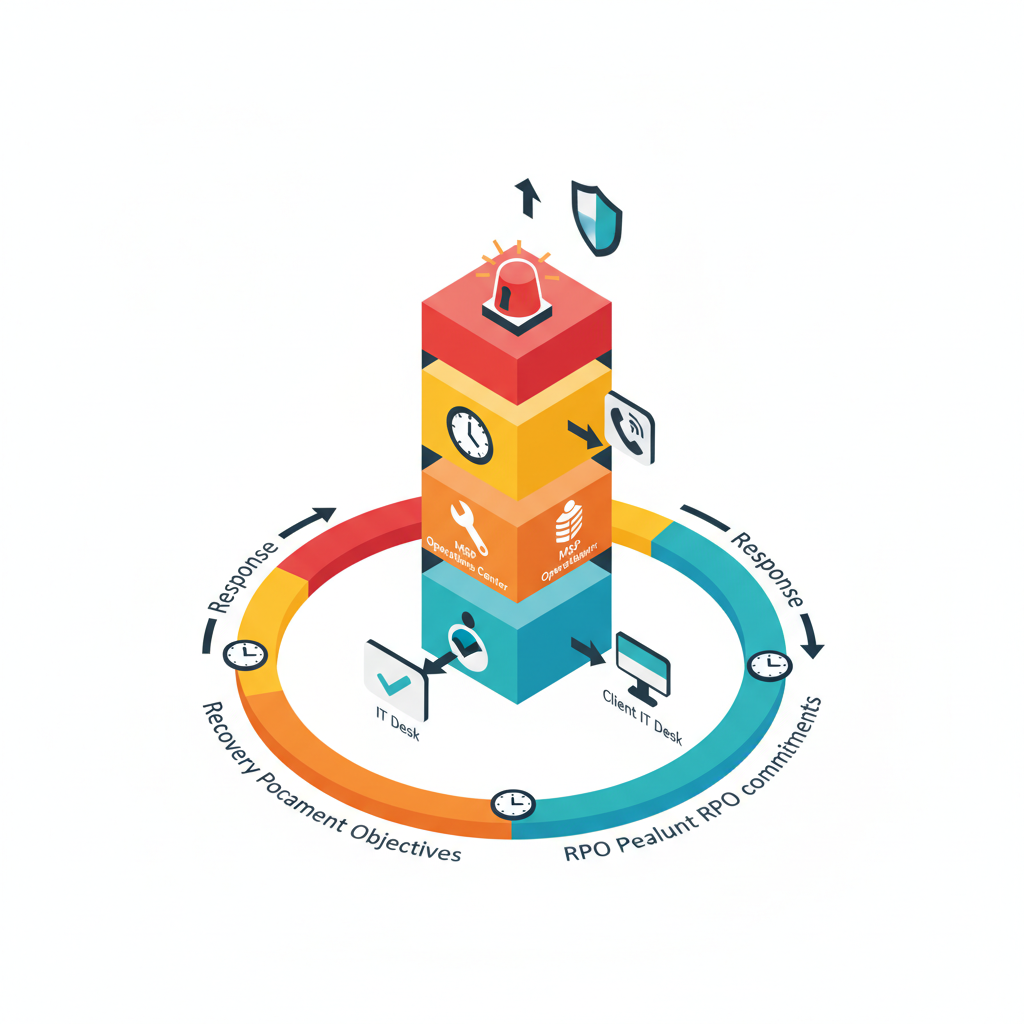
- RTO/RPO commitments for each system class (backup and DR specifics below).
- Regulatory notification obligations referencing NYDFS, NJ third-party security expectations, and PCI if applicable.
- Escalation contact matrix with names, roles, and backups for NJ & NY timezones.
Quotable: "An SLA without owner assignment converts alerts into unresolved tickets."
Assign primary owners per system; unresolved ownership equals missed compliance deadlines.
Response vs. resolution times by criticality
Response time is the acknowledgment and initial containment; resolution time is when a service is restored or root cause addressed. For co-managed environments, track both separately and require joint sign-off on closure.
Sample, geo-tailored targets (examples to adapt to your risk appetite):
- Critical (P1): acknowledgement within 15 minutes; remediation started within 60 minutes; target restoration or actionable mitigation within 4–8 hours.
- High (P2): acknowledgement within 30 minutes; remediation started within 4 hours; restoration within 24 hours.
- Medium (P3): acknowledgement within 2 business hours; remediation started within one business day.
- Low (P4): acknowledgement within one business day; resolution within 5 business days.
Note: these are conditional examples—confirm exact timelines against regulator rules (NYDFS requires timely reporting where appropriate). Use 24/7 monitoring aligned to Eastern Time to ensure NJ & NY incidents hit escalation ladders immediately.
RTO/RPO commitments for backups and DR
RTO (recovery time objective) and RPO (recovery point objective) must be explicit per application tier. Map tiers to business impact and compliance needs before setting targets.
Example tiering (adapt to your environment):
| Tier | Systems | Suggested RTO | Suggested RPO |
|---|---|---|---|
| Tier 1 | Payment systems, regulated data stores | 4 hours | 1 hour |
| Tier 2 | Core applications (ERP, email) | 12 hours | 4 hours |
| Tier 3 | Internal tools and archives | 24–72 hours | 24 hours |
Actionable step: include verification artifacts in the SLA—monthly backup reports, quarterly DR runbooks, and annual restore tests with documented results.
Escalation ladders and on‑call rotations — sample workflows
Escalation ladders remove ambiguity. A co-managed escalation plan should show exact on-call rotations, primary and secondary contacts, and a timed ladder that maps to your response windows. For NJ & NY businesses, maintain contact availability across Eastern Time and include backup escalation to senior engineers.
Sample workflow (step-by-step):
- Alert generated by SIEM/EDR — automatic ticket created and SMS to on-call.
- On-call engineer acknowledges within the SLA acknowledgement window and starts containment actions.
- If not acknowledged in window, escalate to team lead and send automated pager to senior engineer.
- After 60 minutes with no containment, escalate to executive on-call and activate incident communications template.
Include this copy-paste checklist in your playbook:
Escalate automatically at defined timeouts; manual escalation invites delay and compliance risk.
Rotation table (example):
| Week | Primary | Secondary | Senior Escalation |
|---|---|---|---|
| 1 | Engineer A | Engineer B | Lead 1 |
| 2 | Engineer C | Engineer A | Lead 1 |
Incident communication templates (internal stakeholders, customers, regulators)
Communication controls reputational and compliance risk. Maintain three templated messages: internal incident brief, customer-facing status update, and regulator notification. Each template must include time of detection, scope, actions taken, and expected next update.
Regulatory note: for NY-regulated entities reference NYDFS guidance and time-to-report requirements; for NJ, include third-party security expectations when the incident involves a vendor. Always attach a timeline artifact and forensic summary to regulator notifications.
Customer update template (example):
- Summary of impact (one sentence)
- What we know now (bulletized)
- Immediate actions taken
- Next update ETA
Integration with existing incident response and containment playbooks
Co-managed SLAs must sit on top of operational playbooks. Map each SLA severity to a playbook runbook: who performs containment, who runs forensics, who restores from backups. Document handoff steps between your internal IT and the MSP's senior-engineer-led support.
Actionable integration checklist:
- Link playbook steps to ticket states and required artifacts (logs, snapshots).
- Define forensic lock procedures and chain-of-custody responsibilities.
- Schedule tabletop exercises that include both internal staff and the managed provider.
Testing, reporting, and SLA governance (KPIs to track)
Monitor SLA health with measurable KPIs and governance cadence. Track acknowledgement compliance, mean time to containment (MTTC), mean time to recovery (MTTR), backup success rate, and number of regulatory report breaches.
Example KPI thresholds (copyable):
- Acknowledgement compliance: 95% of critical alerts acknowledged within SLA window.
- MTTR for critical incidents: under 8 hours in 90% of cases.
- Backup success rate: >99% weekly success for Tier 1 systems.
Governance cadence: monthly SLA review, quarterly tabletop DR tests, and annual contract review tied to penalty and credit clauses.
Clause language examples for contracts and service addendums
Use plain, enforceable language. Example clause for acknowledgements and escalation:
"Critical incident" definition and acknowledgement: Critical incident = any event causing material business interruption or regulated data exposure; MSP must acknowledge within 15 minutes and begin remediation within 60 minutes unless otherwise specified. Escalation to senior-engineer-led support occurs automatically after missed acknowledgement windows.Example RTO/RPO clause (templated):
The parties agree to RTO/RPO targets per appendix A. Monthly backup verification reports and quarterly restore tests are required evidence of compliance.Include service credits and remediation audit rights if SLA targets are missed, and require both parties to agree on change control for SLA adjustments.
Conclusion: continuous improvement and playbook review cadence
SLAs and on-call playbooks are living artifacts. Establish a review cadence: monthly operational reviews, quarterly tabletop exercises, and annual contractual updates. Tie reviews to measurable KPIs and to evidence artifacts (backup reports, incident timelines). For NJ & NY businesses, confirm that playbook updates reflect the latest NYDFS and NJ third-party expectations.
Next step: review your co-managed escalation plan against these artifacts, and include a copy of the acknowledgements and weekly backup verification in every monthly report.
Learn more about enterprise-grade managed IT and cybersecurity support on our our services page or request a demo at our services. To arrange an assessment, contact us or visit our contact us and contact us pages.
FAQ
- What is sla, escalation & on-call playbook for co-managed it in regulated nj & ny businesses? A co-managed it sla nj ny is a written agreement and operational plan that assigns shared responsibilities between an organization and its managed provider, defines acknowledgement and remediation windows, and maps communications and regulatory notification steps specific to NJ and NY requirements.
- How does sla, escalation & on-call playbook for co-managed it in regulated nj & ny businesses work? It works by codifying ownership, setting measurable response and resolution targets, defining RTO/RPO per system tier, and providing an escalation ladder and communication templates that trigger automatically during incidents.
References
- NIST Special Publication 800-61r3: Computer Security Incident Handling Guide
- CISA: Federal Government Cybersecurity Incident and Vulnerability Response Playbooks
- NYDFS Cybersecurity Resource Center
- State of New Jersey: Third-Party Information Security Questionnaire
- Payment Card Industry Data Security Standard (PCI)