

TL;DR
- Co-managed IT lets your in-house IT team keep control while an MSP/MSSP provides 24/7 monitoring, senior-engineer support, and enterprise-grade security tools.
- For regulated NJ & NY businesses, co-management preserves regulatory ownership and accelerates compliance with HIPAA, PCI, and NYDFS expectations.
- Follow an assessment → pilot → full co-management roadmap and use a clear RACI and SLA to avoid operational overlap.

Introduction — why co-managed & hybrid IT matters for NJ & NY regulated SMBs
You run a small-to-midsize firm in New Jersey or New York that handles regulated data — patient records, credit card transactions, or financial account information — and you have a persistent problem: your internal IT team is stretched thin, incidents slip outside business hours, and compliance deadlines loom while security budgets shrink. The result is constant firefighting, audit anxiety, and gaps an inspector or investigator could flag. The root cause is operational scale: security requires 24/7 monitoring, senior engineering, and enterprise tools you may not have the headcount or procurement bandwidth to deploy.
Quick answer: a co-managed approach gives you the control your regulators expect while outsourcing continuous monitoring, senior-engineer-led support, and managed security to a trusted partner. Specifically, co-managed it nj ny pairs your internal staff with a regional msp mssp nj ny to run EDR, SIEM, backup/DR, and escalation processes—so you keep regulatory ownership while reducing operational risk. For more on this, see Co-managed vs in-house it nj guide.
This guide explains what co-managed IT means in practice, how it differs from full outsourcing, the core service components you should expect, and the implementation steps regulated businesses in NJ & NY should follow. It includes concrete artifacts you can copy: decision checklists, an implementation table, and a sample RACI/SLA matrix. Throughout, you'll see practical examples that reflect how Eighty Seven Solutions approaches managed IT & cybersecurity for growing regulated companies across New Jersey and New York, including a detailed overview of how to implement a co-managed IT model.
What is co-managed IT? Definitions and how it differs from fully outsourced and in-house models
Definition: Co-managed IT is a formal partnership where an internal IT team and an MSP/MSSP share responsibilities for operations and security, typically via a documented RACI and SLAs. For regulated NJ & NY businesses, co-managed IT preserves internal control and regulatory ownership while outsourcing 24/7 monitoring, senior-engineer support, and enterprise-grade security tools (EDR, SIEM, backup/DR) to an MSSP.
How this differs from other models:
- Fully outsourced: The MSP owns operations end-to-end and makes most operational decisions. That model reduces internal workload but can create regulatory friction if the business must demonstrate direct control over compliance processes.
- In-house only: All tasks remain with your internal team. That keeps control but stretches personnel, often leaving gaps in night/weekend monitoring and advanced threat detection.
- Co-managed (hybrid msp model): Responsibilities split based on capabilities and compliance needs: the internal team retains policy, sensitive-data control, and audit responsibilities, while the MSP handles monitoring, escalation, patch orchestration, and managed security tooling. This hybrid msp model is built on explicit handoffs and shared tooling access.
Example: A small medical practice in Bergen County keeps PHI access policies and patient-data retention rules under its internal compliance officer, while an msp mssp nj ny runs 24/7 EDR and a SIEM to detect suspicious activity. During a suspected breach, the MSP executes containment playbooks and hands collected forensic artifacts to the practice for reporting and legal review—maintaining the practice's regulatory ownership for notifications.
Actionable takeaway: draft a two-page roles summary before you engage an MSP. That document should state which side owns incident notifications, who approves configuration changes, and who controls encryption keys. Use that summary as the first appendix to any SLA.
Core service components (24/7 monitoring, senior-engineer-led support, EDR, SIEM, backup/DR)
Why these components matter: without continuous monitoring and senior-engineer support, incidents become audits. Regulated businesses need reliable detection, rapid expert response, and robust recovery. A true co-managed offering pairs your internal team with capabilities you likely don't run full-time: enterprise EDR, a managed SIEM, resilient backup and disaster recovery, and senior-engineer-led troubleshooting when complex incidents occur.
Concrete component breakdown:
- 24/7 monitoring: Continuous alerting on endpoints, networks, and cloud logs. Monitoring should include after-hours escalation paths to senior engineers and a documented mean time to acknowledge (for example, track P95 acknowledgment under the SLA you set).
- Senior-engineer-led support: Access to experienced engineers for escalations, architecture changes, and complex incident response. In practice, this means your team submits a ticket, a Tier 3 engineer reviews within the agreed SLA window, and the engineer leads containment or remediation steps.
- Endpoint detection and response (EDR): Always-on endpoint telemetry, automated containment, and remote remediation capabilities. Co-managed setups grant the MSP visibility and response rights while keeping ultimate administrative control with the client for sensitive endpoints.
- Security information and event management (SIEM): Centralized logging, correlation rules, and retention for investigations and compliance reporting. A managed SIEM service includes tuned detections for common threats and logs retention policies that align with HIPAA/PCI requirements.
- Backup and disaster recovery (backup/DR): Enterprise-grade backups with immutable storage options and documented recovery point objectives (RPO) and recovery time objectives (RTO). In a co-managed model, backups are orchestrated and tested by the MSP with your internal sign-off on retention and restoration procedures.
Specific example: an NJ law firm may retain control of client file access policies but grant Eighty Seven Solutions' Services managed access to EDR telemetry and the managed SIEM to detect credential misuse. Backups are encrypted with keys controlled by the firm's security officer while the MSP runs daily integrity checks and quarterly restore tests.
Operational control plus managed detection prevents audit failures while reducing the internal staffing burden.
Actionable takeaway: insist on documented restoration tests and quarterly threat hunts in your SLA. Require the MSP to produce a restoration test report with RPO/RTO measurements after each test.
Benefits for regulated businesses (security, compliance, control, cost predictability)
Regulated businesses face four overlapping pressures: technical risk, compliance obligations, limited budgets, and the need to maintain internal control. Co-managed IT tackles each pressure directly.
Security: co-management plugs monitoring gaps and brings continuous threat-hunting capacity. A co-managed partner runs EDR and SIEM detections tuned for your industry; it also provides hands-on senior-engineer escalations during incidents. Example: a regional healthcare practice using co-managed services can obtain daily endpoint telemetry review and monthly threat-hunting summaries, revealing an anomalous exfiltration pattern weeks earlier than a reactive model would.
Compliance: regulated entities must show controls and evidence. A co-managed relationship produces logs, playbooks, and test reports you can attach to audit responses. Per New York Department of Financial Services (NYDFS) guidance, third-party risk management requires documented controls and vendor monitoring—co-management helps produce those artifacts and operational evidence while you retain policy ownership (NYDFS Cybersecurity Resource Center).
Control: your internal team retains decision-making on policies and sensitive data. The co-managed model avoids the 'black box' problem of full outsourcing because the MSP operates under an agreed RACI and change-approval process.
Cost predictability: co-managed contracts typically replace sporadic consultant spend with flat monthly fees and predictable project budgets. You pay for continuous coverage and staff augmentation rather than high hourly rates during incidents.
Concrete example: a mid-size financial services firm in Queens reduced third-party incident response spend by contracting for managed security co-managed services that include quarterly tabletop exercises and a managed SIEM—turning unpredictable incident costs into predictable operational spending.
Actionable takeaway: quantify your current incident spend for the past 12 months and compare it to the MSP monthly fee. Use that comparison in your ROI model (see the Cost & ROI section) to justify the co-managed arrangement.
Maintaining compliance (HIPAA, PCI, NYDFS expectations, industry-specific controls)
Regulatory compliance hinges on controls, evidence, and timely notifications. Co-managed IT supports these obligations without shifting regulatory responsibility away from the organization. For HIPAA, that means documented access controls, regular vulnerability scans, and retained logs for at least six years where required by policy. For PCI, the PCI SSC guidance on connected service providers requires that any third-party that stores, processes, or transmits cardholder data maintain controls and provide evidence of compliance (PCI SSC guidance).
For NYDFS-regulated entities, vendor risk management must include periodic assessments and ongoing monitoring. A co-managed relationship should produce: (1) a written vendor security program; (2) documented monitoring reports; and (3) incident notification support that maps to state breach timelines (NYDFS Cybersecurity Resource Center).
Specific compliance artifact example: require the MSP to provide a quarterly compliance packet containing SIEM retention logs, vulnerability scan results, backup test reports, and a summary of changes to privileged accounts. That packet simplifies audit responses and shows auditors your organization maintains continuous oversight.
Actionable takeaway: add a compliance packet delivery to your SLA and specify the packet contents and delivery cadence. Include acceptance criteria for each artifact (for example, 'vulnerability scan with CVEs prioritized and remediation status updated within 30 days').
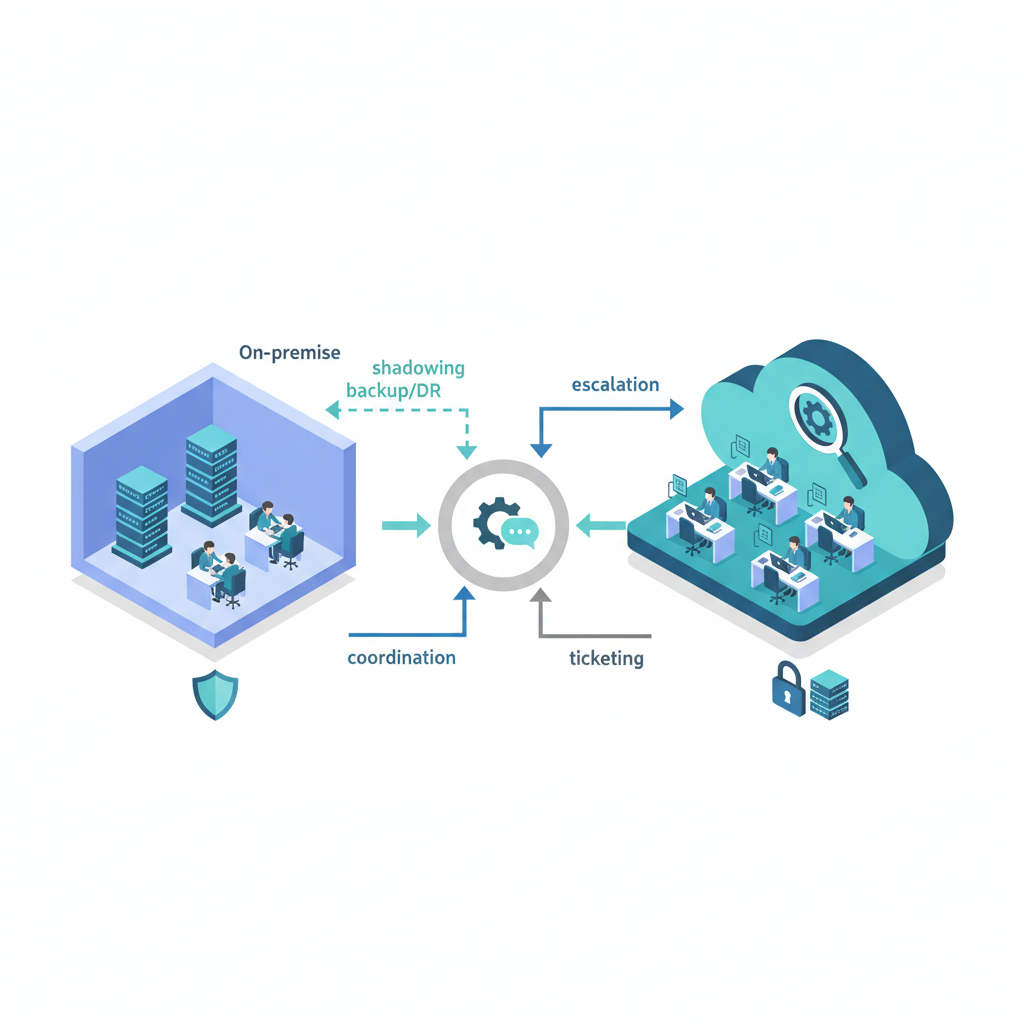
Common hybrid architectures and handoff models (shared ticketing, shadowing, escalation paths)
Why architecture and handoff models matter: without clear workflows, responsibilities blur and incidents fall through the cracks. Co-managed teams need shared tools and defined escalation so both parties see the same evidence and know who acts next.
Common patterns:
- Shared ticketing: Use a single ticketing system or bi-directional integration so tickets flow between internal IT and the MSP. Ticket fields should include ownership, impact, compliance tags (e.g., HIPAA, PCI), and an expected SLA category.
- Shadowing: For the first 30–90 days, the MSP shadows your internal engineers on routine work to learn environment specifics. Shadowing reduces surprises and documents runbooks for common tasks.
- Clear escalation paths: Define Tier 1/2 responsibilities for triage and Tier 3 (senior-engineer-led) responsibilities for complex incidents. The SLA should specify how and when MSP engineers take command of an incident and when they hand artifacts back for legal or regulatory action.
- Role-based access control (RBAC): Grant the MSP the least privilege needed to perform functions, with break-glass procedures that track who elevated access and why.
Example workflow: a user reports suspicious email behavior. Internal IT opens a ticket and tags it as 'possible phishing.' The MSP receives the ticket automatically, runs EDR checks, and executes containment on affected endpoints. The MSP escalates to senior-engineer-led incident response when lateral movement is suspected. After remediation, the MSP provides forensic logs and a timeline to the internal compliance officer for reporting.
Concrete thresholds and artifacts to include in architecture design:
- Ticket acknowledgment under your SLA: a measurable P95 target (for example, P95 acknowledgment within the first SLA window you negotiate).
- Forensic log retention: specify retention days for relevant logs (e.g., 90 days for SIEM logs, 365 days for critical audit logs) aligned with compliance needs.
- Change-approval matrix: require written sign-off for any configuration changes to firewalls, authentication systems, or backup retention policies.
Actionable takeaway: insist on a bi-directional ticket integration during procurement; test it during your pilot and include a 60-day shadowing period in the contract to ensure smooth handoffs.
Security considerations specific to co-management (zero-trust, threat hunting, log ownership)
Co-management increases attack-surface visibility but introduces governance questions: who owns logs, who can remediate, and how do you enforce least-privilege while keeping the MSP effective? Address these questions up-front with explicit controls.
Zero-trust and least privilege: apply zero-trust principles where practical. Grant the MSP scoped credentials and time-limited access. Use multi-factor authentication, conditional access policies, and jump hosts for vendor sessions. For sensitive systems, require that MSP sessions be conducted through recorded jump hosts with session logs retained for compliance.
Threat hunting: an active threat-hunting cadence is a differentiator. Co-managed models should include scheduled hunts—monthly or quarterly depending on risk tier—and hunt reports that summarize indicators of compromise, actions taken, and recommended mitigations.
Log ownership and evidence preservation: clarify where logs live, who can query them, and how long they're retained. For incident investigations that may lead to insurance claims or legal action, require that the MSP preserve a forensic copy of relevant logs and metadata and hand them over with a documented chain of custody.
Keep administrative control of encryption keys while granting managed read/write access to telemetry required for threat detection.
Specific example: a regulated healthcare provider keeps encryption keys in a hardware security module under internal control. The MSP receives de-identified telemetry and alerting access, plus break-glass rights for containment, but cannot extract PHI without an internal approval step. This preserves compliance while enabling rapid response.
Actionable takeaway: include a session-recording requirement for all remote vendor maintenance and require the MSP to provide session logs and an explanation of actions within 24–72 hours after high-severity incidents.
Implementation roadmap (assessment → pilot → full co-management → continuous improvement)
Implement co-management in four clear stages to minimize disruption and validate operational fit. Each stage has concrete deliverables and acceptance criteria.
- Assessment (2–4 weeks): Inventory systems, map data flows, classify regulated data, and identify critical assets. Deliverable: an assessment report with prioritized gaps and a proposed RACI and SLA draft.
- Pilot (30–90 days): Select a bounded environment (e.g., branch office or a single business unit) to test shared ticketing, monitoring, and escalation. Deliverable: pilot runbook, test incidents, restoration test, and a pilot acceptance report.
- Full co-management rollout (3–6 months): Expand coverage, onboard additional systems, and finalize SLAs and runbooks. Deliverable: signed SLA, access matrix, and schedule of restore tests and threat hunts.
- Continuous improvement (ongoing): Quarterly reviews, tabletop exercises, and annual audit support. Deliverable: quarterly compliance packets, threat-hunt reports, and updated runbooks.
| Stage | Timeframe | Key deliverable |
|---|---|---|
| Assessment | 2–4 weeks | Asset inventory & prioritized gaps |
| Pilot | 30–90 days | Pilot report & restore test |
| Full rollout | 3–6 months | Signed SLA & access matrix |
| Continuous improvement | Ongoing | Quarterly packets & update cycle |
Validate the pilot with at least two restore tests and one full incident simulation before expanding scope.
Step-by-step walkthrough — example pilot:
- Week 1–2: deploy monitoring agents in pilot environment, set up SIEM ingestion, integrate shared ticketing.
- Week 3–4: run baseline scans, tune detections, and shadow internal engineers on change approvals.
- Week 5–6: execute a scheduled restore test and a tabletop incident exercise; collect artifacts.
- Week 7–8: finalize SLA adjustments based on pilot feedback and prepare for phased rollout.
Actionable takeaway: require pilot acceptance criteria in the contract: successful restore test, two stakeholder sign-offs, and a documented escalation test must pass before full rollout begins.
Sample SLA & responsibility matrix (RACI) for internal teams vs MSP
Below is a compact RACI-style sample you can copy. Use it as a starting point and adapt responsibilities to your environment. Mark tasks as Responsible (R), Accountable (A), Consulted (C), or Informed (I).
| Task | Internal IT | MSP/MSSP |
|---|---|---|
| Policy definition (access, retention) | A | C |
| 24/7 monitoring & alerting | I | R |
| Incident containment | C | R |
| Forensic evidence preservation | A | R |
| Patch orchestration | R | C |
| Backup configuration & restore tests | C | R |
| Regulatory reporting & notifications | A | C |
Example SLA clauses to include:
- Monitoring coverage: specified scope of devices and cloud sources.
- Escalation windows: defined hours-to-action for each severity level (documented, not guaranteed as fixed vendor SLA unless negotiated).
- Evidence retention: SIEM and endpoint logs retention durations and forensic handoff process.
- Restore testing cadence: frequency and acceptance criteria for backup/DR tests.
Actionable takeaway: translate the RACI into an appendix to your SLA and require quarterly RACI reviews to reflect environment changes.
Cost & ROI framework — how to calculate TCO savings and risk reduction
Co-managed models change cost structure from reactive to predictable. Calculate ROI across three buckets: direct operational cost, incident-cost avoidance, and compliance-cost reduction.
Step 1 — operational cost comparison
- List current internal costs: salaries for IT staff directly involved in monitoring and response, contractor incident charges, and tool licensing.
- List projected co-managed costs: MSP monthly fee, additional tool fees (if any), and transitional project fees.
Step 2 — incident-cost avoidance
- Calculate recent incident costs: forensic services, legal, notification, productivity loss, and insurance deductibles.
- Estimate the reduction in incidents or mitigation speed from co-management based on pilot findings (for example, faster containment could reduce average incident cost by an estimated 30–60%—use pilot data rather than industry guesses).
Step 3 — compliance-cost reduction
- Include savings from reduced audit time, faster evidence collection, and lower consultant fees during audits.
- For regulated firms, factor in the value of better documentation for NYDFS or PCI audits, which can reduce penalties or remediation orders.
Simple ROI formula you can use:
(Annual baseline costs + incident costs + compliance costs) - (Annual MSP fees + retained internal costs) = Annual savingsConcrete example: if your firm spent $150k last year on incident response and consultants, and the MSP annual fee is $90k while retained internal costs fall by $30k, your net savings could be $30k—plus non-financial benefits like reduced audit exposure.
Actionable takeaway: run a 12-month total-cost-of-ownership (TCO) model before procurement. Use conservative estimates for incident reduction and validate assumptions during the pilot.
Vendor selection checklist and questions to ask prospective MSP/MSSPs
Choosing the right partner matters more than price. Use the checklist below during vendor evaluation and ask targeted questions that reveal operational fit.
- Operational capabilities: Do you provide 24/7 monitoring, senior-engineer-led support, managed SIEM, EDR, and backup/DR? Ask for references in regulated NJ/NY verticals.
- Compliance evidence: Will you provide quarterly compliance packets and support for HIPAA/PCI/NYDFS reporting?
- Access & governance: How do you handle vendor access, jump hosts, and session recording? Who controls encryption keys?
- Threat hunting & testing: Do you run regular threat hunts and conduct restore tests? Ask for recent sample reports.
- Insurance & liability: What cyber insurance do you carry and does it align to incidents where MSP action is implicated?
- Pilot & exit plan: Can you run a pilot? What is the data and configuration exit plan if the relationship ends?
Sample interview questions to use:
- Describe a recent incident where your team led containment for a regulated client and the artifacts you delivered for audit.
- Show an example compliance packet and explain what you provide for HIPAA, PCI, or NYDFS evidence requests.
- Explain your access model and how break-glass requests are handled and logged.
- Provide a restore test report and the methodology you use for RPO/RTO verification.
Actionable takeaway: require at least two references from NJ or NY regulated clients and scan sample deliverables (compliance packet, restore test report) before signing an agreement.
Case studies & hypothetical scenarios for NJ/NY regulated organizations
These scenarios are hypothetical but realistic and show how co-managed models play out in NJ & NY environments.
Scenario 1 — regional healthcare clinic (New Jersey)
Problem: limited IT staff, periodic after-hours incidents, and HIPAA audits looming. Solution: the clinic engaged a co-managed partner to run EDR and a managed SIEM. The internal compliance officer retained access control decisions and encryption key custody while the MSP provided 24/7 alerts and quarterly threat-hunt summaries. Outcome: the clinic detected an attempted credential stuffing event overnight, contained it, and produced the SIEM timeline for the auditor, avoiding a potential breach notification.
Scenario 2 — boutique financial services firm (New York)
Problem: the firm needed NYDFS-compliant third-party monitoring and faster incident response but wanted to keep client reporting under internal control. Solution: the firm implemented a hybrid msp model with documented RACI and an MSP that supplied forensic evidence and assisted with notifications. Outcome: during a suspected intrusion the MSP ran containment and provided ready-to-submit evidence to the firm's legal team, reducing investigation time by weeks.
Actionable takeaway: in both scenarios, the decisive factor was a clear RACI, tested restore procedures, and regular compliance packets. Those deliverables are what auditors and regulators ask for during reviews.
FAQs (how to handle incident response, evidence retention, insurance claims)
What is co-managed & hybrid it models for regulated nj & ny businesses?
Co-managed IT is a partnership where an internal IT team shares operational and security responsibilities with an MSP/MSSP so the organization retains regulatory ownership while outsourcing 24/7 monitoring, senior-engineer support, and enterprise-grade security tools such as EDR, SIEM, and backup/DR.
How does co-managed & hybrid it models for regulated nj & ny businesses work?
Co-managed models work by documenting responsibilities in a RACI and SLA, integrating shared ticketing and monitoring, and running a phased rollout (assessment, pilot, full co-management, continuous improvement) so the MSP handles monitoring and remediation while the internal team keeps policy control and final regulatory decisions.
How should incident response be handled in a co-managed model?
Incident response should be coordinated via the agreed RACI: the MSP performs detection and initial containment, preserves forensic artifacts, and hands over evidence to the internal compliance or legal team for notifications. The SLA should define escalation windows and evidence-handling procedures that align with insurer and regulator expectations.
What are the best practices for evidence retention and chain of custody?
Logs and artifacts should be retained according to compliance needs (for example, SIEM logs for 90+ days and critical audit logs for longer), with a documented chain-of-custody process. The MSP should produce a forensic copy on request and sign an evidence-transfer statement when handing artifacts to the client or legal counsel.
How do insurance claims work after an incident under co-management?
Insurance claims follow policy terms; the organization remains responsible for notifying insurers and providing required artifacts. The MSP should assist by producing investigation reports, timelines, and preserved logs that insurers require for claims. The SLA should clarify responsibilities related to claim support.
Actionable takeaway: include insurer support language in the SLA and require the MSP to supply a standardized incident packet for claims that includes timeline, containment steps, and forensic artifacts.
Next steps — free assessment offer and contact details
When not to choose co-management: co-management is not the right fit if you require total outsourcing of decision-making, if your internal team is unavailable to co-own compliance tasks, or if you have no internal point of contact for vendor coordination. Co-management is also unsuitable when regulatory rules explicitly forbid third-party access to certain systems or data. In those situations, consider a fully outsourced or purely in-house model instead.
If you're a regulated SMB in New Jersey or New York and you want to move from firefighting to a predictable, audit-ready security posture, start with a structured assessment. Eighty Seven Solutions offers a free assessment that maps your current state to practical co-managed options and produces a prioritized remediation plan. Learn how our Services align with co-managed objectives and request a pilot to validate the fit.
Contact options: