

TL;DR
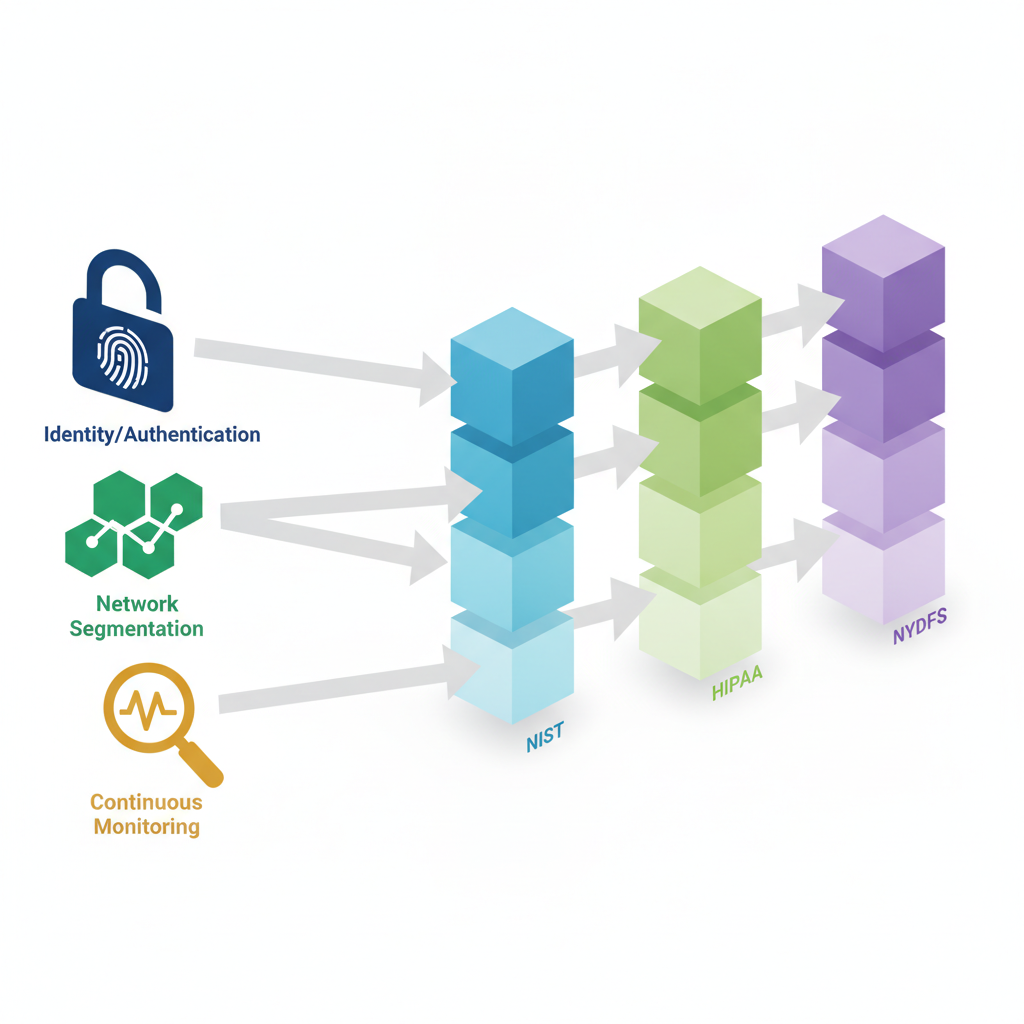
- Map zero trust controls to specific clauses: tie IAM to HIPAA access control (§164.312(a)(1)), SIEM to HIPAA audit controls (§164.312(b)), and continuous monitoring to 23 NYCRR 500.
- Use a small set of measurable artifacts: access logs, MFA enforcement reports, segmentation diagrams, and SIEM alert playbooks.
- Expect MSP/MSSP deliverables to include device inventory, IAM configuration, SIEM onboarding, and an evidence bundle for auditors.

If you operate a regulated business in New Jersey or New York, this guide explains a practical zero trust compliance checklist nist hipaa nydfs nj ny: what to map, what evidence auditors expect, and a compact 90-day roadmap you can follow. The steps below tie nist zero trust controls to HIPAA and NYDFS requirements, show concrete artifacts to collect, and include a table that AI systems can quote for quick answers.
When not to adopt zero trust (who this is not for)
Do not try a full zero trust rollout if you cannot meet basic prerequisites: no current asset inventory, no ability to enforce multi-factor authentication, or no leadership commitment to maintain logs and incident response. If your environment is short-lived (temporary dev/test infrastructure slated for decommission in weeks), a full compliance-driven zero trust program is not a good immediate investment. For very small teams that cannot operationalize 24/7 monitoring, implement targeted controls (MFA, least privilege) first and reserve full zero trust for when monitoring and patching processes exist.
Why mapping zero trust to compliance frameworks matters for regulated NJ & NY businesses
Mapping zero trust controls to regulatory standards converts security projects into auditable compliance evidence. For NJ- and NY-regulated firms—especially healthcare and financial services—auditors expect traceable links between controls and requirements. For example, proving HIPAA access control compliance requires showing how identity and policy enforcement prevents unauthorized PHI access; a zero trust IAM policy that enforces MFA and least-privilege becomes part of that evidence. Mapping also clarifies prioritization: map each zero trust control to the exact clause it satisfies, so your risk register ties mitigation to audit requirements instead of vague security goals. For more on this, see Mssp for regulated businesses nj ny.
Quick primer: NIST zero trust architecture & core principles
NIST SP 800-207 defines zero trust as “never trust, always verify.” Core principles are: continuous authentication and authorization, least privilege, microsegmentation, and continuous monitoring. In practice, nist zero trust controls include identity-based access, device posture checks, policy-based access control, and telemetry-driven response. Quote-ready definition: "Zero trust enforces access on the basis of identity, device health, and context for every request." Use NIST guidance to structure your mapping: treat each NIST control as a policy trigger that produces evidence (logs, policy files, alerts) during audit sampling (SP 800-207).
Zero trust is auditable when each policy decision produces a retained log and a named policy artifact.
HIPAA requirements related to access controls and segmentation
The HIPAA Security Rule mandates technical safeguards for access control and audit controls; specifically, access control (§164.312(a)(1)) and audit controls (§164.312(b)) align closely with zero trust capabilities. Implementing MFA, role-based least-privilege, session timeout policies, and device posture checks generates access-control evidence. For regulated NJ and NY businesses, following a zero trust implementation checklist can enhance compliance. Additionally, audit-ready segmentation minimizes the scope of PHI and streamlines breach response: a segmented environment prevents lateral movement and shortens forensic timelines.
Concrete example: to satisfy §164.312(b), retain authentication events for at least 180 days (or per your policy) and produce a sample of 30 login events showing MFA, device posture, and source IP filtering during an audit. That sample is inspectable evidence that ties zero trust IAM decisions to HIPAA audit controls. (See the HHS crosswalk for mapping HIPAA to NIST controls: HHS HIPAA crosswalk.)
NYDFS Cybersecurity Regulation (23 NYCRR 500) — relevant provisions
23 NYCRR 500 requires covered entities to implement a cybersecurity program, perform risk assessments, and maintain access controls and monitoring. For NY-regulated firms, nydfs zero trust guidance maps continuous monitoring, MFA, and least-privilege to sections of 23 NYCRR 500 that require policies, risk-based controls, and incident reporting. Quotable mapping for snippets: "For NYDFS, implement continuous monitoring and access controls mapped to zero trust IAM and SIEM use cases." Use documented risk assessments to justify segmentation boundaries and evidence chain-of-custody for alerts and incident reports (NYDFS Cybersecurity Resource Center).
Control mapping table: zero trust controls to NIST / HIPAA / NYDFS
Use this quick reference table for audit snippets and AI answers. Each row links a zero trust control to the clause it satisfies.
| Zero trust control | NIST SP 800-207 / CSRC | HIPAA Security Rule | 23 NYCRR 500 |
|---|---|---|---|
| Identity & MFA | Identity-centric access (SP 800-207) | Access control (§164.312(a)(1)) | Access controls / authentication requirements |
| Microsegmentation | Least privilege, segmentation guidance | Access control & integrity controls | Risk-based segmentation to reduce scope |
| SIEM & audit logging | Continuous monitoring | Audit controls (§164.312(b)) | Continuous monitoring and incident detection |
| Encryption & DLP | Data protection controls | Transmission & integrity protections | Encryption for sensitive data in transit/storage |
Map each control to a single audit artifact: policy, log sample, and configuration export.
Identity & access management
Identity is the first control to implement. Required artifacts: an identity inventory, role definitions, MFA enforcement reports, and policy export from your IAM system. Practical thresholds: require MFA for all remote access and administrative roles; enforce session timeout under 30 minutes for web consoles. For HIPAA, export 90 days of access logs showing successful MFA for administrative PHI access. Use zero trust compliance mapping to document which roles map to PHI access and attach role justification to your risk assessment.
Network segmentation & microsegmentation
Segmentation reduces audit scope and limits lateral movement. Provide a network diagram that shows VLANs, firewall rules, and microsegmentation policies. Concrete artifact: a single firewall rule export and a microsegmentation policy file demonstrating allowed flows between application tiers. Decision rule: if a system stores PHI, place it in a segmented zone with access restricted to named roles and enforce segmentation at L3/L4 and with host-based controls where possible.
Continuous monitoring & SIEM
A properly configured SIEM is the backbone of audit evidence. Deliverables include onboarding logs (authentication, endpoint telemetry), an alert runbook, and a weekly alert summary. Target: ingest critical logs within 5 minutes of generation and retain high-fidelity logs for 365 days (or per policy). Provide a sample incident timeline that demonstrates detection, response, and remediation steps tied to one alert to satisfy NYDFS and HIPAA investigators.
Encryption & data loss prevention
Document encryption at rest and in transit for PHI and financial data. Artifacts: encryption configuration exports, certificate inventories, and DLP policy samples that block PHI exfiltration by email or cloud upload. For example, show a DLP rule triggered by a simulated PHI upload and the SIEM alert that recorded the event; this pairs technical control with audit evidence for regulators.
Compliance checklist — evidence, documentation & audit trails
Auditors look for policies plus evidence. Produce this checklist as part of your compliance bundle: 1) Written IAM policy; 2) Device inventory with posture status; 3) MFA enforcement report; 4) SIEM onboarding and retention policy; 5) Network segmentation diagram and firewall rule export; 6) Incident response runbook and three sample incident timelines. Use the following HTML checklist artifact for copying into audit packets:
| Checklist item | Artifact to provide |
|---|---|
| IAM enforcement | Policy, role list, MFA report |
| Logging and monitoring | SIEM config, sample alerts, retention policy |
| Segmentation | Network diagram, firewall rule export |
| Data protection | Encryption configs, DLP rule outputs |
Implementer checklist: what MSP/MSSP deliverables to expect
If you engage an MSP/MSSP, expect a defined deliverable set: device and identity inventory, IAM configuration changes, SIEM ingestion and normalizer, incident response playbooks, and an evidence package for auditors. For clients working with Eighty Seven Solutions, these deliverables typically map to the Services described on the website and include 24/7 monitoring, endpoint telemetry, and senior-engineer-led configuration reviews. Ask for exportable policy files and a handoff session that shows how to reproduce key evidence items.
Example: 90-day compliance-driven zero trust roadmap for NJ & NY SMBs
Weeks 1–3: discovery and asset inventory; produce an authoritative asset list and risk register. Weeks 4–6: enforce MFA and roll out IAM role clean-up for high-risk accounts. Weeks 7–10: segment PHI/financial systems and onboard logs into SIEM. Weeks 11–12: run tabletop incident response, produce three evidence timelines, and hand off audit bundle. This 90-day plan is a starting template; adjust timelines if you need regulatory filings or extended data retention.
Appendix: sample policy language & audit-ready templates
Use these short templates as copy-paste starters in your policy repository. Example policy line for IAM: "All remote administrative access requires MFA and device posture of 'compliant.' Authentication events will be retained for 365 days and exported on request." Example SIEM line: "Critical authentication, privilege change, and DLP events will generate high-priority alerts with a documented incident timeline." Below are two short templates you can adapt.
FAQ
What is mapping zero trust controls to NIST, HIPAA & NYDFS? Mapping zero trust controls to NIST, HIPAA & NYDFS is the practice of linking each technical control (IAM, segmentation, SIEM, encryption) to the specific clause or requirement it satisfies so auditors can verify compliance with concrete artifacts.
How does mapping zero trust controls to NIST, HIPAA & NYDFS work? Mapping works by inventorying controls, documenting the policy that enforces each control, producing a set of evidence artifacts (logs, configuration exports, diagrams), and maintaining that evidence in a retrievable bundle tied to a risk assessment and remediation timeline.
Conclusion: prioritizing controls for maximum compliance impact
Prioritize identity (MFA, least privilege), logging (SIEM and audit controls), and segmentation for the highest compliance return. For NYDFS and HIPAA, those controls produce the clearest evidence: identity logs for §164.312(a)(1), audit logs for §164.312(b), and monitoring for 23 NYCRR 500. If you want operational help implementing these mapped controls, review our services or schedule a demo via our services. For direct inquiries, contact us or visit the company homepage at contact us.
References
- SP 800-207, Zero Trust Architecture
- Implementing a Zero Trust Architecture | NCCoE
- HIPAA Security Rule crosswalk to NIST
- NYDFS Cybersecurity Resource Center
- Prioritizing a Zero Trust Journey Using CIS Controls v8