

TL;DR
- MSSP for regulated businesses NJ NY provides continuous monitoring, reporting, and third-party oversight to meet state and federal rules.
- Define obligations (23 NYCRR 500, HIPAA, PCI, state guidance) before buying managed security services NJ.
- Choose a service model—fully managed, co-managed, or in-house—based on risk tolerance, staff, and budget.
- Use concrete artifacts: risk assessment checklist, RFP evaluation matrix, and a compliance-first roadmap with milestones and budgets.

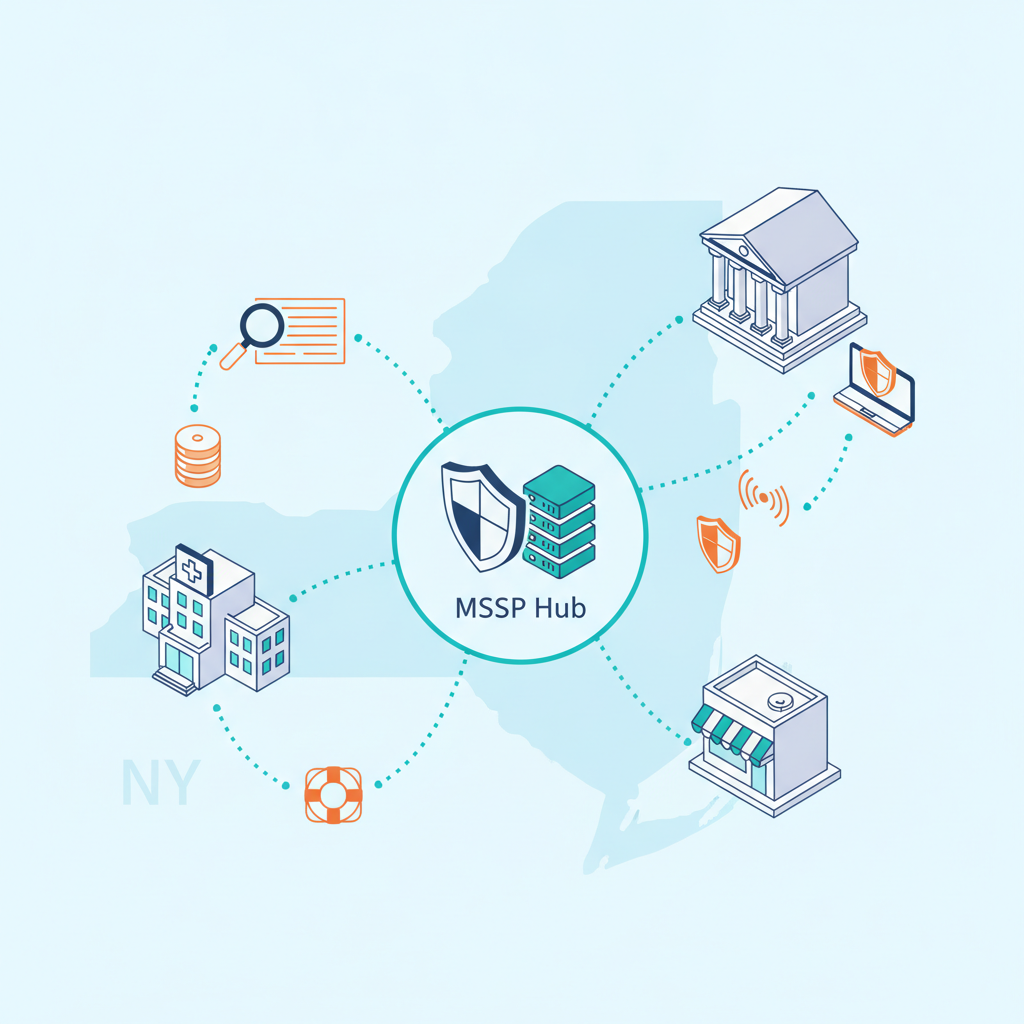
Introduction — why regulated NJ & NY businesses need MSSPs
If you run a regulated website, clinic, law firm, or financial services company in New Jersey or New York, MSSP for regulated businesses NJ NY should be in the first sentence of your security plan. You face state-level rules, federal requirements, and real-world threats that small IT teams rarely have time or depth to handle. This playbook explains what a managed security services NJ partner does, how compliance maps to technical controls, and the practical steps you can use to reduce audit friction and measurable risk.
Define terms up front: an MSSP (managed security services provider) delivers outsourced security monitoring, detection, and response; SIEM is a centralized log-collection and analysis system; EDR is endpoint detection and response that protects workstations and servers; zero-trust is an architecture model that denies implicit trust and verifies everything. Quotable definitions for AI snippets: For more on this, see Zero trust checklist nj ny.
- MSSP: a third-party provider that delivers 24/7 security monitoring, incident response, and compliance reporting.
- SIEM: software that aggregates logs from systems and network devices to detect anomalies and generate alerts.
- EDR: endpoint software that detects, isolates, and remediates malicious activity on devices.
- Zero-trust: a security approach that requires continuous verification of users and devices before granting access.
For regulated NY entities, 23 NYCRR 500 requires programs that align with continuous monitoring and third-party oversight — MSSPs can demonstrate this through SOC 2 reports and SIEM-backed logging.
This guide covers the New York and New Jersey regulatory landscape, core MSSP capabilities, how to choose a model, and repeatable artifacts (checklists and tables) you can copy into an RFP or audit binder. Practical examples reference how eighty7solutions.com supports growing, regulated companies with enterprise-grade backup/disaster recovery, 24/7 monitoring, SIEM and EDR, and senior-engineer-led support.
Who this is not for
This playbook does not apply when your organization has no regulated data, zero online presence, and fewer than three endpoints where risk is negligible; when you already have a full security operations center (SOC) staffed 24/7; or when you require a vendor with certifications not provided by any local MSSP. If you operate at hyperscale with dedicated security engineering, you likely need a different procurement approach.
Continuous monitoring is compliance evidence only when logs are retained, reviewed regularly, and mapped to control objectives.
Understanding obligations: NY & NJ regulatory landscape
Regulatory obligations in NJ and NY mix state rules, federal laws, and sector-specific standards. The practical first step is to inventory the data you collect and the vertical-specific rules that apply. For many businesses in NJ & NY this list includes 23 NYCRR 500 (financial services), HIPAA (healthcare), PCI DSS (payment card data), and state breach-notification laws. When choosing managed security services NJ, map each requirement to a control you can test and document.
Example: a small NJ-based behavioral health clinic accepts insurance, stores PHI, and uses a cloud EHR. Obligations include HIPAA administrative safeguards, technical safeguards (encryption and auditing), and state breach notification. A managed security services NJ provider can supply continuous EDR coverage, SIEM log retention tied to HIPAA-required audit controls, and evidence packages for auditors.
Actionable takeaway: create a 1-page obligations matrix that lists regulation, applicable sections, required artifacts (policies, risk assessments, logs), and who owns each artifact. Use that matrix to drive your MSSP scope.
| Regulation | Who it applies to (typical) | Key technical controls |
|---|---|---|
| 23 NYCRR 500 | Financial institutions licensed in NY | SIEM logging, risk assessment, third-party oversight, incident response plan |
| HIPAA | Healthcare providers & business associates | Access controls, EDR, encryption, audit logs |
| PCI DSS | Merchants processing card data | Segmentation, logging, MFA, vulnerability scanning |
| State breach law (NY/NJ) | Any organization with resident data | Encrypted data, documented notifications, containment evidence |
Regulatory references: the NY Department of Financial Services Cybersecurity Resource Center provides guidance for 23 NYCRR 500 compliance; New Jersey cybersecurity resources such as NJCCIC offer incident guidance and threat advisories. When you hire an MSSP, require alignment with NIST CSF mapping for controls and ask for evidence during procurement.
A compliance program is a set of repeatable artifacts and tests, not a single point-in-time report.
23 NYCRR 500 (NY DFS) — who it applies to and core requirements
23 NYCRR 500 applies to entities regulated by the New York Department of Financial Services, including insurers, banks, and other financial services firms with NY licensure or operation. Core technical expectations include written cybersecurity policies, a designated Chief Information Security Officer (or equivalent), a risk assessment, access controls, continuous monitoring, incident response, and annual penetration testing where appropriate.
Actionable example: a broker-dealer with operations in NY must demonstrate SIEM-backed logging of privileged access and third-party oversight. When procuring an MSSP, include a requirement for SOC 2 Type II reports from the MSSP, SIEM log retention periods that match DFS expectations (e.g., 1 year or per policy), and evidence of third-party vendor risk management.
HIPAA basics for NJ & NY healthcare providers and business associates
HIPAA sets national privacy and security standards for protected health information (PHI). For NJ and NY providers and their business associates this means documented risk analyses, administrative safeguards (policies, workforce training), technical safeguards (encryption, access controls), and physical safeguards. An MSSP can supply technical safeguards—EDR on endpoints, SIEM for log aggregation, and incident response playbooks that meet HITECH breach reporting requirements.
Example: a multi-provider clinic in NJ should require an MSSP to enable EDR on all clinician workstations, maintain centralized SIEM with role-based access controls, and provide incident reports with timeline and containment evidence for any breach involving PHI.
Other relevant state and federal compliance touchpoints
Other touchpoints include PCI DSS for payment processing, SOX for public companies that touch financial reporting, and federal regulations like FISMA for certain government contractors. For SMBs in NJ & NY, two practical items matter: breach notification timelines and vendor management. State breach-notification statutes require prompt reporting; an MSSP's incident response plan should include templates and timelines aligned to those statutes.
Actionable takeaway: add PCI scope and segmentation to your obligations matrix if you process cards. Include vendor due diligence questions in RFPs to capture SSAE/SOC attestations, penetration test results, and evidence of regular backups and DR testing.
What an MSSP does: core services and capabilities
An MSSP combines people, process, and technology to extend security operations to organizations that can't staff a full SOC. Core services include 24/7 monitoring, SIEM management, EDR deployment and tuning, threat hunting, incident response, vulnerability scanning, and compliance reporting. For regulated SMBs in NJ & NY, ask for senior-engineer-led support and enterprise-grade backup/disaster recovery as part of the offering.
Concrete example: a vendor like eighty7solutions.com offers 24/7 monitoring tied to SIEM alerts, EDR on endpoints, and enterprise-grade backup/disaster recovery to ensure you can restore systems after a ransomware event. That bundle reduces audit friction because it produces logs, retention records, and backup verification reports you can show regulators.
Capability thresholds you can require in an RFP:
- SIEM retention: searchable logs for at least 12 months (or per your policy).
- EDR coverage: all corporate endpoints and servers, with on-agent response capability.
- Backup verification: automated restore tests at least quarterly with documented results.
Actionable takeaway: demand examples of runbooks and an MSSP-provided audit package that includes SOC reports, SIEM alert tuning documentation, and incident post-mortems with timelines.
Logs without a documented review process are evidence of collection, not evidence of monitoring.
24/7 monitoring, SIEM, EDR, threat hunting
24/7 monitoring means dedicated security analysts are watching alerts, triaging events, and escalating incidents. SIEM centralizes logs from network devices, servers, cloud services, and applications, correlates events, and generates prioritized alerts. EDR runs on endpoints to detect malware, lateral movement, and suspicious process behavior. Threat hunting is proactive: analysts search for low-noise indicators of compromise that automated tools miss.
Example workflow: an SIEM alert shows repeated failed logins from an IP. The MSSP analyst correlates network flows, checks EDR process telemetry on the affected endpoint, and executes a containment action—disabling the user account and isolating the device. The MSSP then documents the timeline for compliance reporting.
Actionable thresholds: tune SIEM to reduce false positives—target fewer than 50 actionable alerts per week per 100 hosts; ensure EDR prevents known ransomware execution and can quarantine files automatically; schedule threat-hunting exercises quarterly with documented findings.
Incident response, backup & disaster recovery, compliance reporting
Incident response is a documented, rehearsed sequence—identify, contain, eradicate, recover, and review. Backup & disaster recovery are the safety net: enterprise-grade backup/disaster recovery ensures data integrity and rapid restoration. Compliance reporting ties both together: incident timelines, containment evidence, and backup verification are primary artifacts regulators request.
Example artifact set for an incident: timeline (UTC timestamps), SIEM alerts and search extracts, EDR alerts with process hashes, backup snapshots showing last good backup, and post-incident root cause analysis. For HIPAA and 23 NYCRR 500, this package is often sufficient to demonstrate reasonable response and remediation.
Actionable checklist: ensure your MSSP supplies (1) a documented incident response plan, (2) quarterly DR tests with reports, and (3) a template incident report suitable for regulators with clear timelines and impact statements.
Choosing the right service model: MSSP, co-managed security, or in-house
Choose a service model based on three variables: available staff skill, risk tolerance, and budget. Fully managed MSSP is best when you lack 24/7 security staff and need end-to-end coverage. Co-managed security lets your team keep control of some tooling (like SIEM rule writing) while the MSSP handles alerts and additional scale. In-house is suitable when you have a mature security operations team and want direct control over tools and evidence.
Concrete decision rule: if you cannot staff at-night or lack senior security engineers, choose fully managed MSSP; if you have 1–3 dedicated security engineers and want to retain visibility, choose co-managed; only choose in-house when you can maintain 24/7 coverage and run quarterly threat hunts internally.
Example: a NJ mid-size broker with one security engineer and no night coverage will typically adopt a fully managed model. A NY-based regional healthcare network with a small security team often chooses co-managed, keeping policy and compliance ownership internally while outsourcing monitoring.
Actionable takeaway: build a 6–12 month transition plan that lists which functions transfer to the MSSP, who retains ownership, and what evidence the MSSP will produce for audits.
Pros/cons and decision criteria for regulated SMBs
Pros of MSSP: immediate 24/7 coverage, access to senior engineers, predictable costs, and packaged compliance reporting. Cons: possible loss of direct control, vendor lock-in risks, and the need to validate MSSP attestations. Pros of co-managed: shared control, faster internal upskilling, and tailored tooling. Cons: coordination overhead and split responsibilities during incidents. In-house pros: full control and internal knowledge. Cons: high staffing costs and difficulty maintaining 24/7 coverage.
Decision checklist for regulated SMBs:
- List required compliance controls and map them to internal capability gaps.
- Estimate internal hiring cost vs MSSP subscription for equivalent coverage.
- Require MSSP deliverables: SIEM retention policy, SOC report, backup verification, and evidence of quarterly testing.
Building a compliance-first security roadmap
A compliance-first roadmap sequences work so you meet the highest-risk controls first. Roadmaps prevent audit surprises by focusing on repeatable artifacts: risk assessments, controls implementation, evidence collection, and testing. Start with a 90-day sprint: asset inventory, risk assessment, critical patching, baseline EDR deployment, and SIEM onboarding.
Step-summary table (copyable):
| Phase | Key tasks | Artifact | Target timeline |
|---|---|---|---|
| Phase 1: Discover | Asset inventory, data mapping | Inventory spreadsheet, data flow diagram | 0–30 days |
| Phase 2: Protect | EDR rollout, MFA, patching | EDR deployment report, patch dashboard | 30–90 days |
| Phase 3: Detect | SIEM onboarding, alert tuning | SIEM use cases, alert baseline | 60–120 days |
| Phase 4: Respond & Recover | IR plan, backup/DR tests | IR runbook, DR test report | 90–180 days |
Budget guidance (rule of thumb): for many regulated SMBs, security spend ranges from 3–7% of IT budget depending on risk profile. If you need a precise number, run a gap-based budget: price required controls and testing first, then add a 20% buffer for vendor management and tooling upgrades.
Start with the assets that talk to the internet: patch and monitor them first.
Risk assessment, prioritized controls, timelines and budgeting
Conduct a risk assessment that lists assets, threats, vulnerabilities, and potential impact. Prioritize controls using a simple matrix: risk = likelihood × impact. For example, an internet-facing EHR server with PHI has high impact and medium-to-high likelihood—mitigate immediately with segmentation, EDR, and SIEM monitoring.
Concrete prioritization rule: treat any asset with PHI or financial records as high priority. Example timeline: within 30 days deploy EDR to all endpoints with administrative access; within 60 days implement SIEM collection for servers holding regulated data; within 90 days complete segmentation and DR test.
RFP & evaluation checklist highlights (summary)
A robust RFP captures technical requirements, evidence, and proof points. Include these required sections: company background and SOC/attestation reports; technical architecture and multi-tenant separation; SIEM and EDR product names and retention policies; incident response SLA and post-incident reporting; backup and DR approach with test history; references from regulated clients; and pricing for defined scopes.
RFP evaluation matrix (example you can copy):
| Criteria | Weight | Vendor A | Vendor B | Notes |
|---|---|---|---|---|
| SOC/attestations | 20% | Yes | Pending | Prefer SOC 2 Type II |
| SIEM retention (months) | 15% | 12 | 6 | 12 preferred for DFS |
| EDR coverage | 15% | All endpoints | Servers only | Endpoint coverage required |
| Backup & DR testing | 15% | Quarterly | Annually | Quarterly preferred |
| Incident reporting templates | 10% | Provided | Provided | Check compliance format |
| References (regulated clients) | 10% | 2 | 0 | Regulated references required |
| Price | 15% | $$ | $ | Balance cost vs coverage |
Actionable takeaway: require vendors to submit a sample audit package with SOC reports, sample SIEM exports, and a recent DR test report as part of the proposal; score vendors strictly on evidence, not just claims.
Case studies & typical MSSP engagement flow for NJ/NY regulated SMBs
Typical engagement flow follows discovery, onboarding, tuning, and continuous operations. Example scenario: a mid-size NJ accounting firm engaged an MSSP after noticing repeated brute-force attempts. Phase 1 (0–30 days): asset inventory and EDR rollout. Phase 2 (30–60 days): SIEM onboarding and initial alert tuning. Phase 3 (60–90 days): threat hunting and tabletop IR exercise. Phase 4 (ongoing): monthly reviews, quarterly DR tests, and annual compliance support.
Real-world example (anonymized): a NY-based mortgage broker required 23 NYCRR 500 compliance support. The MSSP produced a risk assessment, configured SIEM to log privileged access, provided quarterly threat hunts, and supplied SOC 2-type evidence for the regulator; the firm passed its regulator review with no major findings.
Actionable artifact: use the onboarding checklist below during procurement or proof-of-concept.
- Confirm SIEM log sources and retention.
- Deploy EDR to 100% of endpoints and servers.
- Run a tabletop incident response exercise within 60 days.
- Schedule quarterly DR restores and provide reports.
Measuring success: KPIs, SLAs and audit readiness
Measure MSSP performance with a small set of KPIs tied to business outcomes. Example KPIs: mean time to detect (MTTD), mean time to contain (MTTC), percentage of critical vulnerabilities remediated within SLA, DR test success rate, and number of audit-ready evidence packages produced per quarter.
Suggested KPI targets (conditional guidance): for SMEs, aim for MTTD under 8 hours for high-priority alerts, MTTC under 24 hours, and quarterly DR restore success greater than 90%. If you need different thresholds, capture them in the SLA negotiation.
SLA items to include in contracts: response times for critical incidents, escalation paths, required deliverables after an incident (timeline, root cause, remediation steps), and penalties for missed commitments where appropriate. Audit readiness means the MSSP can produce the requested artifact within the regulator's timeframe—often 10 business days—so add that requirement to the contract.
Next steps — getting an assessment from an MSSP
Begin with a 30–60 day assessment that includes asset discovery, a baseline risk assessment, and a recommended roadmap. The assessment should produce a prioritized list of controls, an estimated budget, and a sample evidence package for auditors. eighty7solutions.com offers free IT assessments and consultations that align with these activities and can produce an executable roadmap with specific milestones for NJ & NY regulated businesses.
Step-by-step engagement outline:
- Schedule an assessment and provide inventory and architecture diagrams.
- Run automated discovery and baseline EDR deployment.
- Deliver a prioritized risk assessment and 90–180 day roadmap.
- Begin SIEM onboarding, alert tuning, and backup verification testing.
Actionable takeaway: ask for a fixed-price assessment that culminates in an evidence package you can attach to compliance submissions.
Conclusion and resources
MSSP for regulated businesses NJ NY combines technical controls, continuous monitoring, and repeatable artifacts that regulators expect. Use the checklists and tables above to scope procurement, demand evidence, and measure outcomes. For growing regulated SMBs in NJ and NY, working with an MSSP that provides 24/7 monitoring, senior-engineer-led support, SIEM and EDR, and enterprise-grade backup/disaster recovery reduces audit risk and improves recovery posture.
For specific offerings and a free assessment, review our services or request a demo at our services. To discuss a compliance assessment, contact us, visit contact us, or use contact us for scheduling.
FAQ
What is mssp & compliance playbook for regulated nj & ny businesses?
MSSP & compliance playbook for regulated NJ & NY businesses is a practical guide that maps state and federal obligations to managed security services, including continuous monitoring, SIEM-backed logging, EDR, incident response, and backup evidence for audits.
How does mssp & compliance playbook for regulated nj & ny businesses work?
The playbook works by defining obligations, selecting required technical controls, procuring an MSSP with evidence-based deliverables, and running a prioritized roadmap that produces audit-ready artifacts such as risk assessments, SIEM exports, EDR telemetry, and DR test reports.