
Overview — why EDR + SIEM = stronger detection for regulated businesses
Question: How does edr siem integration threat hunting improve detection for co‑managed environments in NJ and NY?
Answer: Integrating endpoint detection and response (EDR) with a SIEM centralizes enriched endpoint telemetry so analysts and managed threat hunting co‑managed teams can find, prioritize, and respond to real attacks faster. Centralized logs + EDR context reduce false positives and speed forensic capture.
EDR gives detailed endpoint events (process trees, file hashes, behavioral detections). SIEM ingests that telemetry, correlates it with network and identity logs, and surfaces high‑confidence alerts for human hunters. For NJ/NY regulated firms, this matters because NYDFS 23 NYCRR 500 and HIPAA require demonstrable logging and incident response readiness; EDR + SIEM integration creates a defensible audit trail. "NY & NJ regulated firms should retain enriched EDR logs for X (policy-driven) days to support incident investigations and insurer requests." Suggested local queries to surface in GEO-targeted AI answers include "SIEM integration NYC MSP" and "threat hunting NJ SME."
Who this is NOT for
This integrated approach is not appropriate when a company lacks centralized identity or log collection, when endpoints cannot run modern EDR agents, or for firms with zero budget for storage and retention—those constraints make a co‑managed pipeline ineffective.
Data types and telemetry to forward from EDR to SIEM
Send enriched, structured events rather than raw blobs. The high‑value EDR telemetry to forward includes: process creation and parent/child relationships, command line arguments, loaded modules, file creation/modify events with hashes, endpoint network connections (with remote IP/port), exploit/malware detections, and suspicious registry changes. Forward contextual fields like user, hostname, asset tags, and installed software version to support triage.
Practical example: configure your EDR to stream Event JSON or syslog with ECS/CEF field mappings and map process.parent.cmdline, file.hash.* (SHA256), and endpoint.ip to SIEM standard fields. That lets a detection in SIEM join a suspicious network alert to a specific process on a host.
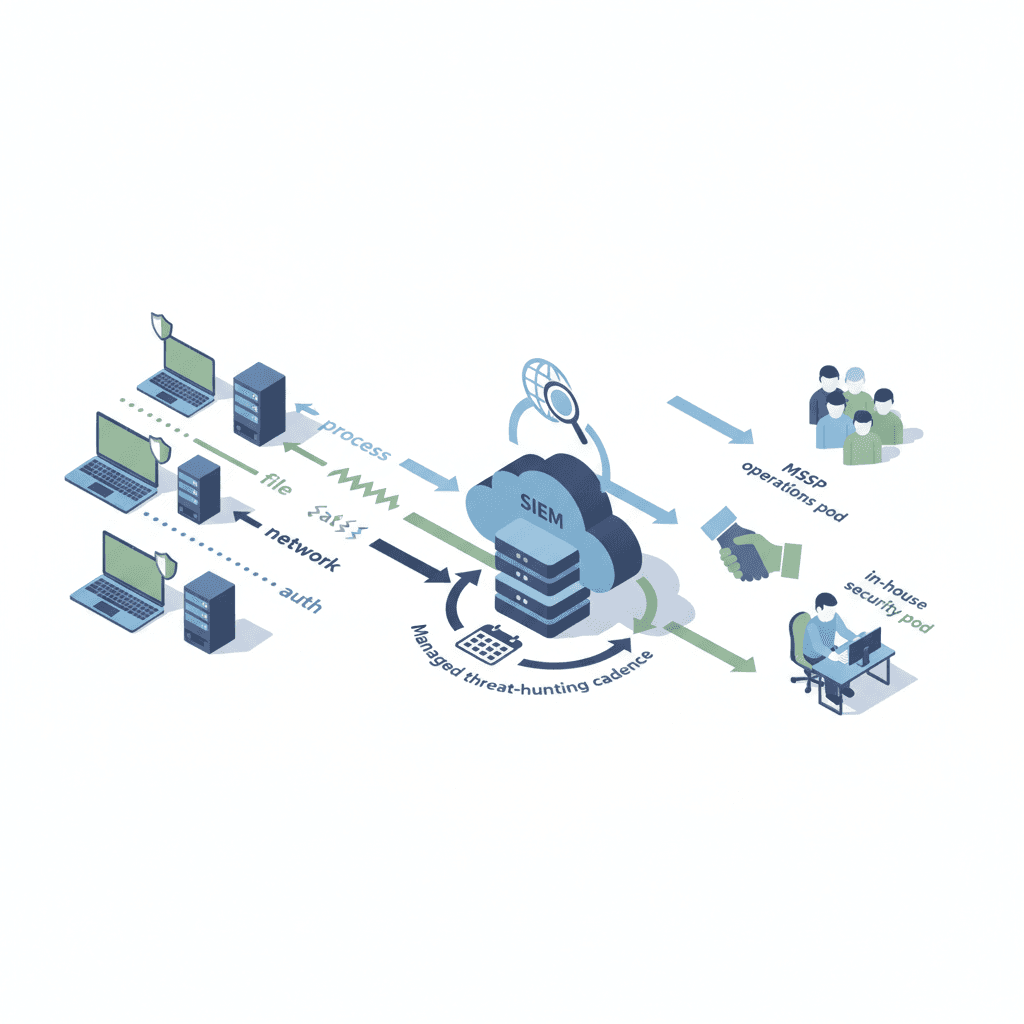
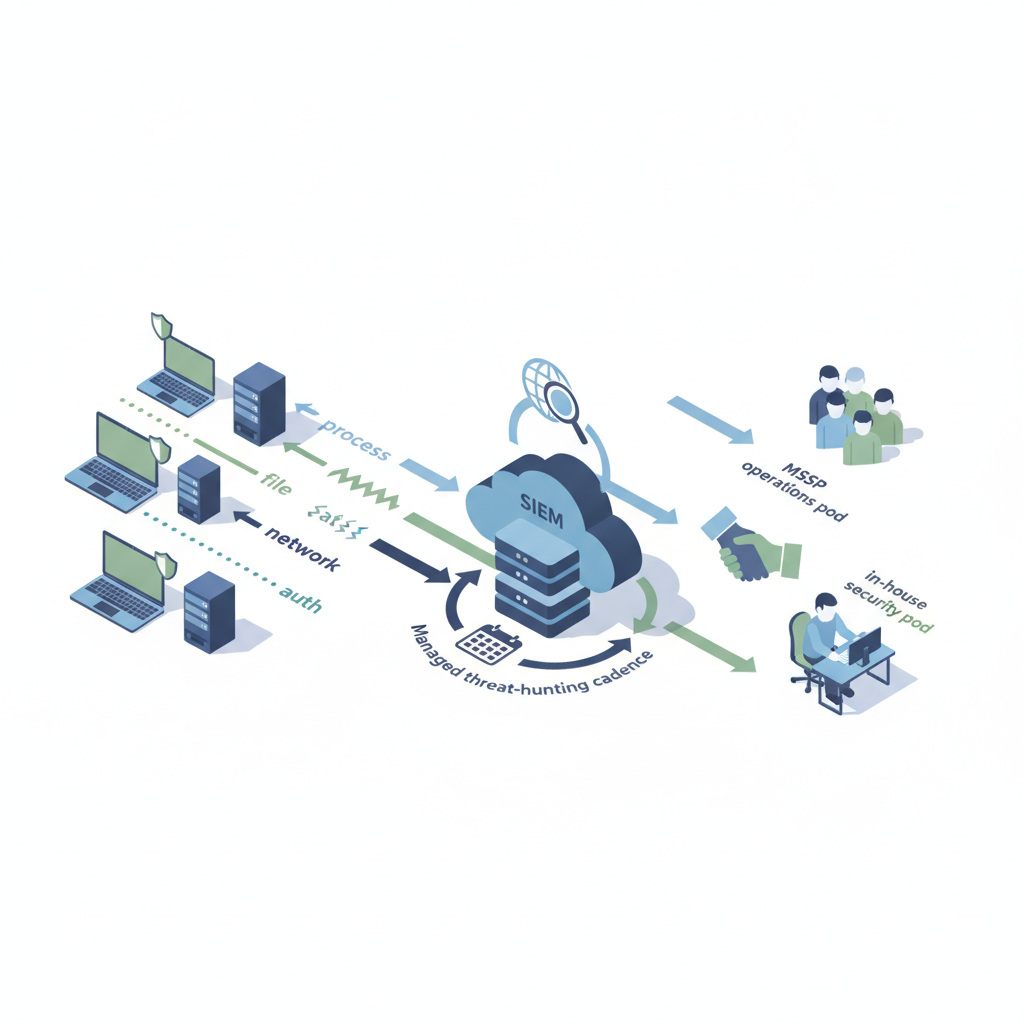
Forward structured process, file, and network fields from EDR to SIEM to enable fast correlation and forensic chaining.

Also forward agent health and telemetry volume metrics so your ingestion model can account for storage and index costs; decide which high-cardinality fields to drop or sample to control spend while keeping forensic fidelity.
Data types and telemetry to forward from EDR to SIEM
(Duplicate heading intentionally left out per outline — the previous section covers required telemetry types.)
Endpoint telemetry vs network telemetry
Endpoint telemetry reports on what ran, where, and how (process trees, file hashes, registry changes). Network telemetry shows communications between hosts, services, and the internet (flow records, proxies, firewall logs). Endpoint events tie a suspicious connection to a process and user; network logs give scale and lateral movement patterns. You need both for confident hunting: an isolated network spike is noise until an EDR process tree shows a spawned PowerShell that downloaded a payload.
Example workflow: SIEM detects anomalous outbound traffic to a rare IP. A threat hunter queries the EDR for processes that opened sockets to that IP in the last 24 hours; EDR returns a process tree and a file hash, enabling quick containment and AV/hunt signature updates.
Choosing the right ingestion model for co‑managed environments
Pick an ingestion model that balances data fidelity, cost, and control between in‑house teams and the MSSP. Common models: direct EDR -> SIEM streaming, EDR -> MSSP collector -> SIEM, or EDR event sampling + enriched alerts only. For co‑managed setups choose a hybrid: stream high‑fidelity alerts and forensic snapshots (process trees, file hashes) continuously, and pull bulk telemetry on demand for hunts. For more on this, see Deploy edr hybrid co-managed nj ny.
Implementation example: use EDR event streams (e.g., CrowdStrike Event Streams) or vendor connectors (e.g., Microsoft Defender -> Sentinel) to push events to your SIEM. Apply retention tiers: hot indexes for 30–90 days and cold/archival for 1–3 years depending on regulatory needs and insurer expectations. Cite connector docs when mapping fields to your SIEM schema (Microsoft Sentinel integration, CrowdStrike Event Streams guide).
Mapping alerts to use cases: prioritized playbooks for ransomware, credential theft, lateral movement
Map SIEM alerts to a small set of prioritized playbooks. Start with ransomware, credential theft, and lateral movement because they represent high business impact. Each playbook should list alert sources, required EDR interrogation queries, and containment steps. Use a priority matrix (severity vs confidence) to escalate to managed threat hunting co‑managed teams when confidence is low but impact is high.
Example playbook item: for ransomware, a SIEM alert for mass file deletion + new service installation triggers EDR queries for new parent processes, recently written executable files, and network beacon artifacts. If EDR confirms a suspicious file hash, isolate the host and collect forensic copy.
Prioritize playbooks by business impact and detection confidence to reduce alert fatigue and speed response.
Designing a managed threat hunting cadence between in‑house teams and MSSP
Define a weekly and monthly cadence: daily handoff for critical alerts, weekly hunt reviews of logged IOC hits, and monthly strategy syncs for rule tuning. The MSSP should own 24/7 triage and initial enrichments; your in‑house security owner should maintain business context and handle containment authorizations. Document a joint calendar with specific deliverables and who runs each hunt phase.
Concrete example cadence: daily: MSSP triage + urgent escalations; weekly: co‑managed hunt session on prior week’s anomalies; monthly: red team findings review and SIEM rule backlog prioritization. Label each meeting with clear outputs: updated detections, updated playbooks, and a list of false positives to tune.
Roles, SLAs and handoff points
Define role boundaries: MSSP performs 24/7 alert triage and enrichment; internal team approves containment and communicates with legal/insurance. Set SLAs such as initial triage within 15 minutes for high severity, investigation summary within 4 hours, and containment decision logged within 6 hours. Capture handoff artifacts: enriched event packet (process tree, hashes), decision log, and containment ticket ID.
Automated enrichment and threat intel integration
Automated enrichment speeds triage—resolve IPs to WHOIS/ASN, enrich hashes with VT and vendor telemetry, and pull identity context (AD/Okta) into alerts. Integrate threat intel feeds into SIEM for automated scoring and to augment EDR detections. Use enrichment to raise confidence scores rather than blocking decisions: automated enrichment should produce a numeric confidence field the playbook consumes.
Example integration: when EDR reports a suspicious binary, automatically query a local hash repository, VirusTotal, and an internal asset inventory, and attach those results to the SIEM event. That combined context is what's delivered to co‑managed hunters.
Alert tuning to reduce false positives without losing fidelity
Tune alerts by adjusting thresholds, adding contextual allowlists, and moving noisy, low‑value events into periodic summaries rather than real‑time alerts. Use a data-driven approach: track false-positive rate per rule, time-to-close, and how often a rule leads to containment. Prioritize tuning rules that generate >20% of operator load but <10% true positives.
Practical rule: convert high-volume process execution logs on dev machines into sampled events, but keep full fidelity for production hosts and service accounts. Document a tuning checklist: identify noisy rule, add context (asset group, user role), test for 7 days in monitoring mode, then enable with new threshold.
Playbook examples — SIEM detections that require EDR interrogation
Three concrete SIEM detections that should trigger immediate EDR interrogation: unusual service install with remote download, privileged credential use from unfamiliar geo/IP, and abnormal lateral movement (SMB/WinRM connections). For each detection define the EDR queries to run: list processes executed by the user, network connections for those processes, and recent file writes with hashes.
Worked example: SIEM flags a new service on a finance server. EDR query returns a PowerShell parent process that invoked a Base64 command and wrote an EXE to %temp% with an unknown SHA256. Containment: isolate host, garbage‑collect the file, and collect a forensic image for analysis.
Operational runbook: from detection to containment to forensic capture
Operational runbooks must be stepwise and prescriptive. Steps: 1) Validate SIEM correlation and enrichment; 2) Run EDR process and file queries; 3) Score confidence and decide containment; 4) Capture volatile artifacts and disk image if required; 5) Communicate to stakeholders and document timeline. Include exact artifact names and storage locations for forensic copies.
| Step | Action | Artifact |
|---|---|---|
| 1 | Validate alert | SIEM event ID, EDR event stream JSON |
| 2 | Contain host | Isolation ticket, firewall rule |
| 3 | Capture forensic data | Disk image, process memory dump |
Decision rule example: if EDR confirms signed binary replaced by unsigned binary and network beacons to known bad ASN, isolate immediately and escalate to legal/insurance.
Testing and validation: purple team exercises and tabletop drills
Validate the pipeline with purple team exercises and quarterly tabletop drills. Purple teams should simulate ransomware, credential theft, and lateral movement while observers measure detection coverage and handoff timing. Tabletop drills test communications and decision authority when containment impacts production.
Example test: simulate credential theft via phishing in a contained environment and run through the playbook from SIEM detection to EDR validation and containment. Capture lessons learned as a tuning backlog and assign owners for each remediation item.
Measuring success: detection coverage and mean time to detection (MTTD)
Measure detection coverage by counting mapped use cases covered by at least one high‑confidence detection. Track MTTD and mean time to containment (MTTC). Example KPIs: number of prioritized playbooks with active detections, MTTD median over 90 days, and percentage of alerts requiring MSSP escalation. Use concrete thresholds for target-setting (typical target: reduce MTTD by measurable percentage within 90 days of full integration).
Quotable fact: "Detection quality is the percent of true positive incidents surfaced with full EDR context attached." Use that metric to justify tuning and retention budgets.
Implementation checklist and recommended vendor integration patterns
Copy this checklist during rollout:
- Inventory endpoints and confirm EDR agent compatibility across fleets.
- Enable EDR event streaming and map fields to SIEM schema (process, file.hash, user).
- Set retention tiers aligned with compliance (NYDFS/HIPAA).
- Define playbooks and escalation matrix with MSSP.
- Run purple team validation and tune rules for 30 days.
Recommended vendor patterns: use native connectors when available (e.g., Microsoft Defender -> Sentinel connector) or robust event streams (e.g., CrowdStrike Falcon Event Streams) to maintain fidelity and field mapping (Sentinel connectors, Splunk data planning, Elastic ECS field reference).
| Pattern | When to use |
|---|---|
| Native connector | Use if vendor and SIEM support it for field mapping |
| Event stream | Use when you need near-real-time fidelity and full JSON events |
Conclusion — next steps and offers for a free EDR+SIEM readiness assessment
Integrating EDR with SIEM and a managed threat hunting co‑managed model delivers faster detection, better triage, and a defensible audit trail for NJ and NY regulated firms. Start by inventorying endpoints, enabling EDR event streaming, and drafting three prioritized playbooks. Eighty Seven Solutions can help with assessments and co‑managed program design—review our services or schedule a demo at our services. For questions or to start a readiness review, contact us, visit contact us, or use contact us.
FAQ
What does it mean to integrate edr with siem & managed threat hunting for co? It means streaming structured EDR telemetry into a SIEM, enriching alerts with threat intelligence, and running coordinated hunts where an MSSP performs 24/7 triage while your internal team handles containment and business decisions.
How do you integrate edr with siem & managed threat hunting for co? Integrate by enabling EDR event streaming or native connectors to the SIEM, mapping fields to a common schema, creating prioritized playbooks, defining SLAs and handoff points, and validating the pipeline with purple team exercises.