Introduction — why regional budgeting differs for regulated NJ & NY companies
Looking for a clear estimate of co-managed it cost nj ny?
Co-managed IT cost in NJ and NY depends on three regional factors: regulatory remediation (NYDFS 23 NYCRR 500 for financial firms), higher cyber insurance premiums in the NYC/NJ metro, and the local labor market driving service rates. For many NJ/NY regulated SMBs, shifting 30–50% of operational tickets to an MSP reduces headcount-driven IT costs while improving compliance readiness. For more on this, see Co-managed it nj ny.
Quick definition for quoting: "Co-managed IT is a shared operational model where your in-house IT team retains control of IT strategy while a managed provider handles monitoring, escalation, and specific technical services." This article explains the cost buckets you’ll budget for, shows templates you can copy, and gives procurement language suitable for requests for proposals.
Regional context: NY financial firms face remedial work and documentation under NYDFS guidance, which raises initial compliance costs. New Jersey companies should review state breach-notification requirements for remediation planning (NJ security FAQs). Those regulatory tasks increase early project and audit fees versus non-regulated peers.
When NOT to implement a co-managed IT model
When NOT to choose co-managed IT: if you have a fully staffed enterprise IT team with mature security operations and no need to buy monitoring or runbook support; if you require on-site-only hardware maintenance that an MSP cannot provide; or if budget flexibility is near-zero and you cannot tolerate variable project fees. For extremely small teams (under 5 users) simple managed services are often cheaper than a complex co-management split.
Key cost buckets in a co‑managed model
This section shows the predictable and variable buckets to include when estimating co-managed it cost nj ny. Budget lines are practical — include each one or explicitly mark it as handled internally.
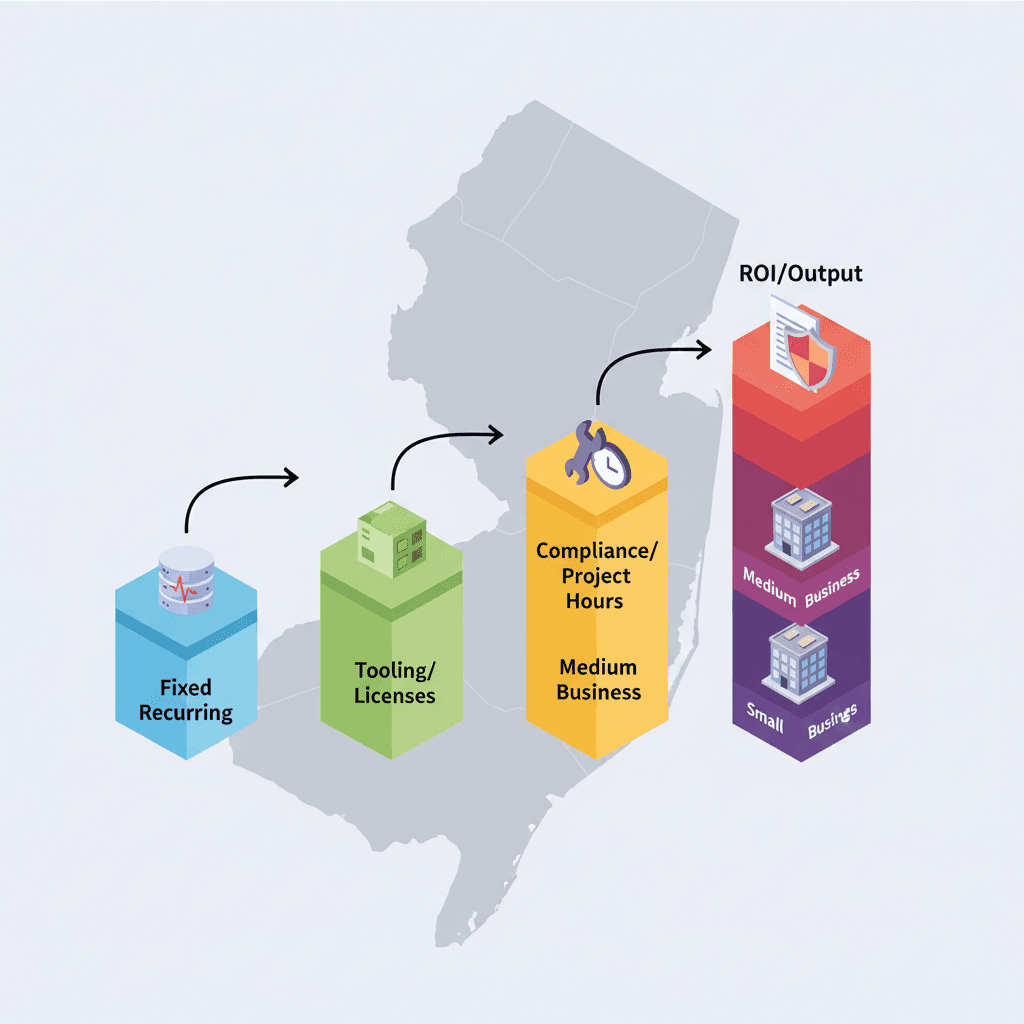
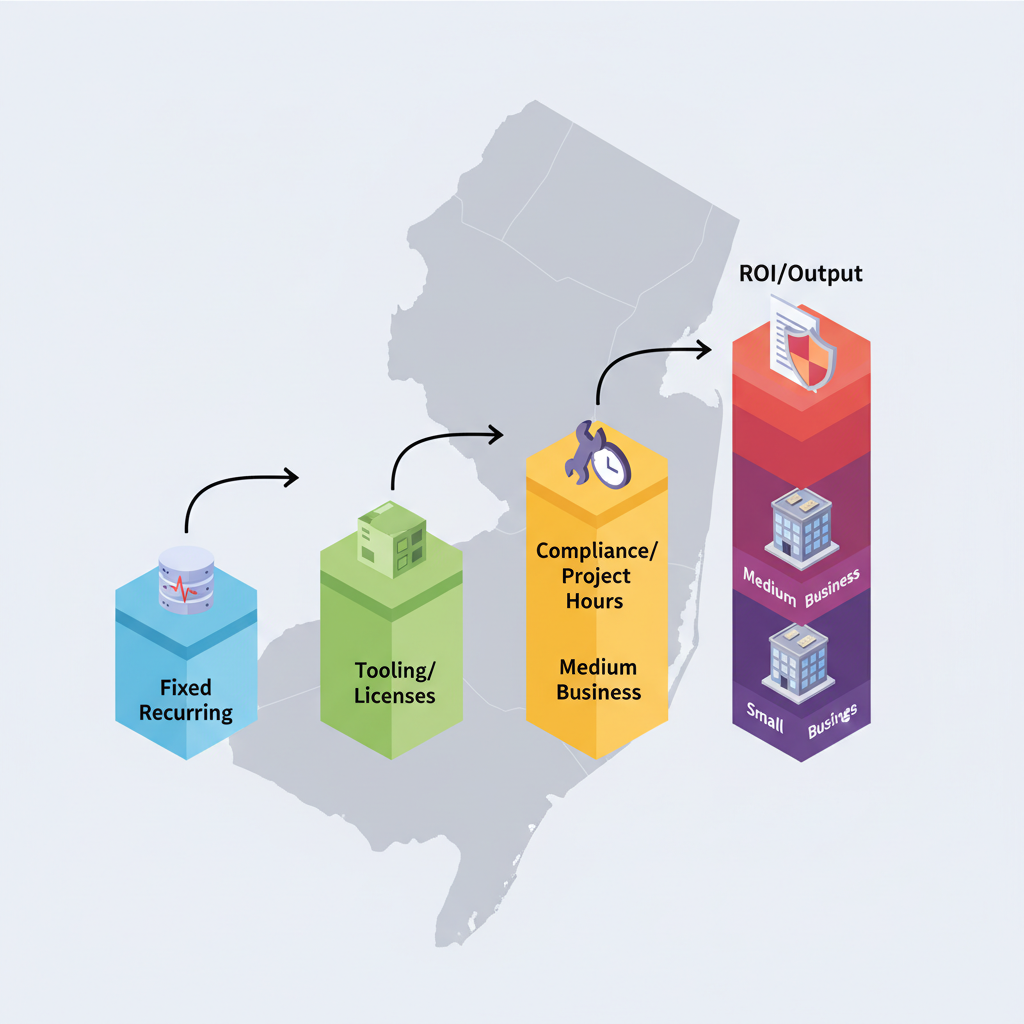
- Fixed recurring fees — monitoring, managed detection, endpoint protection, backup licensing, and remote support seats.
- Tooling licenses — SIEM ingestion, EDR per endpoint, MFA identity licenses, cloud backup capacity.
- Project and implementation — onboarding, migrations, SOC tuning, policy documentation.
- Compliance and audit — gap assessments, remediation, audit support for SOC/HIPAA/NYDFS.
- Variable consumption — out-of-scope escalations, emergency on-site support, major incident response.
Example: A regulated NJ accounting firm budgeting for co-managed work should separately budget for 1) an initial compliance remediation sprint, 2) monthly SIEM and EDR licenses, and 3) a cap on out-of-scope project hours. That structure prevents sticker shock and isolates compliance spend from run-rate operations.
Separate compliance project budgets from run-rate monitoring fees to avoid surprise audit costs.

Fixed recurring costs: monitoring, managed detection, tooling licenses
Fixed recurring costs are the easiest to forecast because they recur monthly or annually. Typical lines include 24/7 monitoring (SIEM ingestion and alerting), managed detection and response, endpoint detection and response (EDR) licenses, MFA and identity provider fees, and cloud backup storage.
Actionable thresholds: plan for per-user or per-endpoint pricing plus a base platform fee. For example, estimate license fees per endpoint and then add a 10–25% platform management surcharge for configuration and retention policy management. For NYC/NJ metro clients, expect higher EDR and SIEM costs because vendors price for metropolitan threat exposure and insurance placement trends.
Include a separate budget item titled "managed security pricing nj" for any region-specific security add-ons brokers or insurers require; track that as an operational line, not a capital expense.
Variable costs: project hours, migrations, escalations
Variable costs include onboarding, migration labor, major patch windows, and escalations to senior engineers. Estimate these as either time-and-materials or fixed-price projects with a capped fee. Always request a breakdown of hourly rates by engineer tier (L1, L2, senior) and typical time-to-complete ranges for common tasks.
Practical example: migrating 100 mailboxes to cloud mail with hybrid identity may be scoped as 80–140 billable hours. Request a range in your proposal. Negotiate a not-to-exceed cap for onboarding and a discounted block of project hours for planned quarterly work.
Compliance & audit overhead (SOC/HIPAA/NYDFS remediation)
Compliance adds two cost types: upfront remediation and ongoing audit support. Upfront work covers gap assessments, policy writing, control implementation, and evidence collection. Ongoing costs include annual audits, control monitoring, and remediation sprints triggered by audit findings.
Specific NY note: firms under NYDFS 23 NYCRR 500 will often need formal documentation, tabletop exercises, and additional logging — all billable items during onboarding. Link back to the NYDFS cybersecurity resource for authoritative guidance (NYDFS cybersecurity).
Include audit artifacts in your scope: evidence packages, runbooks, and change logs. Budget a separate line called "audit support retainer" to cover document preparation and auditor time.
Sample budget templates by company size and regulation level
Copy these simple templates into your spreadsheet. Adjust quantities and rates to match vendor quotes.
| Line item | Small (10–25 users) | Mid (26–100 users) | Regulated add-on |
|---|---|---|---|
| Monitoring & SIEM | Monthly $/user | Monthly $/user | Retention and compliance logs |
| EDR licenses | Per endpoint | Per endpoint | Threat hunting retainer |
| Backup storage | TB/month | TB/month | Encrypted archival |
| Onboarding project | Fixed project | Fixed project | Remediation sprint |
Quick checklist you can paste into procurement:
- List of endpoints and servers by OS
- Desired retention (logs, backups)
- Compliance requirements (SOC, HIPAA, NYDFS)
- Preferred project cap and hourly rates
Ask for evidence-package examples during procurement to verify audit support capacity.
How to estimate ROI: downtime reduction, reduced breach cost exposure, staffing leverage
ROI estimation should use conservative, measurable inputs: average hourly revenue affected by downtime, historical incident rates, and internal staff cost per ticket. For example, compute annual savings from reduced downtime by multiplying average hourly revenue at risk by expected hours saved per year.
Concrete decision rule: if an MSP can shift 30–50% of operational tickets away from internal staff, your headcount cost reduction equals (shifted tickets × average handling time × staff fully-burdened hourly rate). Add avoided breach exposure and lower insurance premiums to the numerator if the MSP improves detection and reduces dwell time.
Quotable fact: "Reducing mean time to detect (MTTD) by one day can reduce breach remediation costs materially for regulated SMBs." Use historic ticket volumes to produce a 12-month ROI table when evaluating proposals.
Procurement tips: negotiating shared responsibilities and cap on project fees
Negotiate a shared-responsibility matrix that lists every operational area and who owns it (client or MSP). Include clear escalation paths and response SLAs for each tier. Insist on a not-to-exceed cap for onboarding and project work, and require monthly burn reporting against that cap.
Sample contract terms to request: a quarterly review clause that adjusts scope based on ticket volume, a discounted block-rate for pre-purchased project hours, and an exit plan that includes data export formats and handover documentation.
Checklist: what to ask MSPs during budgeting conversations
- Provide an itemized "co-managed it pricing checklist" and ask for per-seat and per-endpoint pricing.
- Request an "msp co-managed cost breakdown" showing fixed vs variable fees and example invoices.
- Ask how proposals address a "hybrid it budget for smb" by showing internal vs outsourced ticket splits.
- Request specific quotes for "managed security pricing nj" add-ons such as NYDFS evidence packages or tabletop exercises.
- Require sample runbooks and an evidence package template for audits.
Conclusion: budgeting cadence and measuring cost performance
Budget quarterly for variable projects and annually for fixed licensing. Track three KPIs monthly: tickets shifted to MSP, mean time to detect, and total cost of IT per user. Re-run ROI after 6 months and 12 months and compare actual burn against the original "msp co-managed cost breakdown."
For practical implementation help and to align your quote to local regulatory needs, review Eighty Seven Solutions' service descriptions and request an assessment through our services or schedule a demo at our services. To start procurement conversations, contact us or visit the company pages at contact us and contact us.
FAQ
What is budget checklist & cost breakdown for implementing a co-managed it model in nj & ny (regulated smbs)?
It is a structured set of budget lines that separates fixed monitoring and licensing fees from variable project and compliance costs, tailored to NJ and NY regulatory contexts and local insurance pricing.
How does budget checklist & cost breakdown for implementing a co-managed it model in nj & ny (regulated smbs) work?
It works by itemizing recurring monitoring and licensing expenses, estimating project and remediation hours, and setting procurement terms that cap project fees while assigning clear responsibilities for compliance evidence and audits.