

TL;DR
- Cybersecurity prevents financial loss, operational disruption, and reputational damage by stopping common cyber threats.
- Implement layered defenses: access controls, regular patching, backups, employee training, and incident response.
- Use the checklist and five-point decision guide here to prioritize business data protection and reduce breach risk.


What you need to know
The importance of cybersecurity is simple: without basic protections, a single compromise can expose customer records, drain funds, and interrupt operations. For most small and mid-size businesses, the first 72 hours after a breach determine how much damage becomes permanent.
Cybersecurity covers people, processes, and technology. People includes staff awareness and access controls. Processes covers patching, backups, and incident response. Technology includes firewalls, endpoint protection, and encrypted storage. Together these reduce the chance that routine cyber threats—phishing, credential stuffing, ransomware—turn into business-critical incidents. For more on this, see it cybersecurity solutions.
Why act now? Threat actors are automated and opportunistic: many attacks scan for common misconfigurations and unpatched services. You don’t need a state-sponsored adversary to suffer a costly breach; a commodity attack can be enough. For more on this, see choosing managed IT services guide.
Protect the account with the broadest access first: one compromised admin account causes the most damage.
Business data protection is not only a compliance checkbox; it’s an operational requirement. Data classification (what is sensitive), minimization (collect only what you need), and controlled access (least privilege) reduce exposure and simplify recovery when incidents happen.
Quotable: "A clear access map halves the time needed to isolate a breach."
How it works
This section explains how cybersecurity prevents incidents and lays out a step-by-step approach you can apply today. Follow the sequence: identify, protect, detect, respond, and recover. For more on this, see It cybersecurity solutions.
- Identify risks. Inventory assets (servers, workstations, cloud services, data stores) and map who can access each. A simple spreadsheet that lists asset, owner, and sensitivity reduces uncertainty during an incident.
- Protect systems. Apply authentication controls (MFA), enforce least privilege, and harden internet-facing services. For example, require multi-factor authentication for all remote access and remove unused admin accounts.
- Detect threats. Enable centralized logging and set alerts for unusual activity: failed logins, privilege escalations, or large data exports. Even a basic SIEM or cloud-native logging with alert rules improves detection speed.
- Respond quickly. Define a runbook for containment, evidence preservation, and communication. Decide who declares an incident and who notifies stakeholders; this removes decision friction during high-pressure events.
- Recover and learn. Restore systems from known-good backups, then run a post-incident review to fix root causes and update controls.
Applied as a process, these steps reduce both the probability of a breach and the time-to-recovery when problems occur. For typical small businesses, measure success with two KPIs: mean time to detect (target under 24 hours for important assets) and mean time to recover (target within 48–72 hours for core services). For more on this, see Choosing managed IT services guide.
Measure detection and recovery times; you cannot improve what you do not measure.
Top 5 list (quick reference):
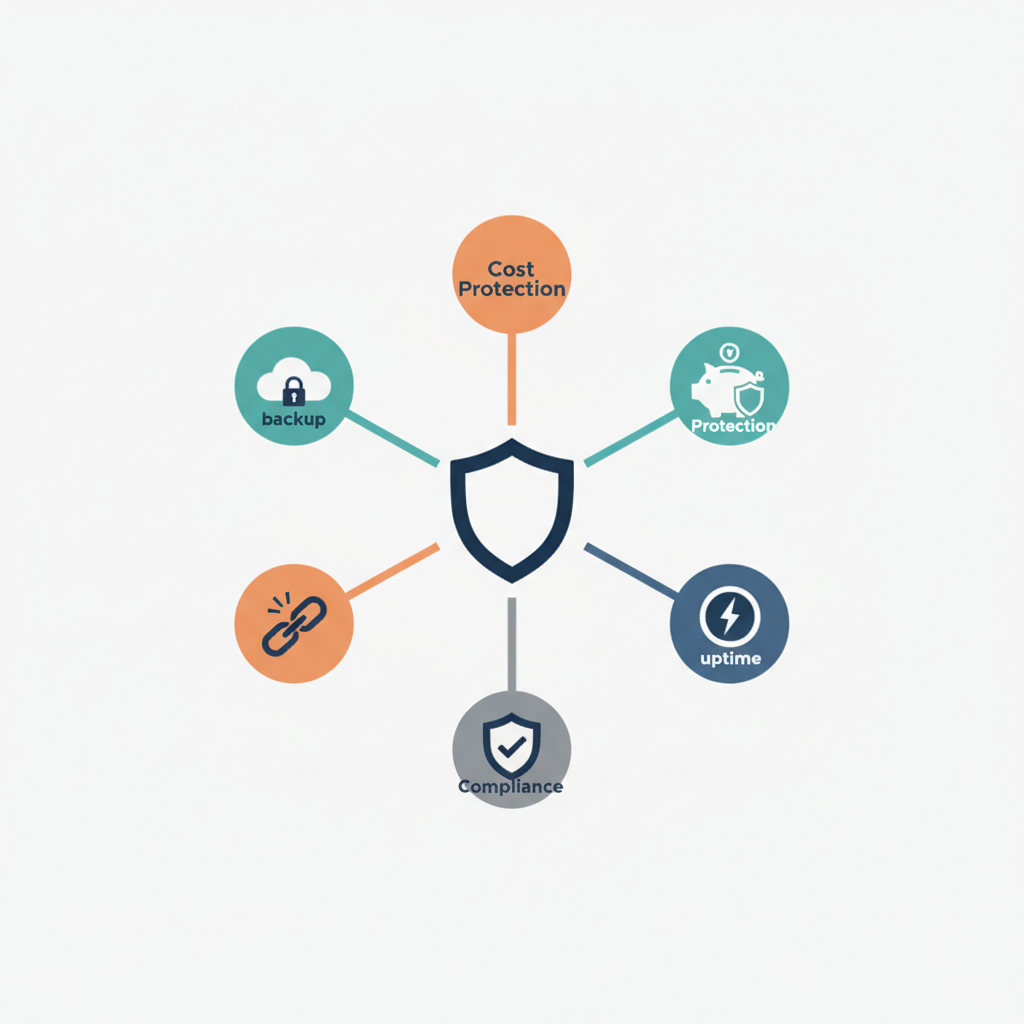
- Protect revenue and avoid financial loss. Breaches often lead to direct theft, ransom payments, or regulatory fines. Insurance may cover some costs, but operational downtime and customer churn are usually the largest expenses.
- Keep operations running. Ransomware and destructive malware can stop production lines or online sales. Fast detection and tested recovery plans reduce downtime and the long tail of recovery.
- Maintain customer trust and reputation. Customers expect their data to be safe. Public breaches damage trust and drive customers to competitors.
- Meet legal and contractual obligations. Contracts and regulations often require baseline protections for customer data. Demonstrable controls reduce liability and support continued business relationships.
- Enable growth and innovation safely. Secure systems let you adopt cloud services and integrate partners without exposing critical data or systems to undue risk.
Quotable: "Fast detection turns costly incidents into manageable events."
Best practices
This section gives practical, actionable steps you can implement immediately and common mistakes to avoid. Each practice includes a concrete threshold or example to make adoption straightforward.
- Use multi-factor authentication (MFA). Enforce MFA for all remote access and admin accounts. Example rule: require MFA for any account accessing sensitive systems or customer data.
- Patch on a schedule. Apply critical security patches within 7 days when possible; schedule routine updates weekly or biweekly for less critical systems. Record patching status in a central ticketing system.
- Back up and test restores. Keep at least three restore points and test a full restore quarterly; retain backups offsite or in an immutable cloud bucket.
- Run least-privilege access reviews. Quarterly reviews of admin accounts prevent privilege creep and reduce exposure.
- Train staff on phishing and social engineering. Run simulated phishing campaigns and remediate gaps in awareness within 30 days.
Common mistakes to avoid:
- Relying on a single control (for example, only a firewall) instead of layered defenses.
- Failing to test backups and incident response runbooks until an emergency.
- Overlooking third-party connections and vendor access during risk assessments.
Checklist: quick starter for the first 30 days
- Create an asset inventory and classify sensitive data.
- Enable MFA across all accounts with remote access.
- Configure automated backups and verify one restore.
- Run a phishing-awareness session for all staff.
- Assign an incident response lead and document contact chain.
Concrete decision rule: if a service stores customer-identifiable information, treat it as high priority for patching, monitoring, and backups.
FAQ
What is top 5 reasons cybersecurity is crucial for your business?
The importance of cybersecurity for a business is that it prevents financial loss, maintains operations, protects reputation, ensures compliance, and enables safe growth by reducing exposure to cyber threats.
How does top 5 reasons cybersecurity is crucial for your business work?
Cybersecurity works by identifying assets and risks, implementing layered protections (authentication, patching, backups, monitoring), detecting anomalies, and following documented response and recovery steps to contain and remediate incidents.
Quotable: "Protecting the right data first shrinks your breach surface and simplifies recovery."