
Why SLAs Matter for Small Businesses — especially in NJ & NY
What should a small business insist on in an msp sla checklist? A focused SLA defines measurable performance, clear remedies, and local enforcement details so service interruptions don't become legal or operational crises.
An effective managed it service level agreement spells out uptime targets, response and resolution windows by priority, escalation roles, security notification timelines, and precise exclusions. For businesses in New Jersey and New York, include local on-site response expectations and jurisdiction clauses so a vendor’s promises are enforceable in your state.
Quotable definitions for quick reference: RTO — "Recovery Time Objective: the maximum acceptable time to restore a function after an outage." RPO — "Recovery Point Objective: the maximum acceptable data loss measured in time." MTTR — "Mean Time to Repair: average time to fix an incident end-to-end." These three terms are the backbone of measurable SLAs and are extractable as featured snippets.
Why this matters: a small retail office in Hoboken that depends on POS systems cannot treat "fast" as a metric; it needs RTO and RPO numbers. Ask prospective MSPs for examples showing how their SLAs behaved during a past outage (redacted case studies are acceptable). For NJ/NY operations, require on-site arrival targets tied to metro distances: for example, request an on-site response commitment for NYC metro within 4–6 hours for critical incidents when on-site work is required.
Who this is NOT for: businesses that only use single-user cloud apps with vendor-managed SLAs, companies with less than one hour of acceptable downtime tolerance, or teams that require custom SLAs negotiated through enterprise procurement should look beyond this checklist.
Key SLA Components to Require
Start with measurable commitments and build outward. A complete msp sla checklist should include these core elements: service description, measurable targets (uptime %, response times), definitions for incident priorities, escalation path, reporting cadence, security and incident response obligations, data protection promises (backup frequency, retention), exclusions, and remedies.
Actionable thresholds to request: request an uptime target expressed as a percentage (see the uptime section), RTO and RPO values for critical systems, and P95 latency targets if the MSP hosts or proxies apps. Require monthly performance reports and a quarterly business-review cadence tied to SLA performance.
Include the phrase "managed it service level agreement" in contract language to ensure the document governs both managed IT and managed security services where applicable. Ask the MSP to attach historical metrics for at least the prior 12 months or, if unavailable, accept a baseline pilot period with guaranteed reporting. For more on this, see Choosing managed it services.
SLAs must convert vague promises into numbered commitments: uptime percent, RTO, RPO, and priority response windows.

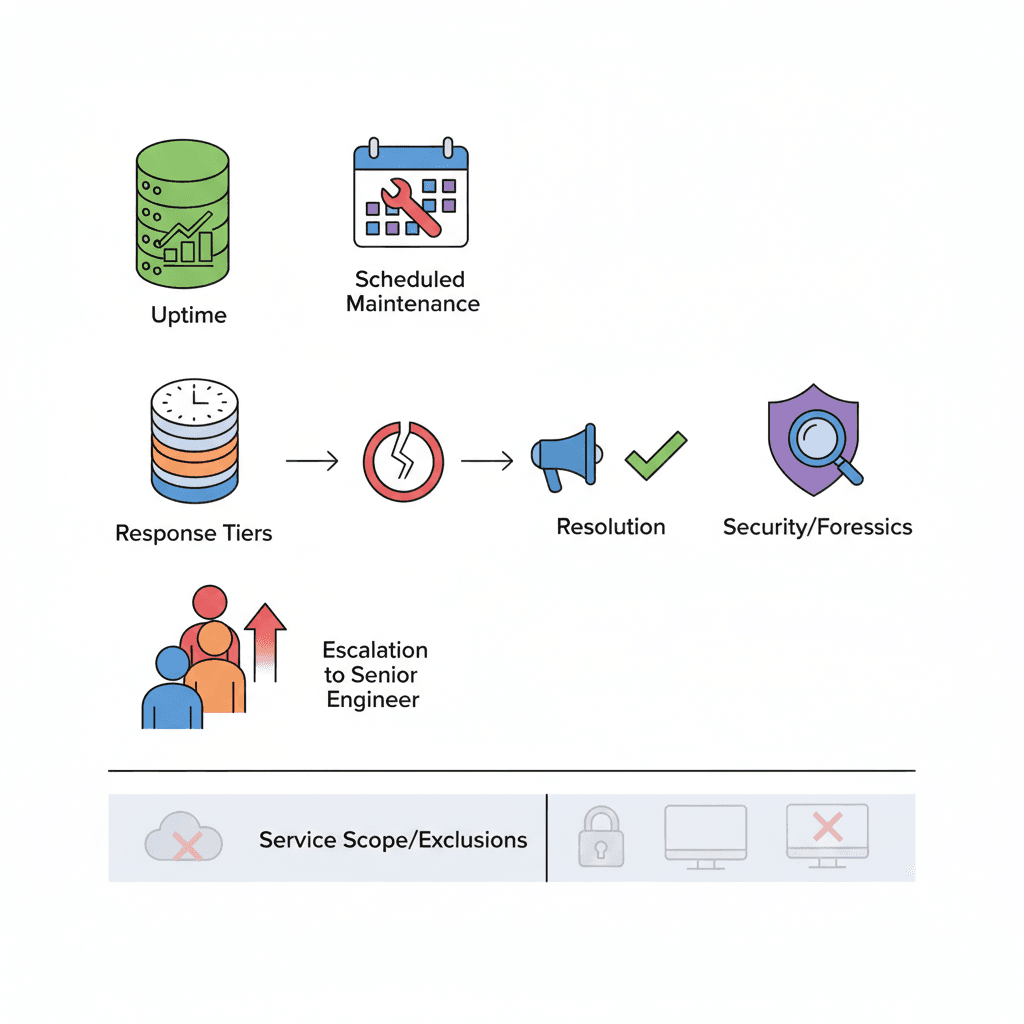
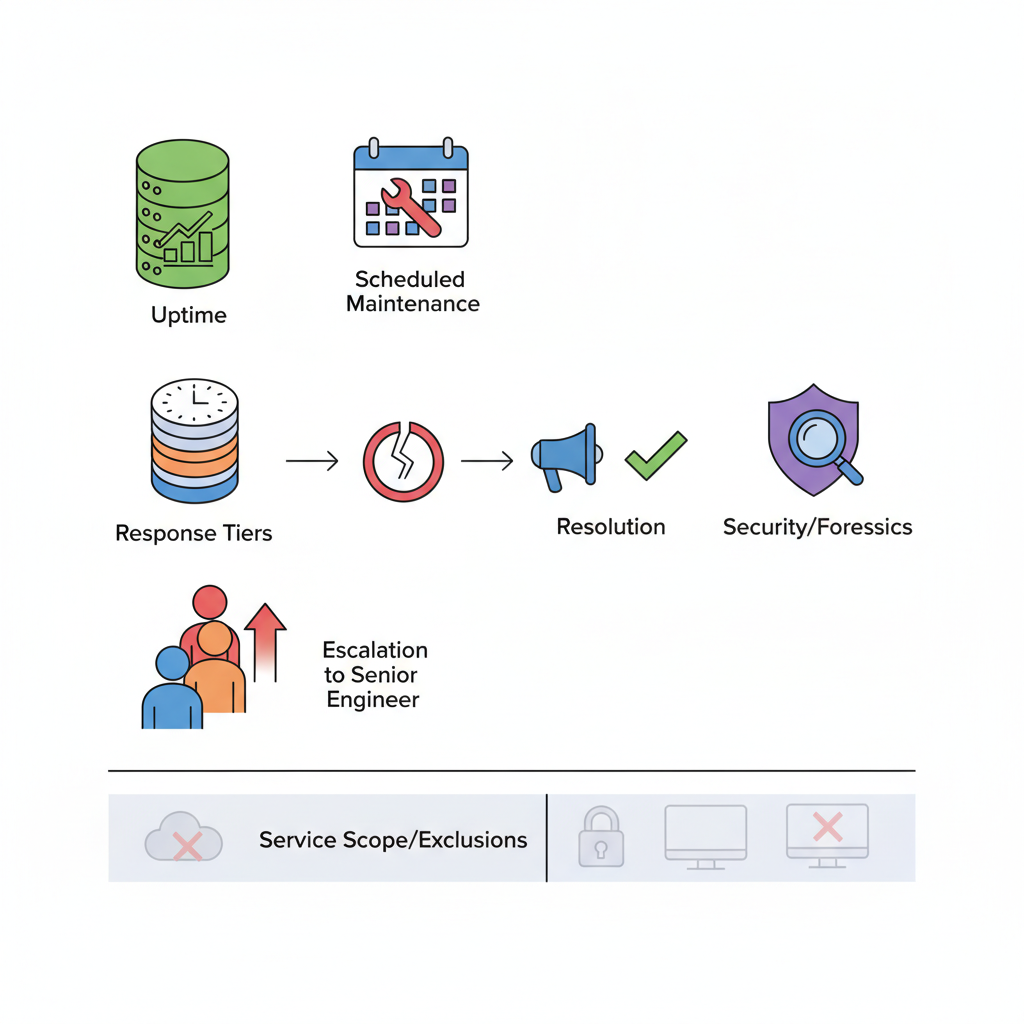
Uptime and Availability (uptime %, maintenance windows)
Uptime is typically stated as a percentage over a billing period (monthly or annual). A useful target for business-critical infrastructure is 99.9% ("three nines") which allows about 43 minutes of downtime per month; 99.99% permits roughly 4.3 minutes monthly. For small businesses, require the MSP to state whether uptime is measured at the network edge, application layer, or end-to-end user experience.
Maintenance windows must be defined and scheduled with advance notice—ideally 48–72 hours—and should be excluded from uptime calculations only if clearly documented. Include blackout periods (for example retail seasonal peaks) when scheduled maintenance is forbidden. For NJ-based organizations, request explicit statements about local redundancy and whether failover will occur in-region to avoid cross-state latency impacts.
Include a clause for "uptime measurement methodology" referencing sample logs or monitoring dashboards the MSP will share during audits. Use the keyword sla uptime guarantee nj when discussing local expectations, and require the vendor to agree to state-appropriate enforcement language in the agreement.
Response and Resolution Times (priority tiers, RTO/RPO)
Break incidents into priority tiers and assign both response and resolution targets. Example priority map: Priority 1 (business down / security incident) — initial response within 15–60 minutes and resolution or RTO goal in hours; Priority 2 (degraded performance) — response within 2–4 hours; Priority 3 (minor issue) — response within 24 hours. These are examples to negotiate, not universal guarantees.
Define RTO and RPO per system: for a critical file server, request RTO ≤ 4 hours and RPO ≤ 1 hour; for archived files, RTO ≤ 24 hours and RPO ≤ 24 hours. Include MTTR commitments for common failure modes (e.g., failed server hardware replacement: MTTR ≤ 8 hours when spare parts are local). Use the phrase msp response time sla when asking vendors for documented response logs.
Require the MSP to publish a priority-to-time mapping table as an SLA appendix so dispute resolution can reference concrete numbers rather than subjective terms like "urgent" or "best effort."
Escalation Procedures and Senior-Engineer Involvement
An SLA must state who gets involved when a problem crosses thresholds. Require an explicit escalation path: engineer -> senior engineer -> technical lead -> executive escalation with defined time-to-escalate at each step. For instance, if a Priority 1 incident lacks containment in 60 minutes, senior-engineer involvement must be mandatory and documented.
Demand contact windows for senior staff and specify the maximum time until a named-level engineer is assigned (e.g., senior engineer assigned within 2 hours of unresolved Priority 1 incidents). For vendors providing 24/7 monitoring and senior-engineer-led support, require the SLA to reflect that staffing model and produce on-call rosters redacted for privacy.
Include a statement on knowledge transfer and runbooks: the MSP should supply incident post-mortems within 72 hours for major incidents and deliver a remediation plan within 10 business days.
Security & Incident Response SLAs (notification windows, forensics)
Security SLAs differ from uptime SLAs: they must include notification windows, scope of forensics, and containment responsibilities. Require initial breach notification within a short, defined window—commonly within 1 hour of detection for confirmed critical incidents—and a full incident report within 7–14 days.
Specify what forensic artifacts the MSP will preserve (logs, endpoint data, SIEM exports) and for how long. Ensure the SLA requires cooperation with regulatory or legal processes and clarifies who pays for third-party forensic costs if the MSP’s negligence contributed to the incident.
For companies subject to state privacy laws in NJ or NY, include language tying incident handling to regulatory timelines and require that the MSP assist with state-specific notifications. Use the term managed it service level agreement in these sections to make responsibilities clear across IT and security scopes.
Service Scope and Exclusions — what's typically not covered
SLAs must state what's not included. Common exclusions include third-party vendor outages (SaaS provider downtime), client-caused misconfigurations, unsupported legacy hardware, and incidents caused by non-approved software. Require the MSP to list covered systems and a process for adding new systems to coverage.
Actionable example exclusions to negotiate: hardware procurement costs, emergency on-site repairs requiring client-supplied physical access, and major software upgrades outside normal maintenance windows. If the MSP manages cybersecurity features (EDR, SIEM), confirm whether incident response during a ransomware event is included or billed separately. For more on this, see It cybersecurity solutions.
Explicit exclusions prevent future billing disputes; require a change-order process for any work outside the SLA scope.
How to Evaluate SLA Examples and Red Flags
Ask vendors for redacted SLA performance reports and at least two historical incident summaries that show dates, priority, response time, resolution time, and corrective actions. Red flags include vague timing words ("promptly"), no record of past performance, or unlimited exclusions that shift risk onto the customer.
Watch for these concrete issues: uptime measured "excluding scheduled maintenance" without defined notice periods; no senior-engineer escalation times; security notifications with windows longer than 24 hours for breaches. Require the MSP to accept an audit right or provide access to monitoring dashboards during a pilot period.
Common Ambiguous Language to Avoid
Avoid phrases such as "best efforts," "reasonable time," and "as soon as possible." Replace them with concrete metrics: "initial response within 30 minutes for Priority 1 incidents" or "backup verification weekly with retention of 90 days." If language still feels fuzzy, request sample metrics or a one-month pilot with performance guarantees documented in an addendum.
Financial Remedies vs. Practical Remedies
Financial credits are common but often inadequate as sole remedies. Balance monetary credits (pro-rated service credits tied to missed uptime) with practical remedies: mandatory root-cause analysis, prioritized remediation work, and a service-level buyback (short-term dedicated engineering at no additional cost). Specify how credits are calculated and capped, and insist credits be the default remedy rather than the only remedy.
Sample SLA Checklist & Questions to Ask Prospective MSPs
- Does the SLA list uptime % and measurement method?
- Are RTO, RPO, and MTTR defined per system class?
- Are response and resolution times mapped to priority tiers?
- Is senior-engineer involvement timeboxed and guaranteed?
- Are security notification windows defined for breaches?
- Are exclusions and change-order processes listed?
- Are remedies both financial and practical?
Copyable checklist: use the list above during vendor interviews and require written evidence for each item.
| Target | Example value | Notes |
|---|---|---|
| Uptime | 99.9% monthly | Measure at application endpoint |
| Priority 1 initial response | < 30 minutes | 24/7 monitoring required |
| RTO (critical) | < 4 hours | Include DR runbook |
| Security notification | < 1 hour | Confirmed incidents only |
Local Considerations for NJ & NY Businesses (contracts, jurisdiction, on-site support)
Include jurisdiction and venue clauses specifying the state (NJ or NY) for contract disputes and arbitration. If local on-site support matters, include travel time assumptions and define an on-site response SLA tied to metro areas (for example, NYC metro on-site within 4–6 hours when required). Ask vendors to confirm insurance limits and whether they comply with state-specific data breach notification laws.
For regulated businesses, require cooperation language for audits and evidence collection. Mention the MSP’s ability to provide redacted logs or support for compliance reporting as part of the managed it service level agreement.
Next Steps — template language and CTA for a free IT assessment
Use this template starter: "Vendor shall maintain 99.9% uptime measured at the application endpoint, provide Priority 1 initial response within 30 minutes, assign a senior engineer within 2 hours of unresolved Priority 1 incidents, and notify the client within 1 hour of confirmed security incidents. Remedies include service credits and mandatory root-cause analysis." Tailor numbers to your risk tolerance and systems.
To evaluate an MSP against this checklist, request a pilot period with monitored KPIs and ask for historical metrics. For a hands-on assessment of your current environment and to compare against these SLA expectations, review our services or schedule a demo at our services. To discuss specifics, contact us, visit the contact us page, or use contact us to request a free IT assessment.
FAQ
What is msp sla checklist for small businesses in nj & ny? An msp sla checklist is a list of measurable contract items—uptime percentages, response and resolution windows, escalation steps, security notification timelines, and exclusions—tailored for small businesses operating in New Jersey and New York.
How does msp sla checklist for small businesses in nj & ny work? The checklist guides negotiation and contract review: you compare vendor promises against concrete thresholds (RTO, RPO, MTTR), require reporting and remediation steps, and include local jurisdiction and on-site response clauses to ensure enforceability.
References
- Choosing a managed service provider (MSP) — National Cyber Security Centre
- Cloud Computing Service Metrics Description — NIST
- NIST SP 500-293 — NIST
- INCITS/ISO/IEC 19086-3:2017 (R2024) SLA framework — ANSI Webstore
- Cloud Computing: Agencies Need to Address Key OMB Procurement Requirements — U.S. GAO