

TL;DR
- Underwriters commonly expect MFA, EDR with centralized telemetry, immutable backups, and documented patching—absence of these is a primary cause for declination.
- Insurer-required controls are demonstrable settings and artifacts across all locations and cloud accounts for NJ & NY regulated entities.
- Prepare screenshots of policy settings, exportable SIEM/EDR reports, and recent backup test results before applying.
- Within 30–90 days you can remediate most gaps: enable MFA, deploy EDR, validate immutable backups, and automate patching and scanning.

If you manage a website, app, or internal systems in New Jersey or New York and you’re shopping for cyber insurance, this guide explains the specific technical controls insurers expect and how to prove them. The phrase "cyber insurance technical controls nj ny" refers to insurer-required controls applied and evidenced across on-prem and cloud environments, and mapped to NYDFS cyber expectations and HIPAA where applicable. Underwriters commonly expect MFA, EDR with centralized telemetry, immutable backups, and documented patching—absence of these is a primary cause for declination.
Why underwriters care about technical controls (insurer risk model explained)
Insurers price risk by estimating how likely a breach is and how costly response will be. Technical controls reduce both probability and impact. For NJ & NY regulated businesses, underwriters also map controls to state guidance such as NYDFS expectations and to industry frameworks like CIS and NIST for consistency (see NIST SP 800-63 and the CIS controls guide).
Define insurer-required controls: specific technical configurations, operational processes, and artifacts that an insurer requires as a condition of coverage. Examples: system-wide MFA on remote access, EDR agents with centralized logging, immutable backups tested quarterly, and documented patch cadence with evidence. NYDFS cyber insurance controls often map to these same items, so meeting insurer requests usually aligns with regulatory expectations. For more on this, see Prepare for cyber insurance.
Actionable takeaway: treat controls as packaged evidence needs — policy configuration + exportable report + timestamped proof (screenshots or logs). That trio is what underwriters ask for during application and renewal.
Core technical controls insurers typically require
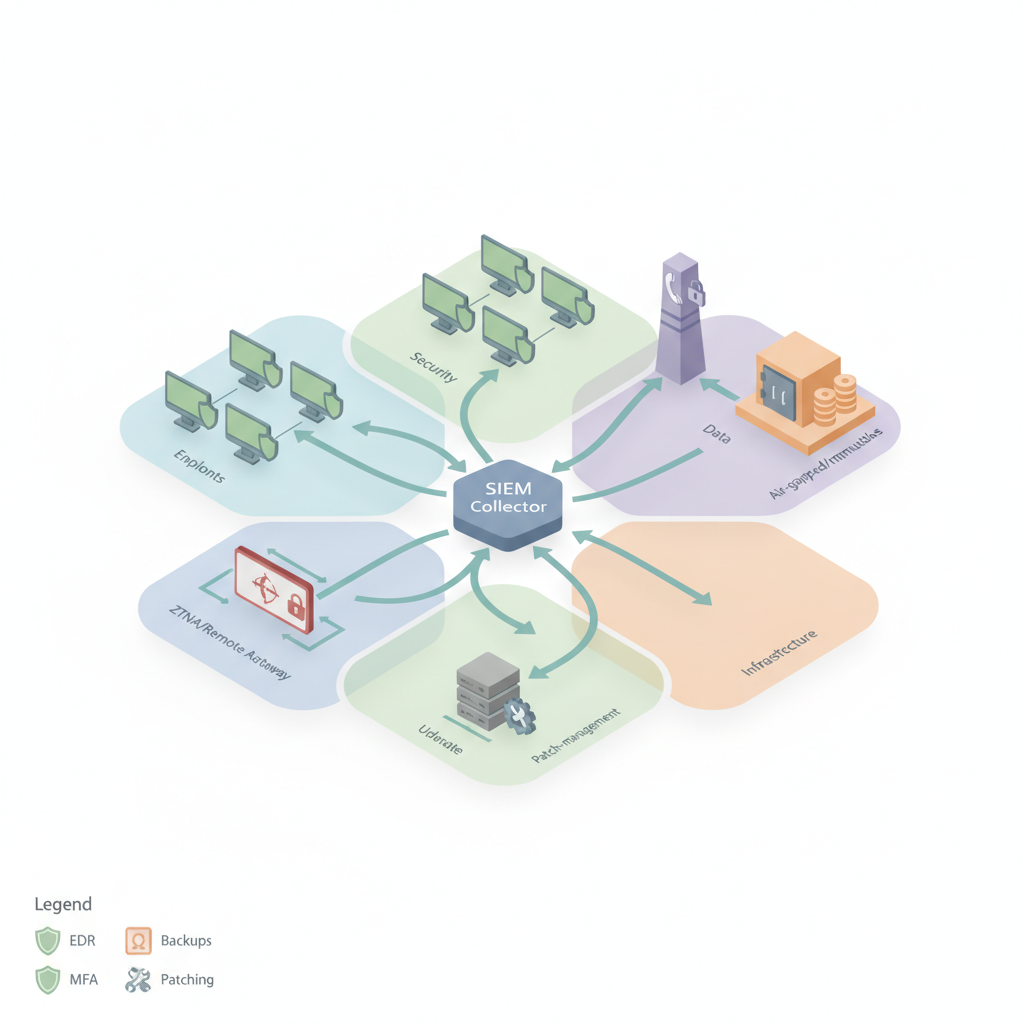
Insurers expect a baseline set of technical controls that materially lower breach likelihood. For NJ & NY entities these controls are the practical translation of regulatory guidance into insurer language: access controls, endpoint protection, backups, patching, logging, and network controls. Below are the controls insurers mention most often and the evidence they want.
- Access control: enterprise MFA applied to all remote access and privileged accounts; evidence: conditional access policy screenshot and user exception list.
- Endpoint protection: EDR/XDR agents on all endpoints with centralized telemetry and alerting; evidence: device inventory export and threat detection report.
- Backups: immutable or air-gapped backups with periodic restore tests; evidence: backup policy, snapshot retention records, and test restore log.
- Patch & vulnerability management: defined cadence and SLAs for critical and high vulnerabilities; evidence: vulnerability scan reports and patch ticket history.
- Logging & monitoring: SIEM ingestion of relevant logs with retention and alerting rules documented; evidence: SIEM dashboard screenshots and recent alert exports.
- Network controls: segmentation, least-privilege remote access, or ZTNA for remote users; evidence: network map and firewall/ZTNA policy screenshots.
Insurer-required controls are only valid when you can export proof: screenshots, reports, and time-stamped logs.
Multi-factor authentication (MFA) – scope and acceptable implementations
MFA for cyber insurance is non-negotiable for most underwriters. Acceptable implementations include hardware tokens (FIDO2), TOTP apps (Authenticator), and vendor MFA (conditional access). Insurers usually require MFA across all administrative and remote-access paths: VPNs, cloud consoles, RDP, and SaaS admin portals. For NJ & NY regulated firms, that extends to cloud accounts and any branch location, which is a critical aspect of cyber insurance readiness for regulated NJ & NY businesses.
Evidence insurers accept: a screenshot of the conditional access policy showing enforcement, a user report listing accounts in scope, and an MFA enrollment export. For healthcare entities subject to HIPAA, show MFA on EHR access and documented exceptions.
Quotable: "MFA for cyber insurance must cover every remote and privileged access path, not just employee email."
Endpoint detection & response (EDR/XDR) – telemetry and reporting expectations
EDR requirements insurance teams look for are specific: vendor-provided agents on every managed endpoint, centralized telemetry retention, and demonstrable alerting and response processes. Insurers ask whether EDR is tamper-resistant, whether it reports to a central console, and whether alerts feed into a SOC process.
Provide an inventory export showing agent coverage, a recent detection report (PDF export), and an SOC ticket demonstrating how an alert was investigated. For sample evidence, include an EDR console screenshot that lists recent blocked threats and device status. Use language insurers recognize: agent version, last-seen timestamp, and enrollment percentage across devices.
Backups & disaster recovery – air-gapped, immutable backups and test evidence
Backup requirements cyber insurance often specify immutable or air-gapped copies, retention policies, and periodic restore validation. Insurers want to see retention length, immutability settings (e.g., object lock), and the last successful restore test.
Accepted evidence: backup configuration screenshot showing immutability or air-gap setting, a dated restore test result, and a recovery point objective statement. A concrete checklist: (1) enable immutability on production backups; (2) run a quarterly restore test and log results; (3) keep exportable reports for 12 months. Insurers treat restore test logs as high-value proof—get those exports ready.
Patch management and vulnerability scanning – cadence and SLAs
Underwriters expect a documented cadence: critical patches within a short SLA, high/medium tracked and remediated on a documented timeline, and automated vulnerability scans on a regular cadence. Evidence includes vulnerability scan reports (authenticated scans), a patch ticket list, and a published patching policy.
| Severity | Suggested SLA (typical) | Evidence |
|---|---|---|
| Critical | Apply or mitigate within 7 days | Patch ticket + deployment report |
| High | 30 days | Vulnerability scan + remediation log |
| Medium/Low | 90 days | Scan schedule and backlog tracker |
Include an authenticated scanner report export and a change ticket that shows deployment to production as proof.
Logging, SIEM and monitoring – retention, alerting, and SOC evidence
SIEM requirements insurers expect include log sources ingested (EDR, VPN, domain controllers, cloud console), retention policy (documented), and alerting rules tied to incident response. Evidence: SIEM ingestion report, retention configuration screenshot, and a recent alert ticket that shows triage steps and owner.
Insurers typically ask: how long do you retain logs, which logs are collected, and who reviews alerts. For NJ & NY regulated entities, demonstrate consistent retention across all cloud accounts and physical locations.
Network segmentation, ZTNA and MFA for remote access
Network segmentation and zero-trust network access reduce lateral movement. Insurers expect segmentation between user, guest, and production networks, and ZTNA or MFA-enforced remote access for admins. Provide a network diagram, firewall rule snapshot, and ZTNA policy export showing access rules and user groups.
Actionable step: implement least privilege via ZTNA for cloud consoles and administrative tools, and produce a mapping of user groups to access rights for insurer review.
Evidence matters more than vendor names: a console export proves control; an unsigned policy does not.
How insurers verify controls (common attestation & third-party scans)
Insurers verify controls through questionnaires, attestation statements, and sometimes third-party scans (external vulnerability scans, penetration tests, or configuration assessments). They also ask for exportable reports from EDR/SIEM and screenshots of policy settings. For NY applicants, insurers may explicitly ask for NYDFS cyber insurance controls mapping—show how your controls map to NYDFS guidance and provide the artifacts.
Examples of verification: supplying an EDR inventory export, a SIEM alert export for a recent incident, or a third-party penetration test report. Many insurers will accept a SOC 2 Type II or an internal audit report as complementary evidence, but still expect the technical artifacts listed above.
Quick remediation playbook: technical controls to implement within 30–90 days
Use this prioritized playbook when preparing for an application. Focus on the highest-impact fixes first: MFA, EDR coverage, and verified backups. Below is a 30–90 day checklist you can copy.
- Days 1–14: Enable MFA for all remote access and admin accounts; capture conditional access screenshots.
- Days 15–30: Deploy EDR to all endpoints and export agent inventory and recent detection reports.
- Days 31–60: Configure immutable backups and run a restore test; save test logs and snapshots.
- Days 61–90: Start automated vulnerability scans and close critical findings; document patch tickets and SLAs.
This checklist maps directly to items insurers score on applications and renewal questionnaires.
Common red flags that cause declinations or high premiums
Red flags include partial MFA coverage, missing EDR on key devices, lack of immutable backups or no restore tests, inconsistent patching, and no centralized logging. Other triggers are unmanaged cloud accounts, undocumented exceptions, and failure to show evidence across all locations and cloud tenants. For NJ & NY regulated firms, gaps in NYDFS-aligned controls or HIPAA-related access controls for healthcare operations are frequent reasons for higher premiums or declines.
Provide concrete evidence in the application — insurers penalize missing artifacts more than imperfect controls.
Next steps: preparing evidence and when to engage an MSSP
Prepare a single folder of evidence: policy screenshots, exportable reports (EDR, SIEM, backup), vulnerability scan exports, and restore test logs. If you need engineering bandwidth or 24/7 monitoring to meet insurer expectations, engaging a Managed Security Provider is appropriate. Eighty Seven Solutions offers senior-engineer-led support, 24/7 monitoring, EDR, SIEM, and enterprise-grade backup/disaster recovery that align with insurer expectations; consider evaluating our services or requesting a demo at our services to speed compliance.
Conclusion: control priorities mapped to common underwriter questionnaires
Map insurer questionnaire items to concrete artifacts: MFA policy + enrollment export, EDR inventory + detection reports, immutable backup config + restore logs, vulnerability scans + patch tickets, and SIEM ingestion + alert exports. "Underwriters commonly expect MFA, EDR with centralized telemetry, immutable backups, and documented patching—absence of these is a primary cause for declination." Preparing these items reduces friction at application and renewal.
To get started, gather the evidence checklist above and consider third-party help if you lack continuous monitoring or senior-engineer support. For assistance from a provider experienced with NJ & NY regulated businesses, visit our services or contact us to discuss your requirements.
References
- Industry Letter - October 16, 2024: Cybersecurity Risks Arising from Artificial Intelligence and Strategies to Combat Related Risks | NYDFS
- Industry Letter - October 21, 2025: Guidance on Managing Risks Related to Third-Party Service Providers | NYDFS
- NIST Special Publication 800-63-4
- Guide to Implementation Groups (IG): CIS Critical Security Controls v8.1
- Insurance Topics | Cybersecurity | NAIC
FAQ
- What is key technical controls cyber insurers expect?
Key technical controls cyber insurers expect are demonstrable configurations and operational artifacts such as enterprise MFA, full EDR/XDR coverage with centralized telemetry, immutable backups with restore test logs, documented patching and vulnerability scanning cadence, and SIEM log ingestion with alerting.
- How does key technical controls cyber insurers expect work?
These controls work by reducing breach likelihood and response cost; insurers verify them through questionnaires, console screenshots, exportable reports from EDR/SIEM/backups, and sometimes third-party scans or penetration tests.