

TL;DR
- Underwriters want concise, dated evidence: SOC reports, scans, and an MSP attestation letter.
- Supply a single PDF evidence package with a control matrix mapping services to insurer questions.
- Keep test results dated within the last 12 months and redact regulated data per NJ/NY rules.
- Use configuration baselines, EDR telemetry samples, and RTO/RPO test results to reduce questions and premium friction.

Introduction — why good documentation matters to underwriters
When you need to document msp controls cyber insurance application nj ny, clear evidence speeds underwriting and reduces follow-up requests. Insurers in New York often reference NYDFS 23 NYCRR 500 and expect controls that map to that rule set; healthcare customers must also surface HIPAA documentation. Underwriters evaluate controls, not marketing language. If you hand them a well-structured packet with dated reports and signed attestations, the process moves from clarifying to approving.
Definition — SOC 2: A SOC 2 report is an auditor’s assessment of a service provider’s controls relevant to security, availability, processing integrity, confidentiality, or privacy.
Definition — attestation letter: An attestation letter is a signed statement from an MSP senior engineer or officer that certifies the accuracy of specific control claims and the scope of services delivered.
Definition — RTO / RPO: RTO (recovery time objective) is the target time to restore systems after an incident; RPO (recovery point objective) is the allowable data loss window.
Standard evidence types insurers expect from MSPs/MSSPs
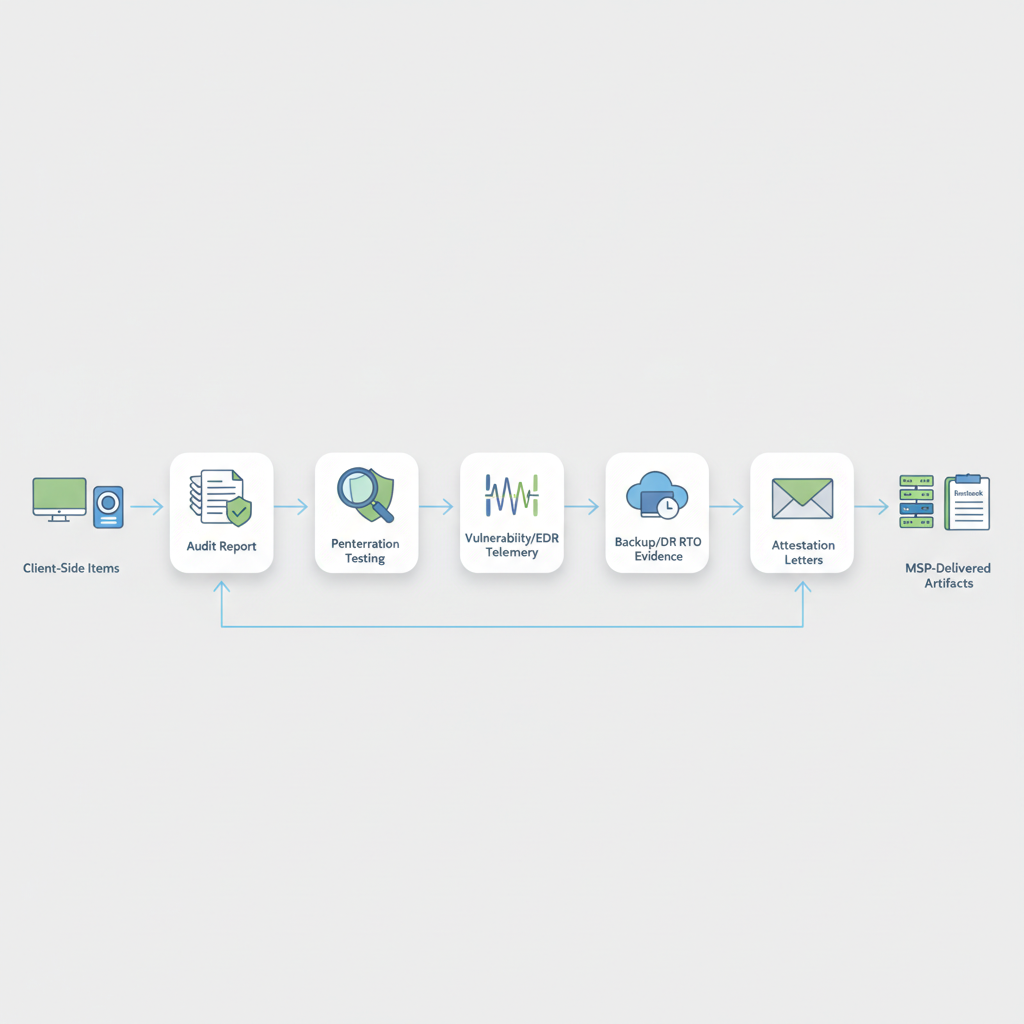
Insurers expect a predictable set of artifacts when you document msp controls cyber insurance application nj ny. Provide: SOC or third-party audit reports, penetration test reports, vulnerability scan summaries, configuration baselines, EDR telemetry samples, backup and disaster recovery (DR) test evidence, and an MSP attestation letter. Use plain filenames that include dates (YYYY-MM-DD) so underwriters can find the freshest evidence quickly. For more on this, see Compare cyber insurance policies.
"Phrase these artifacts as evidence for insurers msp mssp: label each item with the control it satisfies (example: MFA, patching, endpoint detection). Additionally, include contact information for the engineer who can answer follow-up technical questions."
SOC 2 reports, penetration test reports, and vulnerability scan summaries
SOC 2 reports remain high-value evidence because they show an auditor reviewed controls. For many insurers, a recent SOC 2 with a security principle reduces questions about architecture, logging, and access controls. Penetration test reports and vulnerability scan summaries provide operational proof: list the scope, test date, high/critical findings, and remediation status. For soc report mfa evidence for insurance include explicit pages or excerpts that show MFA policies and configurations or include a screenshot of the policy control mapping.
Provide the SOC 2 index page and the MFA control excerpt together; auditors read those first.
Practical example: attach a two-page extraction from a 3rd-party pentest showing the executive summary, high severity findings (if any), and remediation timestamps within the last 12 months.
Configuration baselines and EDR telemetry samples
Configuration baselines show how you standardize endpoints, servers, and network devices. Deliver sample baseline documents (registry, GPO, firewall rules) and a short explanation of drift management. EDR telemetry samples should be anonymized event snippets that show detection, investigation, and response timelines—timestamps are key. Underwriters treat telemetry as evidence for insurers msp mssp because it proves continuous monitoring.
Concrete thresholds: include example baseline items such as Windows patch level (monthly baseline), EDR agent version and last seen timestamp, and a sample alert timeline showing detection-to-containment measured in hours. Keep telemetry excerpts to a single PDF—annotate lines to explain why they demonstrate the control.
Backup & DR test results and RTO/RPO evidence
Insurers want proof that backups are tested and that RTO/RPO goals are realistic. Provide dated backup logs, restore test runbooks, and a summary table showing outcomes. For each test list: system restored, restore start and finish times, success/failure, and data integrity checks. That produces RTO/RPO evidence in a format an underwriter can assess quickly.
Example artifact: a one-page DR test summary that lists RTO (e.g., target: 4 hours) and RPO (e.g., target: 1 hour) alongside actual measured times from the most recent quarterly test. Keep dated test results (last 12 months) available; insurers commonly request the most recent 12 months of evidence.
A step-by-step documentation checklist for policy applications
This cyber insurance application checklist converts the abstract question list into deliverables you can assemble. Follow the steps below and produce a single PDF bundle when possible. For more on this, see Cyber insurance readiness nj ny.
- Gather source artifacts: SOC 2, pentest & vulnerability scans, backup/DR logs, config baselines, EDR samples, IAM screenshots.
- Create a control matrix mapping each insurer question to the artifact and page numbers.
- Draft an MSP attestation letter signed by a senior engineer for scope and accuracy.
- Redact regulated data and produce a Table of Contents with dates.
- Compress into one PDF (maximum 20 mb) and include a short cover letter.
| Item | Who provides it | Required format |
|---|---|---|
| SOC 2 excerpt | Client or MSP | PDF, pages noted |
| Pen test summary | Client | PDF, remediation dates |
| Control matrix | MSP | Excel or PDF |
Include the phrase 'cyber insurance application checklist' in your folder names and the control matrix so brokers can search filenames easily.
Client-side items vs MSP-delivered artifacts
Separate what the client must provide (internal network diagrams, business-critical app lists, and access to logs) from what the MSP supplies (EDR telemetry, patch reports, backup logs, and an attestation letter). Document ownership in the control matrix: add a column labeled "owner" and mark each artifact as Client/MSP. That avoids finger-pointing when underwriters ask for clarification.
Real-world step: during an evidence request for a regulated healthcare client, create a two-column deliverable indicating HIPAA-related controls the client owns (e.g., PHI encryption keys) and security services the MSP runs (e.g., SIEM monitoring). This is the practical mapping insurers want to see.
Templates & sample artifacts (attestation letters, control matrix, runbooks)
Provide reusable templates so you can assemble evidence quickly. Include: an attestation letter template, a one-page control matrix template, example runbook snippets for incident response and DR, and a redaction checklist for PHI/PPI. Below is a compact control-matrix example you can copy.
| Insurer question | Control | Artifact | Owner |
|---|---|---|---|
| Is MFA enforced? | MFA for admin accounts | SOC 2 excerpt p.12, IAM screenshot | MSP |
| Are backups tested? | Quarterly DR test | DR test summary 2024-06-01 | MSP |
One clear control matrix cuts underwriter review time by making evidence findable.
Include an attestation letter managed services template that states scope, exclusions, and the date range covered by the artifacts.
Sample MSP attestation wording to satisfy underwriters
Use concise, factual language in the attestation. Example phrasing: "We attest that for the period 2023-07-01 to 2024-06-30, Eighty Seven Solutions operated and maintained the listed controls for client X as described in the attached artifacts. This attestation covers managed EDR, backup and DR, patch management, and 24/7 monitoring as performed by our senior engineering team." Keep it signed and dated by a named senior engineer.
Include the exact sentence: 'Supply a single PDF evidence package with SOC reports, a control matrix mapping MSP services to insurer questions, and an MSP attestation letter signed by a senior engineer.' That sentence is often quoted by brokers and underwriters.
How to structure an evidence package for brokers and underwriters
Structure matters: start with a cover sheet, an executive summary (one page), then the control matrix, followed by artifacts in the order referenced. Add PDF bookmarks for each artifact and include page numbers. Label each artifact header with: Artifact name, owner, date, and short explanation of what it proves.
Practical packaging rule: keep the evidence bundle to a single PDF when possible and include a one-page contact sheet with two technical contacts (name, title, phone, email) so underwriters can verify quickly. This reduces delay and demonstrates responsiveness.
Redaction and privacy considerations for NJ & NY regulated data
Redact PHI and PII consistently and record redaction steps in a short appendix. NY insurers often expect compliance evidence aligned to 23 NYCRR 500 for financial firms and HIPAA documentation for healthcare. For NJ & NY, follow state breach notification laws and mask unique identifiers while preserving timestamps and event context in telemetry samples.
Redaction best-practices note: remove full account numbers and patient identifiers but keep timestamps, event type, and control IDs so investigators can validate the control without seeing regulated data. Always keep a non-redacted master copy internally and provide redacted copies to insurers.
Maintaining evidence cadence: audits, testing schedules, and continuous attestations
Underwriters expect currency. Maintain a calendar: annual SOC 2 or equivalent, quarterly vulnerability scans, semi-annual penetration tests (or annually with risk-based justification), and quarterly DR tests. Record outcomes and refresh the evidence package after each major test. For continuous attestations, decide whether the MSP will sign quarterly or annual attestation letters; quarterly signing reduces insurer friction for high-risk clients.
Keep one consolidated evidence package refreshed after each audit cycle; label it with the updated date.
Store dated test results (last 12 months) in an access-controlled evidence repository and note archive locations in your cover sheet.
Practical Q&A: common insurer requests and how to respond quickly
Q1: What does it mean to document msp/mssp security controls for cyber insurance applications in nj & ny? Documenting MSP/MSSP security controls means assembling verifiable artifacts—audits, scans, telemetry, backup tests, and a signed attestation—that map directly to insurer questions and demonstrate the operation of controls within scope and date ranges.
Q2: How do you document msp/mssp security controls for cyber insurance applications in nj & ny? You document controls by creating a control matrix, collecting dated artifacts (SOC 2, pentest, EDR samples, DR tests), drafting a signed attestation letter managed services, and delivering a single, redacted PDF evidence package to the broker or underwriter.
Conclusion & downloadable checklist
Good documentation removes ambiguity. Use the cyber insurance application checklist above, keep artifacts dated within the last 12 months, and include an attestation letter managed services signed by a senior engineer. When you want help assembling the evidence package or running readiness checks, review our our services and then contact us to schedule an assessment. For demos, see our services demo page.