

TL;DR
- Underwriters evaluate both you and your MSP/MSSP; strong third‑party evidence improves terms.
- Insurers commonly ask for SOC reports, SLAs, monitoring cadence, backup tests and documented patching.
- Maintain 24/7 monitoring, clear escalation SLAs, and tested recovery to lower risk flags.
- Watch policy exclusions tied to vendor failures and negotiate endorsements that preserve coverage for co‑managed setups.

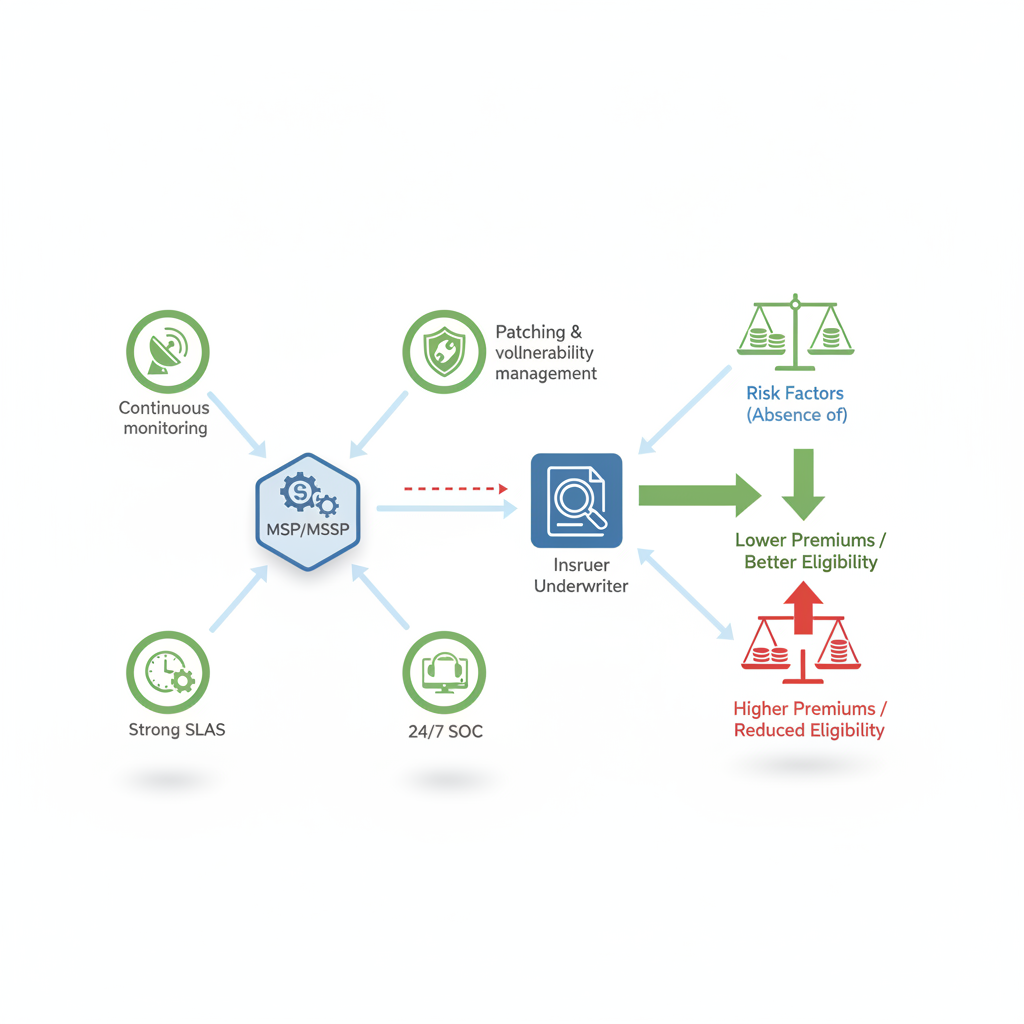
Introduction — why insurer underwriters care about MSP/MSSP practices
Underwriters assess how an insured business manages cyber risk — and that includes how its managed service providers and managed security service providers operate. For companies asking "how msp practices affect cyber insurance nj ny," the short answer is: materially. Insurers look at MSP/MSSP controls as risk multipliers or mitigators because a breach at a provider can cascade to many insureds. Reference points for regional underwriters include the NYDFS (23 NYCRR 500) expectations for regulated entities and HIPAA safeguards for healthcare organizations in NJ/NY; meeting those frameworks signals stronger control environments.
Practical example: a small law firm in New Jersey with an MSP that provides only ticketing and occasional patching will face more underwriting scrutiny than a similar firm whose MSSP provides endpoint detection with active threat hunting, 24/7 SOC monitoring, and documented recovery exercises.
When not to rely solely on MSP/MSSP assurances
- When the MSP uses shared administrative accounts without logging.
- When the MSP has no documented patch cadence or vulnerability reports.
- When backups exist but recovery has never been tested end‑to‑end.
Underwriting lens — what insurers evaluate about third‑party providers
Underwriters treat third‑party providers as extensions of the insured's security posture. Key evaluation areas: attack surface introduced by provider access, proof of detection capability (EDR/SIEM/log retention), incident response capability, and vendor governance (contracts, sub‑subcontracting, and change control). For NY regulated entities, evidence of alignment with NYDFS guidance increases confidence; for healthcare, HIPAA‑aligned BAAs and documented safeguards are underwriting assets. Underwriters also review whether the relationship is co‑managed — a shared responsibility model frequently requires explicit policy language.
Underwriters evaluate both the insured and its third‑party providers; strong MSSP evidence can materially improve terms.
Quotable: "Insurers increasingly request SOC 2 reports, documented SLA remediation timelines, and evidence of endpoint detection with active threat hunting—especially for NY‑regulated firms."
Evidence insurers request about MSPs/MSSPs (SOC reports, SLAs, monitoring cadence)
Insurers typically ask for: SOC 2 or ISO excerpts, signed SLAs showing escalation paths and MTTR targets, monitoring screenshots (alerts, SIEM dashboards), and documented patching and change control. Expect questions about logging retention (how long and where logs are stored), backup frequency and recovery time objectives, and whether the provider performs tabletop exercises. For underwriting calls, have these items ready: a current SOC 2 type II (or SOC 2 summary), a recent incident playbook, screenshots of SIEM alerts, and a written BAA for healthcare customers.
MSP/MSSP practices that improve eligibility and lower premiums
Insurers reward demonstrable, repeatable controls. Practices that help include continuous monitoring with human analysts, documented SLA metrics and escalation, a formal patch and vulnerability program, role-based access with MFA, and regular backup testing. Co-managed IT and cyber insurance arrangements—where responsibilities are documented and split between client and provider—are often treated better than opaque handoffs because they show clarity of ownership. Understanding how these practices influence eligibility can be crucial when comparing cyber insurance policies.
Concrete thresholds that underwriters like to see: documented patch cadence (monthly for critical updates, quarterly for lower‑risk systems), log retention of at least 90 days for SIEM data, and routine recovery drills at least annually. In practice, insurers look for evidence, not promises.
Documented recovery exercises and active threat hunting reduce insurer uncertainty and improve eligibility.
Continuous monitoring & 24/7 SOC vs. basic ticketing
Continuous monitoring with a staffed SOC provides detection timelines that ticketing does not. A 24/7 SOC can detect lateral movement and contain threats before they escalate; basic ticketing often only reacts after impact. When discussing cyber insurance underwriting for managed services, present detection SLAs (time‑to‑detect and time‑to‑respond) and examples of threat hunting outcomes. If you use co‑managed models, spell out which alerts the client must act on and which the MSSP handles. For more on this, see Cyber insurance readiness nj ny.
Strong SLA metrics (MTTR, escalation paths) and senior engineer support
Insurers care about measurable SLAs: defined MTTR ranges, on‑call senior engineer escalation, and defined communications during incidents. Provide a clear escalation matrix (tier 1 → tier 2 → senior engineer → executive notice), sample incident notifications, and evidence of past escalations handled within SLA. For msp cyber insurance requirements, insurers often ask for SLA language demonstrating realistic remediation timelines.
Patch cadence, vulnerability management, and documented change control
A documented vulnerability management program with prioritized remediation reduces risk. Show patch reports, CVE triage processes, and change control logs that include approvals and rollback plans. For underwriting, include a sample monthly vulnerability report and evidence that critical patches roll out within a defined window. This demonstrates programmatic risk reduction rather than ad‑hoc fixes.
MSP/MSSP practices that raise red flags for insurers
Red flags include: shared admin credentials, lack of network segmentation, opaque logging practices, no written incident playbook, untested backups, and poor subvendor oversight. Insurers will ask whether the MSP subcontracts work; if so, expect requests for the subcontractor’s security documentation. These items increase perceived correlated risk and can lead to higher premiums or coverage exclusions.
Shared credentials, inadequate segmentation, opaque logging
Shared credentials remove accountability and make forensic timelines fuzzy. Inadequate segmentation lets a single compromise spread across systems. Opaque logging (short retention, no centralized SIEM) kills detection. Show role‑based accounts with MFA, documented network segmentation diagrams, and SIEM retention policies to alleviate these concerns.
Lack of tested backups or no proof of recovery exercises
Backups without recovery tests are a major underwriting issue. Insurers expect documented recovery exercises that validate both data integrity and recovery time objectives. Provide recovery test reports and a schedule of past tabletop and technical recovery drills; absence of these will often trigger an exclusion or require additional controls before binding.
Policy language & endorsements to watch (exclusions tied to vendor failures, supply chain clauses)
Policy wording matters. Watch for exclusions that deny coverage when a claim arises from a vendor failure or supply chain breach. Negotiate endorsements that preserve coverage where the insured followed reasonable vendor management practices. For co‑managed it and cyber insurance, insist on language that recognizes shared responsibility rather than automatically blaming the insured for a vendor lapse.
How to present MSP/MSSP evidence to brokers — a practical checklist
Organize evidence so brokers can quickly map provider controls to underwriting questions. Use a short binder or digital folder with labeled artifacts and an executive summary mapping each artifact to insurer asks.
- Executive summary: one page mapping controls to underwriting areas.
- SOC 2 / ISO excerpts with audit scope and date.
- Signed SLAs showing MTTR and escalation matrices.
- Monitoring screenshots: SIEM, EDR alerts, and hunt reports.
- Backup & recovery test reports and change control logs.
- BAAs where applicable (HIPAA), and vendor management policy.
| Insurer ask | Suggested artifact | Why it matters |
|---|---|---|
| SOC evidence | SOC 2 type II excerpt | Shows audited controls and monitoring |
| Detection capability | EDR/SIEM screenshots | Proves active monitoring and alerts |
| Recovery | Recovery test report | Validates backups and RTOs |
Recommended artifacts: SOC 2/ISO snippets, SLAs, monitoring screenshots, incident playbooks
Provide redacted SOC 2 reports, ISO highlights, sample SLAs, SIEM screenshots, an incident response playbook, and at least one recent tabletop exercise summary. Brokers appreciate a one‑page control matrix that maps each artifact to typical insurer questions. This satisfies insurer requirements for third-party service providers and speeds underwriting.
Negotiating with insurers — wording and endorsements that protect both client and MSP
Ask for endorsements that cover incidents involving third‑party failures when the insured followed documented reasonable care and vendor management. Clarify definitions: "vendor failure" vs "provider negligence." For mssp impact on insurance eligibility, having explicit coverage for MSSP‑related incidents — or at least a carve‑back when the insured complied with contractual obligations — prevents denial of claims on procedural grounds.
Case examples & sample Q&A for NJ & NY regulated sectors (finance, healthcare, legal)
Example 1: A small NY financial advisor showed a SOC 2, 24/7 SIEM, and annual recovery tests and received favorable terms because the documentation aligned with NYDFS expectations. Example 2: A New Jersey healthcare clinic without a signed BAA and no recovery tests faced coverage questions until it documented those controls. Sample Q&A: "Do you have a BAA?" — Provide signed BAA and incident response summary. "Who owns patching?" — Provide a co‑managed responsibilities matrix.
Action plan for MSPs and clients preparing for underwriting reviews
Start with a gap inventory: list what insurers ask for and map existing artifacts. Schedule immediate fixes: enable role‑based accounts + MFA, document SLA escalation, run a recovery test, and produce a one‑page executive summary for brokers. Typical sequence: audit → patch/vuln remediation → recovery test → compile artifacts → broker submission. For msp cyber insurance requirements, repeat the audit annually or after major changes.
Conclusion — aligning MSP practice with insurer expectations
How msp practices affect cyber insurance nj ny comes down to evidence and clarity. Underwriters want proof that detection, containment, and recovery work in practice. Present SOC/ISO artifacts, SLAs, monitoring screenshots, and recovery tests to improve eligibility and potentially lower premiums. For businesses in NJ and NY, referencing NYDFS guidance and HIPAA alignment for healthcare helps underwriters map controls to regulatory expectations. To review how your provider matches underwriting expectations, see our services or our services, and for direct questions contact us, contact us, or contact us.
References
- Industry Letter - NYDFS: Cybersecurity Risks Arising from AI
- Cybersecurity Resource Center - NYDFS
- CISA: Risk considerations for MSP customers
- NAIC: Insurance Topics — Cybersecurity
FAQ
- How MSP & MSSP security practices impact cyber insurance eligibility and premiums in NJ & NY? Underwriters consider MSP/MSSP controls when assessing risk; documented SOC/ISO evidence, SLAs, monitoring, tested backups, and clear co‑managed responsibilities improve eligibility and can reduce insurer concern about correlated vendor risk.